Products
Features
YouTube Video Summarizer
Summarize YouTube videos
Web & PDF Highlighter
Highlight web pages & PDFs
Chat with PDF
Ask any PDF questions with AI
Ask AI Clone
Chat with your highlights & memories
Audio Transcriber
Transcribe audio files to text
Glasp Reader
Read and highlight articles
Kindle Highlight Export
Export your Kindle highlights
Idea Hatch
Hatch ideas from your highlights
Integrations
Obsidian Plugin
Notion Integration
Pocket Integration
Instapaper Integration
Medium Integration
Readwise Integration
Snipd Integration
Hypothesis Integration
Apps & Extensions
Chrome Extension
Safari Extension
Edge Add-ons
Firefox Add-ons
iOS App
Android App
Discover
Discover
Ideas
Discover new ideas and insights
Articles
Curated articles and insights
Books
Book recommendations by great minds
Posts
Essays and notes from readers
Quotes
Inspiring quotes collection
Videos
Curated videos and summaries
Explore Glasp
Glasp Newsletter
Weekly insights and updates
Glasp Talk
Interview series with great minds
Glasp Blog
Latest news and articles
Glasp Use Cases
Learn how others use Glasp
Build & Support
Glasp API
Access Glasp's API for developers
MCP Connector
Connect Glasp to Claude & ChatGPT
Community
Glasp Reddit Community
Students
Student discount and benefits
FAQs
Frequently Asked Questions
AboutPricing
DashboardLog inSign up

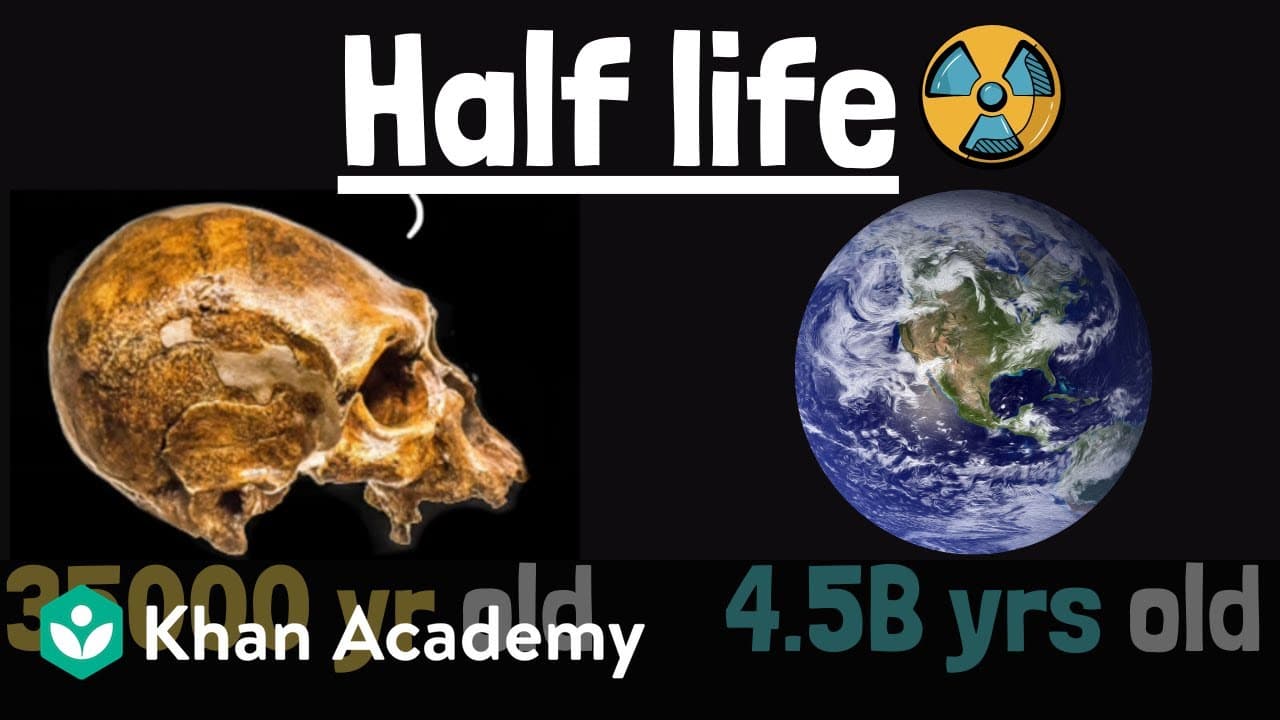
Half-life | Nuclear chemistry | High school chemistry | Khan Academy
February 9, 2024
by
Khan Academy
YouTube video player
Half-life | Nuclear chemistry | High school chemistry | Khan Academy

TL;DR

Radiometric dating uses radioisotopes to determine the age of objects, based on the concept of half-life.

Transcript

this is a neanderthal skull neanderthals are extinct species of humans and we believe they went extinct about 35 to 40,000 years ago and this is Earth and we believe Earth to be about 4 and A2 billion years old but my question was always how do we know these things how do we figure these things out turns out one common method is radiometric dating ... Read More

Key Insights

  • ☠️ Radiometric dating relies on the concept of half-life, where the decay of radioactive isotopes occurs at a predictable rate.
  • 🤕 The amount of remaining isotopes in an object can be used to estimate its age.
  • 🤕 Different isotopes have different half-lives, allowing scientists to determine the age range of various objects.
  • 🫀 Radioactivity is a random process, and the chances of an atom decaying at any given moment are 50/50.
  • ☢️ The halflife of a radioactive isotope is fixed and does not depend on the amount or conditions of the sample.
  • 🍰 Shorter half-lives indicate a more radioactive isotope that decays quicker.
  • 🤕 Radiometric dating has been used to estimate the age of the Earth and ancient artifacts, such as Neanderthal bones.

Install to Summarize YouTube Videos and Get Transcripts

Explore YouTube Video Summarizer or Get YouTube Transcript Extractor

Questions & Answers

Q: How does radiometric dating work?

Radiometric dating relies on the principle of half-life, where radioactive isotopes decay over time. By measuring the remaining amounts of isotopes in an object, scientists can determine its age.

Q: What is half-life?

Half-life is the amount of time it takes for half of the radioactive isotopes in a sample to decay. It is a fixed value unique to each isotope.

Q: Can radioactivity be influenced or controlled?

No, radioactivity is a random process, and there is no way to influence or control the decay of radioactive isotopes. It is purely based on statistical probability.

Q: How is radiometric dating used to determine the age of the Earth?

Geologists use the decay of isotopes, such as uranium-238, in zircon crystals to estimate the age of the Earth. By measuring the ratio of isotopes in these crystals, scientists can calculate the time since their formation.

Summary & Key Takeaways

  • Radiometric dating involves using radioisotopes to determine the age of objects, such as Neanderthal skulls and the Earth.

  • Radioisotopes, like carbon-14 and uranium-238, decay over time, and the rate of decay is measured by the concept of half-life.

  • By studying the amount of decayed isotopes in an object, scientists can estimate its age.


Read in Other Languages (beta)

English

Share This Summary 📚

Summarize YouTube Videos and Get Video Transcripts with 1-Click

Download browser extensions on:

Try YouTube Summary with ChatGPT & Claude or YouTube Transcript Generator

Explore More Summaries from Khan Academy 📚
Ways to represent data | Data and statistics | 6th grade | Khan Academy thumbnail
Ways to represent data | Data and statistics | 6th grade | Khan Academy
Khan Academy
How to classify numbers | Numbers and operations | 8th grade | Khan Academy thumbnail
How to classify numbers | Numbers and operations | 8th grade | Khan Academy
Khan Academy
Producer surplus | Consumer and producer surplus | Microeconomics | Khan Academy thumbnail
Producer surplus | Consumer and producer surplus | Microeconomics | Khan Academy
Khan Academy
Tragedy of the commons | Consumer and producer surplus | Microeconomics | Khan Academy thumbnail
Tragedy of the commons | Consumer and producer surplus | Microeconomics | Khan Academy
Khan Academy
How earth's tilt causes seasons | Cosmology & Astronomy | Khan Academy thumbnail
How earth's tilt causes seasons | Cosmology & Astronomy | Khan Academy
Khan Academy
Breakthrough Junior Challenge Winner Reveal! Homeroom with Sal - Thursday, December 3 thumbnail
Breakthrough Junior Challenge Winner Reveal! Homeroom with Sal - Thursday, December 3
Khan Academy

Summarize YouTube Videos and Get Video Transcripts with 1-Click

Download browser extensions on:

Try YouTube Summary with ChatGPT & Claude or YouTube Transcript Generator

Apps & Extensions

  • Chrome Extension
  • Safari Extension
  • Edge Add-ons
  • Firefox Add-ons
  • iOS App
  • Android App

Key Features

  • YouTube Video Summarizer
  • Web & PDF Summarizer
  • Web & PDF Highlighter
  • Chat with PDF
  • Ask AI Clone
  • Audio Transcriber
  • Glasp Reader
  • Kindle Highlight Export
  • Idea Hatch

Integrations

  • Obsidian Plugin
  • Notion Integration
  • Pocket Integration
  • Instapaper Integration
  • Medium Integration
  • Readwise Integration
  • Snipd Integration
  • Hypothesis Integration

More Features

  • APIs
  • MCP Connector
  • Blog & Post
  • Embed Links
  • Image Highlight
  • Personality Test
  • Quote Shots

Company

  • About us
  • Blog
  • Community
  • FAQs
  • Job Board
  • Newsletter
  • Pricing
Terms

•

Privacy

•

Guidelines

© 2026 Glasp Inc. All rights reserved.