Engineering The Largest Nuclear Fusion Reactor
TL;DR
ITER aims to demonstrate nuclear fusion's potential as a clean energy source.
Transcript
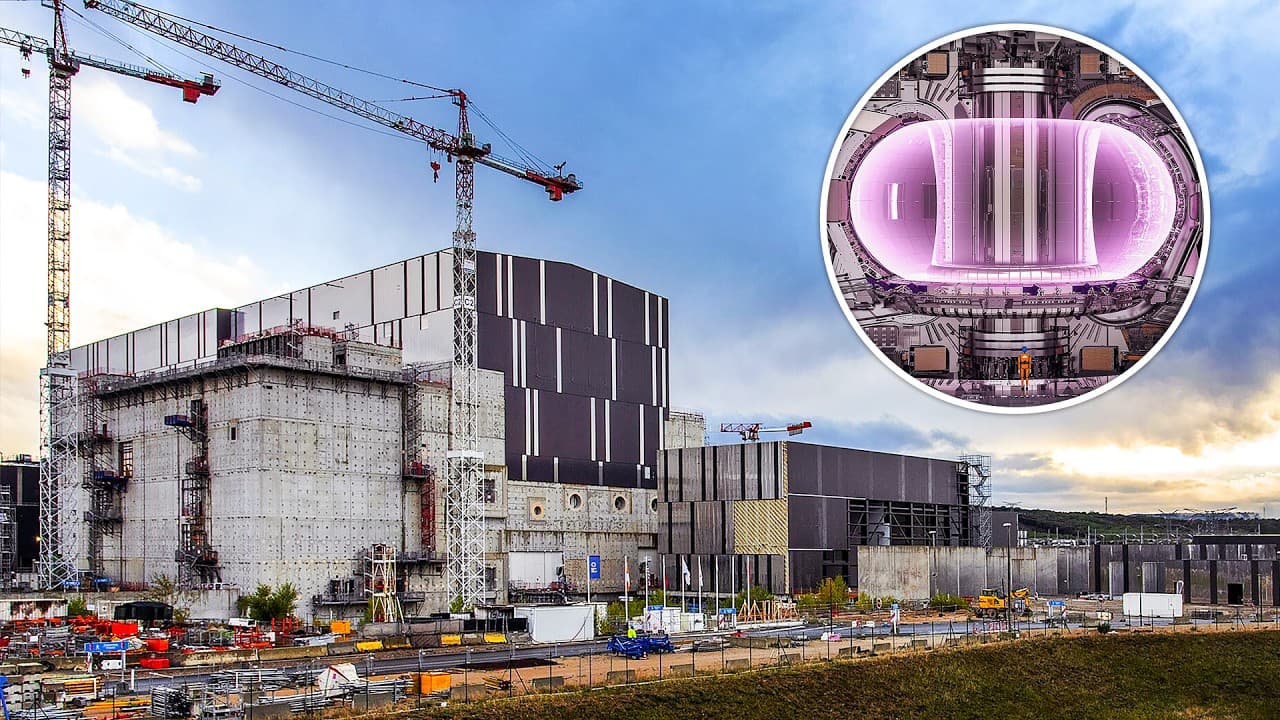
This is my friend Jade, creator of the Up and Atom channel. She makes these incredible math and physics explainers that I absolutely love, and she recently got the opportunity to visit ITER (eater) in France. You may have seen this place in the news: 35 nations working together to build an enormous, industrial-scale nuclear fusion reactor. The ... Read More
Key Insights
- ITER, an international collaboration of 35 nations, is constructing the largest nuclear fusion reactor to explore clean energy solutions.
- The project's goal is to achieve a tenfold energy gain, producing 500 megawatts of fusion power from 50 megawatts of input power.
- The tokamak reactor will contain plasma at temperatures 10-20 times hotter than the sun's core, using magnetic confinement for containment.
- ITER's infrastructure includes massive cranes, cooling systems, and on-site manufacturing facilities to handle the project's scale and sensitivity.
- The facility requires a 400 kV power connection and complex systems to manage electricity and heat flows, crucial for its experimental operations.
- ITER will not generate electricity; instead, it serves as a research platform to refine technologies for future commercial fusion reactors.
- Safety and environmental considerations are paramount, with innovative engineering solutions to withstand natural disasters and ensure containment.
- The project highlights global cooperation in advancing energy technology, with significant civil engineering and scientific challenges to overcome.
Install to Summarize YouTube Videos and Get Transcripts
Explore YouTube Video Summarizer or Get YouTube Transcript Extractor
Questions & Answers
Q: What is the primary goal of the ITER project?
The primary goal of the ITER project is to demonstrate the feasibility of nuclear fusion as a clean and sustainable energy source. By achieving a tenfold energy gain, ITER aims to produce 500 megawatts of fusion power from 50 megawatts of input power, paving the way for future commercial fusion reactors.
Q: How does ITER plan to contain the extremely hot plasma within the reactor?
ITER plans to contain the extremely hot plasma using magnetic confinement. The tokamak reactor will employ strong magnetic fields generated by superconducting magnets to hold the plasma in place, preventing it from coming into contact with the reactor walls, which cannot withstand such high temperatures.
Q: What are some of the engineering challenges faced by the ITER project?
The ITER project faces numerous engineering challenges, including constructing a facility capable of handling extreme temperatures and pressures, ensuring safety and containment, and coordinating massive infrastructure like cranes and cooling systems. Additionally, the project must manage complex power and heat flows while maintaining precise environmental conditions.
Q: Why is ITER not designed to produce electricity?
ITER is not designed to produce electricity because its primary purpose is to serve as a research platform to refine fusion technologies. The facility focuses on demonstrating the feasibility of achieving a tenfold energy gain and understanding the processes involved in nuclear fusion, which will inform the development of future commercial fusion reactors.
Q: What role does the international community play in the ITER project?
The international community plays a crucial role in the ITER project, with 35 nations collaborating to share knowledge, resources, and expertise. This global cooperation is essential for tackling the scientific and engineering challenges of nuclear fusion and advancing the technology needed for future energy solutions.
Q: How does ITER manage the flow of electricity and heat within the facility?
ITER manages the flow of electricity and heat through a complex system of power connections, transformers, and cooling systems. The facility connects to a 400 kV power line and uses rectifiers to convert AC to DC for the superconducting magnets. Heat generated during experiments is dissipated using a water cooling system and a large cooling tower.
Q: What safety measures are in place at the ITER facility?
Safety measures at the ITER facility include a robust containment structure to confine fusion products, specialized concrete for radiation shielding, and engineering solutions to withstand natural disasters like earthquakes and floods. The facility also features backup power systems and remote operation to ensure safety during experiments.
Q: What is the significance of ITER's tenfold energy gain goal?
ITER's tenfold energy gain goal is significant because it represents a major milestone in fusion research, demonstrating the potential of nuclear fusion as a viable energy source. Achieving this goal would validate the scientific principles behind fusion and provide critical insights for developing future commercial reactors that could revolutionize energy production.
Summary & Key Takeaways
-
ITER is a collaborative effort by 35 nations to build the world's largest nuclear fusion reactor, aiming to demonstrate the feasibility of fusion as a clean energy source. The project involves complex engineering and scientific challenges, including handling extreme temperatures and ensuring safety.
-
The reactor, known as a tokamak, will use magnetic confinement to contain plasma hotter than the sun's core. ITER's ultimate goal is to achieve a tenfold energy gain, a significant milestone in fusion research, though it will not produce electricity itself.
-
The facility's construction includes specialized infrastructure, such as massive cranes and cooling systems, to support the project's scale and sensitivity. ITER serves as a research platform to refine technologies for future commercial fusion reactors, emphasizing global cooperation and innovation.
Read in Other Languages (beta)
Share This Summary 📚
Summarize YouTube Videos and Get Video Transcripts with 1-Click
Try YouTube Summary with ChatGPT & Claude or YouTube Transcript Generator
Explore More Summaries from Practical Engineering 📚




Summarize YouTube Videos and Get Video Transcripts with 1-Click
Try YouTube Summary with ChatGPT & Claude or YouTube Transcript Generator