Executive orders | US government and civics | Khan Academy
TL;DR
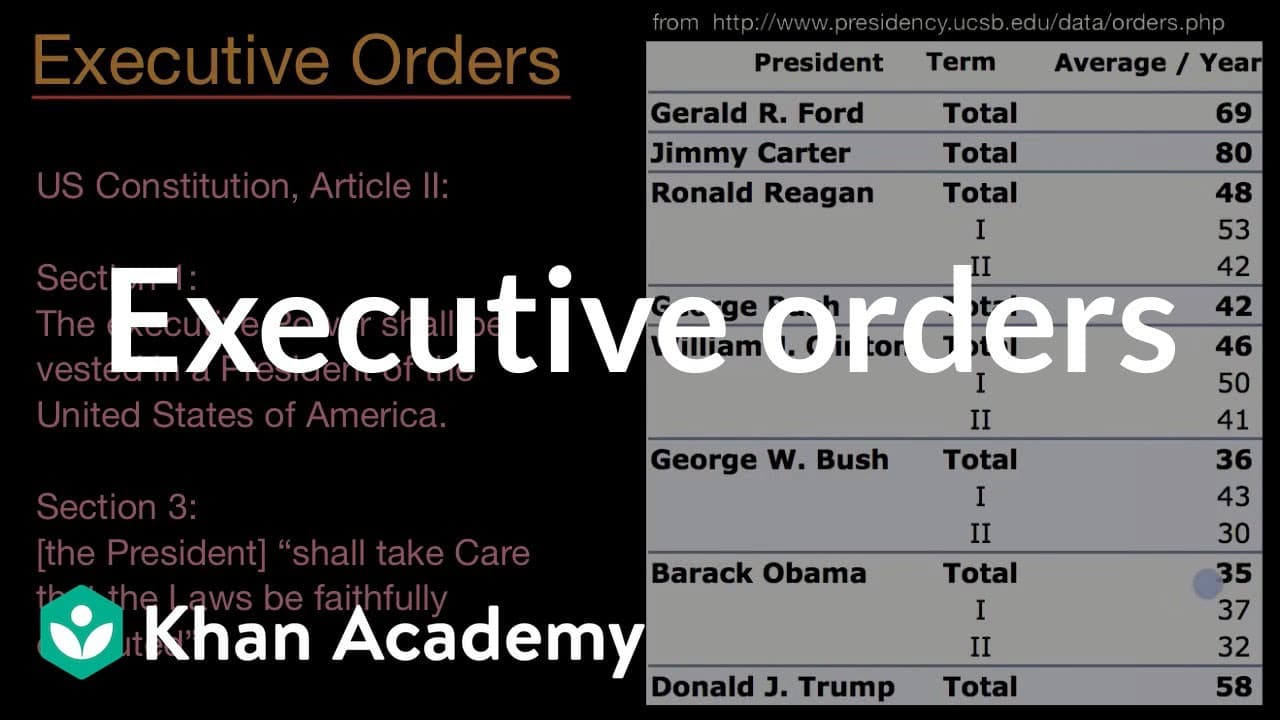
Executive Orders are directives issued by the President of the United States that hold the force of law and have been used since George Washington's presidency to expand presidential power beyond the boundaries of the Constitution.
Transcript
- [Lecturer] What we're going to discuss in this video is Executive Orders. And these are directives being issued by the President of the United States that can have the force of law. And I know what you're thinking, isn't Congress our legislative body, the body that actually creates the laws? And is it the job of the President to be the head of th... Read More
Key Insights
- 🇺🇸 Presidents have been issuing Executive Orders since the early days of the United States, expanding their power beyond what is explicitly stated in the Constitution.
- ❓ The frequency of Executive Orders varies among Presidents, with some issuing more than others.
- 👹 Significant Executive Orders throughout history include the Emancipation Proclamation, the internment of Japanese Americans during World War II, and the seizure of steel mills during the Korean War.
- ✊ The Supreme Court can rule Executive Orders unconstitutional and acts as a check on presidential power.
Install to Summarize YouTube Videos and Get Transcripts
Explore YouTube Video Summarizer or Get YouTube Transcript Extractor
Questions & Answers
Q: What are Executive Orders and why are they important?
Executive Orders are directives issued by the President that carry the force of law. They are important because they allow the President to take action and implement policies without relying solely on Congress.
Q: What is the constitutional justification for Executive Orders?
The constitutional justification for Executive Orders comes from the President's role as the head of the Executive Branch and the obligation to faithfully execute the laws.
Q: Can Executive Orders be challenged in court?
Yes, Executive Orders can be challenged in court, including the Supreme Court. The courts have the power to rule Executive Orders unconstitutional if they exceed the President's authority.
Q: Are there clear boundaries on what makes an Executive Order constitutional or not?
No, there are not clear boundaries on the constitutionality of Executive Orders. It remains an area of debate and interpretation, with the Supreme Court playing a role in determining the limits of presidential power.
Summary & Key Takeaways
-
Presidents have been issuing Executive Orders since George Washington's time, ranging from lightweight directives to significant regulations.
-
Two statements in Article II of the U.S. Constitution provide constitutional justification for Executive Orders.
-
The frequency of Executive Orders varies among Presidents, with some issuing more than others.
Read in Other Languages (beta)
Share This Summary 📚
Summarize YouTube Videos and Get Video Transcripts with 1-Click
Try YouTube Summary with ChatGPT & Claude or YouTube Transcript Generator
Explore More Summaries from Khan Academy 📚





Summarize YouTube Videos and Get Video Transcripts with 1-Click
Try YouTube Summary with ChatGPT & Claude or YouTube Transcript Generator