The Lunar Crater Radio Telescope with Dr. Ashish Goel
TL;DR
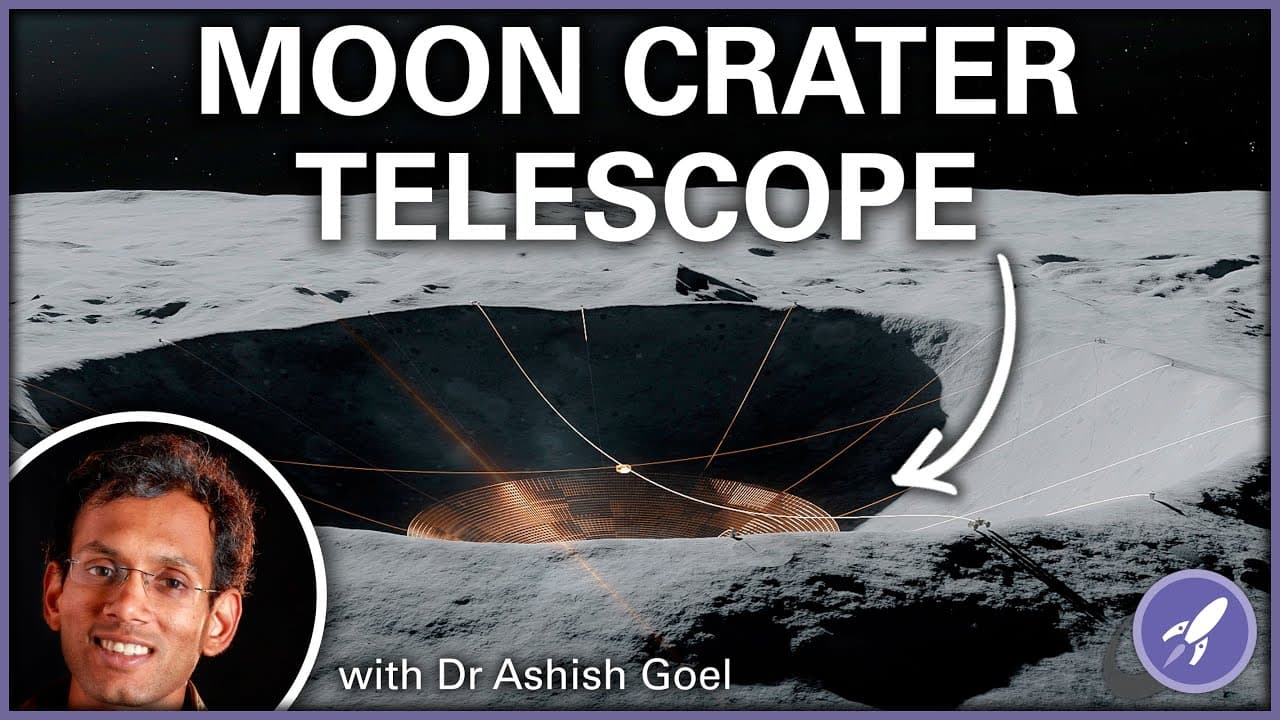
Building a giant radio telescope inside a lunar crater on the far side of the Moon to study early Universe signals.
Transcript
of Universe Today. I've been to space and astronomy journalist for over 20 years. I like to bring you behind the scenes talk to the scientists, the researchers coming up with the clever ideas that we're reporting on at Universe Today. Today. I'm Dr. I'm Tom doctor. I'm doing I'm joined. Today I'm joined by Dr. Ashish Gaul. Doctor Oh, welcome to the... Read More
Key Insights
- 📽️ Integration of robotics and astronomy in the lunar crater telescope project.
- 🗯️ Importance of choosing the right lunar crater for telescope deployment.
- 🔭 Possibilities for future telescope expansions, including interferometry and SETI studies.
- 📌 Unique advantages of lunar location for shielding and focusing on early Universe signals.
- 🎨 Challenges in designing a deployable mesh reflector for the telescope.
- 🤩 Potential scientific outcomes, such as studying structuring of the early Universe before star formation.
- 🧑🚀 Collaboration with other researchers and involvement of future astronauts in the deployment process.
Install to Summarize YouTube Videos and Get Transcripts
Explore YouTube Video Summarizer or Get YouTube Transcript Extractor
Questions & Answers
Q: What is the main goal of the lunar crater telescope project?
The main goal is to build a telescope on the far side of the Moon to study signals from neutral hydrogen in the early Universe that cannot penetrate Earth's ionosphere.
Q: How does the telescope's location on the Moon offer advantages for studying these signals?
Being shielded from Earth and the Sun, the telescope can focus on cosmological signals of interest while reducing noise interference.
Q: What challenges are involved in deploying a large reflector on the Moon?
Challenges include designing a deployable mesh reflector suspended in a crater, ensuring structural stability, and considering the feasibility of robot or astronaut-assisted deployment.
Q: How could the telescope be expanded in the future for additional scientific exploration?
Possibilities include creating an array of telescopes, implementing interferometry with Earth-based telescopes, and potentially exploring SETI-related research with finer mesh designs.
Summary & Key Takeaways
-
Dr. Ashish Gaul, a robotics technologist at NASA, works on robotic concepts for future missions, combining physics and astronomy for lunar crater telescope.
-
The project aims to deploy a parabolic reflector in a crater on the Moon's far side to capture signals from neutral hydrogen from the early Universe.
-
The telescope could enable studying the structure and evolution of the Universe before the formation of stars and galaxies.
Read in Other Languages (beta)
Share This Summary 📚
Summarize YouTube Videos and Get Video Transcripts with 1-Click
Try YouTube Summary with ChatGPT & Claude or YouTube Transcript Generator
Explore More Summaries from Fraser Cain 📚

Summarize YouTube Videos and Get Video Transcripts with 1-Click
Try YouTube Summary with ChatGPT & Claude or YouTube Transcript Generator