How Do Cardiovascular and Lymphatic Systems Work?
TL;DR
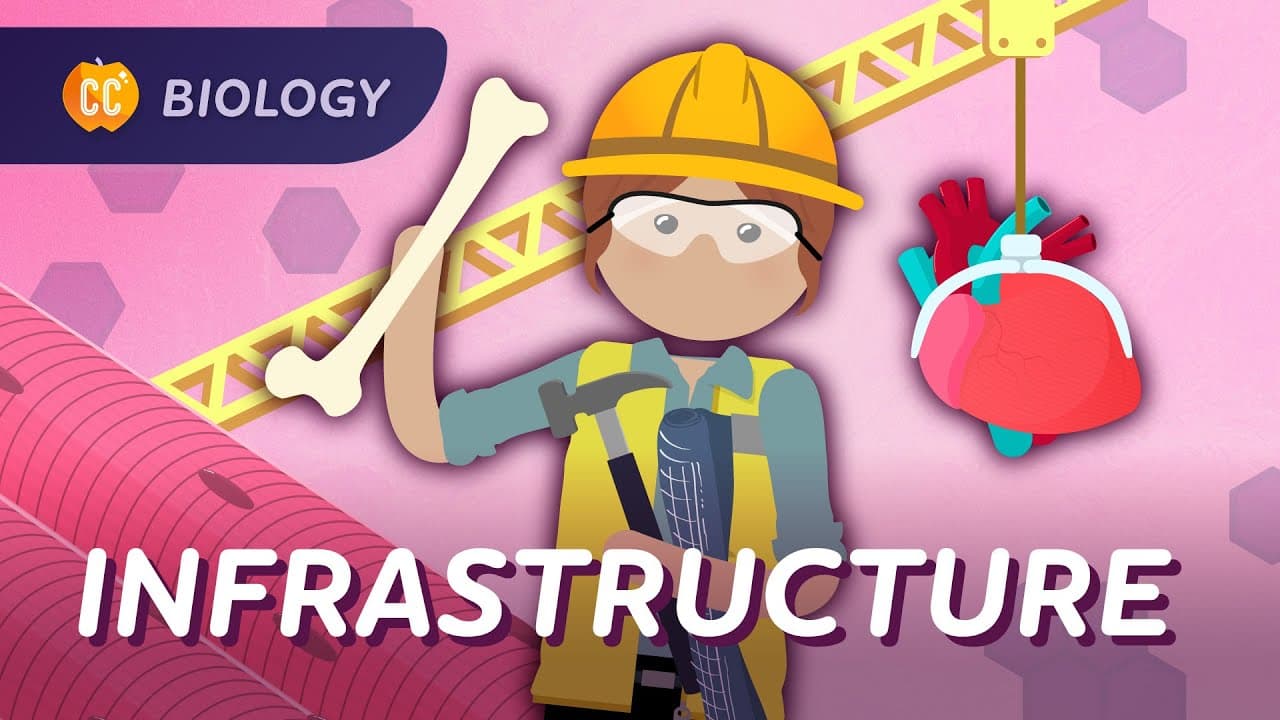
The cardiovascular system, including the heart and blood vessels, transports oxygen and nutrients throughout the body. The lymphatic system manages fluid levels and supports the immune system. Together with the musculoskeletal system, these systems form the body's infrastructure, enabling movement and maintaining vital functions.
Transcript
Bones are great. Lots of animals have them. And the ones that don’t are either blobs, like jellyfish, or rockin’ a hard outside coating, like most insects. But animals need a lot more than a skeleton to keep their goo sacks gooin’. Inside us, there are incredible systems that act as the body’s roads, bridges, and structures. Like, take blood ves... Read More
Key Insights
- The cardiovascular system transports oxygen and nutrients via blood vessels.
- Blood vessels, like capillaries, allow nutrient and gas exchange through diffusion.
- The heart pumps blood through two circuits: one to the lungs and one to the body.
- Vertebrates have varying heart structures; mammals and birds have four-chambered hearts.
- Vivien Thomas developed a procedure to treat blue baby syndrome, crucial in heart surgery.
- The lymphatic system returns excess interstitial fluid to the bloodstream.
- The lymphatic system also absorbs dietary fats and plays a role in immunity.
- Bones provide structure, store minerals, and produce blood cells in bone marrow.
Install to Summarize YouTube Videos and Get Transcripts
Explore YouTube Video Summarizer or Get YouTube Transcript Extractor
Questions & Answers
Q: How does the cardiovascular system transport oxygen?
The cardiovascular system transports oxygen through a network of blood vessels. Oxygen-rich blood is pumped from the heart to the lungs, where it picks up oxygen. The oxygenated blood then travels through arteries to tissues and cells throughout the body, delivering oxygen and collecting carbon dioxide for exhalation.
Q: What role does the lymphatic system play in the body?
The lymphatic system plays a crucial role in maintaining fluid balance by returning excess interstitial fluid to the bloodstream. It also absorbs dietary fats from the digestive system and is integral to the immune system, helping to protect the body against infections and diseases.
Q: Why are capillaries important in the cardiovascular system?
Capillaries are vital in the cardiovascular system because they facilitate the exchange of nutrients, gases, and waste products between blood and tissues. Their thin walls allow for efficient diffusion, enabling oxygen and nutrients to enter cells while removing carbon dioxide and other waste products.
Q: How do bones contribute to the body's functions?
Bones provide structural support, protect vital organs, and serve as a mineral reservoir. They also produce blood cells in the bone marrow, playing a crucial role in hematopoiesis. Bones work with muscles to facilitate movement, making them essential for both protection and mobility.
Q: What is the significance of Vivien Thomas's contribution to heart surgery?
Vivien Thomas significantly advanced heart surgery by developing a procedure to treat blue baby syndrome. His work demonstrated the safety and effectiveness of the surgery, which became a life-saving treatment for many infants. Despite initial recognition challenges, his contributions are now acknowledged as pivotal in cardiac surgery.
Q: How does the heart function within the cardiovascular system?
The heart functions as the central pump of the cardiovascular system, circulating blood through two primary circuits. The pulmonary circuit moves blood between the heart and lungs for oxygenation, while the systemic circuit distributes oxygen-rich blood to the rest of the body, ensuring all tissues receive necessary nutrients and oxygen.
Q: What is the process of diffusion in capillaries?
Diffusion in capillaries involves the movement of molecules from areas of high concentration to areas of low concentration. This process allows oxygen and nutrients to pass from the blood into body cells, while carbon dioxide and waste products move from cells into the blood for removal, maintaining cellular homeostasis.
Q: How do muscles and bones work together to enable movement?
Muscles and bones work together to enable movement through a coordinated system where muscles contract and relax, pulling on bones. This interaction occurs at joints, where muscles generate force by contracting, allowing for various movements. Muscles typically work in pairs, with one contracting while the other relaxes, facilitating smooth and controlled motion.
Summary & Key Takeaways
-
The cardiovascular system is essential for transporting oxygen and nutrients throughout the body. It consists of the heart and an extensive network of blood vessels, including capillaries that facilitate nutrient exchange through diffusion. This system is critical for maintaining homeostasis and supporting cellular functions.
-
The lymphatic system complements the cardiovascular system by managing fluid levels, absorbing dietary fats, and contributing to immune function. It returns excess interstitial fluid to the bloodstream, preventing tissue swelling and ensuring proper circulation. Its role is vital in maintaining the body's fluid balance.
-
The musculoskeletal system, comprising bones and muscles, provides structure and enables movement. Bones store minerals, protect organs, and produce blood cells, while muscles contract to facilitate movement. Together, these systems form the infrastructure that supports the body's complex activities.
Read in Other Languages (beta)
Share This Summary 📚
Summarize YouTube Videos and Get Video Transcripts with 1-Click
Try YouTube Summary with ChatGPT & Claude or YouTube Transcript Generator
Explore More Summaries from CrashCourse 📚




Summarize YouTube Videos and Get Video Transcripts with 1-Click
Try YouTube Summary with ChatGPT & Claude or YouTube Transcript Generator