How To Find The Slope and Y Intercept of a Line | Linear Equations - Algebra
TL;DR
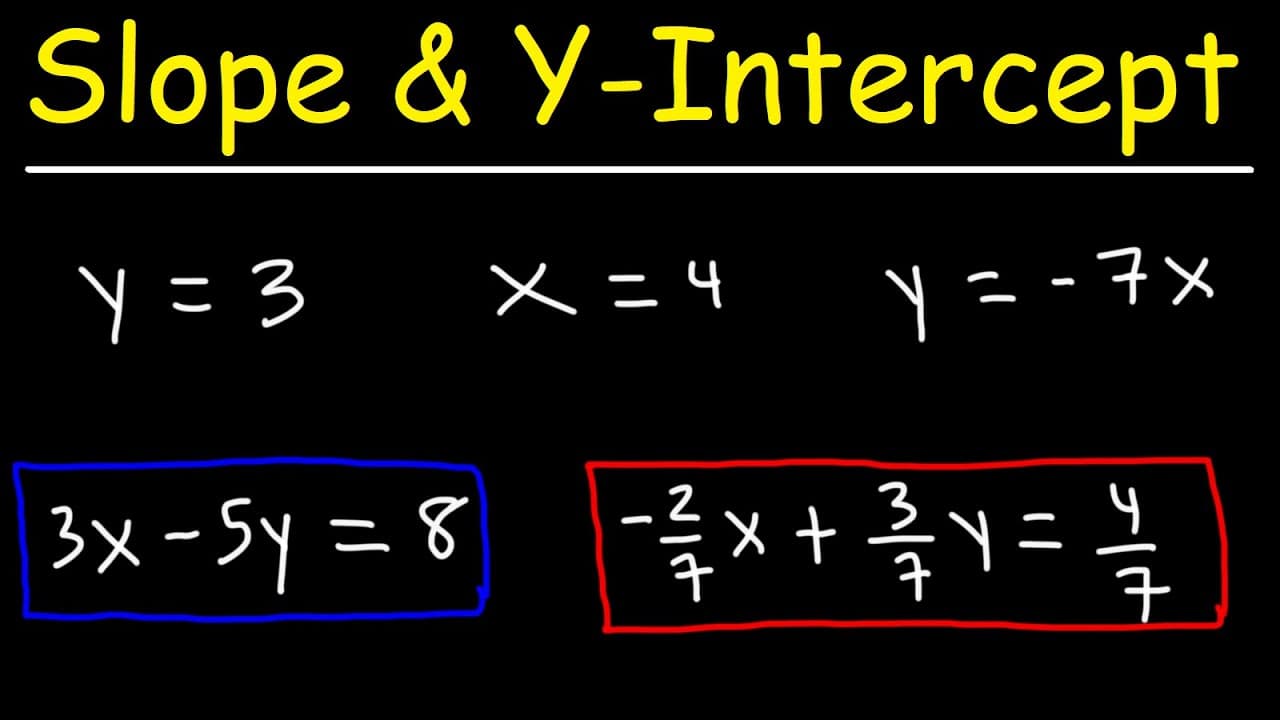
Learn how to find the slope and y-intercept from linear equations using the slope-intercept form, even when equations are not in this form.
Transcript
in this video we're going to talk about how to find the slope and Y intercept from a linear equation now it's important to be familiar with the slope intercept form of a linear equation and here it is M represents the slope m is a number in front of x b represents the y intercept so if we were to write the slope intercept equation right below this ... Read More
Key Insights
- 😃 The slope-intercept form of a linear equation is y = mx + b, where m represents the slope and b represents the y-intercept.
- ❣️ To find the slope and y-intercept, identify the numbers in front of x and the constant term without x, respectively.
- 💁 Equations can be rearranged to convert them to slope-intercept form.
- ❣️ When the equation is in the form x = a number, the slope is undefined, and there is no y-intercept.
- #️⃣ When the equation is in the form y = a number, the slope is 0, and the y-intercept is equal to the given number.
- 💁♂️ The slope-intercept form allows for easy identification of the slope and y-intercept.
- 🫥 Vertical lines have undefined slopes, while horizontal lines have a slope of 0.
- 🔺 The slope can be calculated using the formula m = (Y2 - Y1) / (X2 - X1) if two points on the line are known.
- 🏙️ The y-intercept is the point where the line intersects the y-axis.
Install to Summarize YouTube Videos and Get Transcripts
Explore YouTube Video Summarizer or Get YouTube Transcript Extractor
Questions & Answers
Q: How do you find the slope and y-intercept from a linear equation in slope-intercept form?
In slope-intercept form, the slope is represented by the number in front of x, and the y-intercept is represented by the constant term without x. For example, in the equation y = 2x + 3, the slope is 2 and the y-intercept is 3.
Q: What do you do when the equation is not in slope-intercept form?
If the equation is not in slope-intercept form, you can rearrange it to convert it to the desired form. For example, in the equation y = 8 - 4x, you can rewrite it as -4x + 8 to identify the slope (-4) and y-intercept (8).
Q: How do you find the slope and y-intercept when the equation only includes a variable without a number?
If there is no number in front of x, you can assume it is 1. For example, in the equation y = -x + 5, the slope is -1 and the y-intercept is 5.
Q: What happens when the equation is in the form x = a number or y = a number?
When the equation is in the form x = a number, the slope is undefined, and there is no y-intercept. When the equation is in the form y = a number, the slope is 0, and the y-intercept is equal to the given number.
Summary & Key Takeaways
-
Linear equations can be written in slope-intercept form as y = mx + b, where m represents the slope and b represents the y-intercept.
-
To find the slope, identify the number in front of x. The y-intercept is the constant without the x.
-
If the equation is not in slope-intercept form, rearrange it to find the slope and y-intercept.
Read in Other Languages (beta)
Share This Summary 📚
Summarize YouTube Videos and Get Video Transcripts with 1-Click
Try YouTube Summary with ChatGPT & Claude or YouTube Transcript Generator
Explore More Summaries from The Organic Chemistry Tutor 📚




Summarize YouTube Videos and Get Video Transcripts with 1-Click
Try YouTube Summary with ChatGPT & Claude or YouTube Transcript Generator