Will Starshot's Insterstellar Journey Succeed?
TL;DR
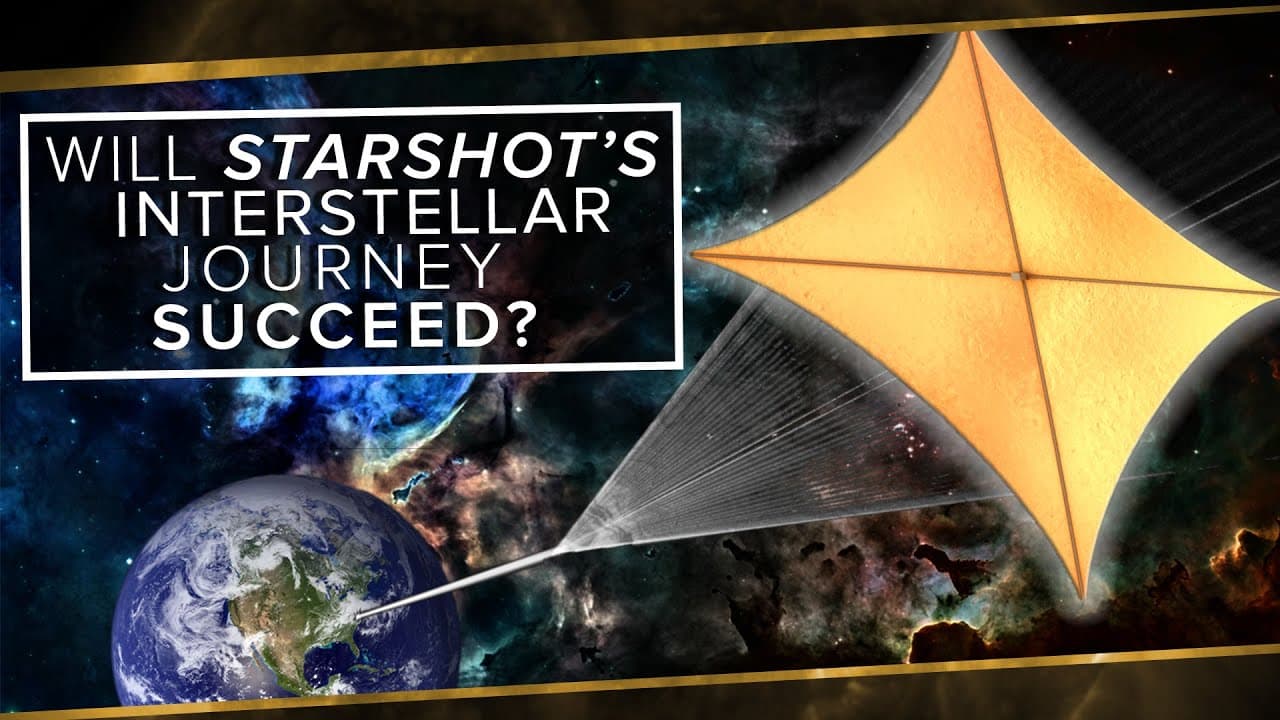
Breakthrough Starshot aims to send nanocraft to Alpha Centauri using light sails.
Transcript
Breakthrough Starshot plans to send spacecraft to the nearest star within your lifetime. Is this for real? Does this mean it's the future, finally? [MUSIC PLAYING] Do you remember when the future had spaceships? I grew up in the afterglow of the Apollo program, in the era of the space shuttle. We were so sure that these were just steps on the inevi... Read More
Key Insights
- Breakthrough Starshot is an ambitious project to send nanocraft to Alpha Centauri using light sails propelled by lasers.
- The concept of light sails eliminates the need for onboard propellant, making the spacecraft much lighter and faster.
- The project is backed by prominent figures, including Yuri Milner, Stephen Hawking, and Mark Zuckerberg, with a significant initial funding of $100 million.
- The Starshot initiative plans to launch thousands of nanocraft to gather sufficient data during their brief flyby of Alpha Centauri.
- Technological advancements in nanotechnology, materials science, and laser power are crucial for the success of the project.
- The nanocraft will be equipped with cameras capable of high-resolution imaging, potentially identifying continents and oceans on exoplanets.
- The project relies on the continued exponential improvement of technologies, as predicted by Moore's law.
- The initiative raises questions about the future of scientific funding and the role of private investments in large-scale projects.
Install to Summarize YouTube Videos and Get Transcripts
Explore YouTube Video Summarizer or Get YouTube Transcript Extractor
Questions & Answers
Q: What is the main goal of Breakthrough Starshot?
The main goal of Breakthrough Starshot is to send swarms of light sail-driven nanocraft to the Alpha Centauri star system. These nanocraft aim to capture close-up images of alien worlds and gather data about the star system, potentially within the lifetime of the current generation.
Q: How do light sails work in the context of this project?
Light sails work by being propelled through space by the pressure of light, either from the sun or a powerful Earth-based laser. This method eliminates the need for onboard propellant, significantly reducing the weight of the spacecraft and allowing it to achieve high speeds, essential for interstellar travel.
Q: What are the technological challenges facing Breakthrough Starshot?
The project faces several technological challenges, including miniaturizing payload components, developing ultra-thin and heat-resistant sails, and ensuring the precise combination and direction of laser beams through Earth's atmosphere. Additionally, the nanocraft must withstand extreme acceleration and potential impacts from interstellar dust.
Q: Who are some of the notable figures supporting the project?
Breakthrough Starshot is supported by notable figures such as physicist Yuri Milner, Stephen Hawking, and Mark Zuckerberg. The advisory team includes distinguished scientists like Freeman Dyson, Martin Rees, and Saul Perlmutter, who bring their expertise to the project.
Q: What is the expected timeline for the project?
The project aims to launch in around 20 years, with a travel time of over 20 years to reach Alpha Centauri. Including the time required for data transmission back to Earth, the first results are expected in approximately 45 to 50 years, assuming the project proceeds as planned.
Q: Why is the project considered feasible despite the challenges?
The project is considered feasible due to the backing of substantial funding and the involvement of leading scientists and engineers. It relies on the anticipated exponential improvement of relevant technologies, as predicted by Moore's law, and has no identified deal breakers, making its ambitious goals attainable.
Q: How does Breakthrough Starshot plan to gather data from Alpha Centauri?
The plan involves launching thousands of nanocraft to ensure a continuous stream of data collection during their brief flyby of the Alpha Centauri system. The nanocraft will be equipped with high-resolution cameras and other sensors to capture detailed images and data about the star system's planets.
Q: What are the potential implications of the project for future space exploration?
If successful, Breakthrough Starshot could revolutionize interstellar exploration by demonstrating the feasibility of using light sails for high-speed travel. It could pave the way for future missions to other star systems, expanding our understanding of the universe and potentially discovering signs of extraterrestrial life.
Summary & Key Takeaways
-
Breakthrough Starshot is an initiative aiming to send nanocraft to Alpha Centauri using light sails propelled by a powerful laser beam. The project envisions launching thousands of these lightweight probes to gather data during a brief flyby of the star system.
-
The project is supported by significant funding and the expertise of renowned scientists and engineers. It relies on advancements in nanotechnology, materials science, and laser technology to achieve its ambitious goals.
-
Key challenges include miniaturizing payload components, developing ultra-thin and heat-resistant sails, and ensuring precise laser propulsion. Despite these hurdles, the project has the potential to revolutionize interstellar exploration.
Read in Other Languages (beta)
Share This Summary 📚
Summarize YouTube Videos and Get Video Transcripts with 1-Click
Try YouTube Summary with ChatGPT & Claude or YouTube Transcript Generator
Explore More Summaries from PBS Space Time 📚





Summarize YouTube Videos and Get Video Transcripts with 1-Click
Try YouTube Summary with ChatGPT & Claude or YouTube Transcript Generator