Contract Law 42 III Vokes v Murray
TL;DR
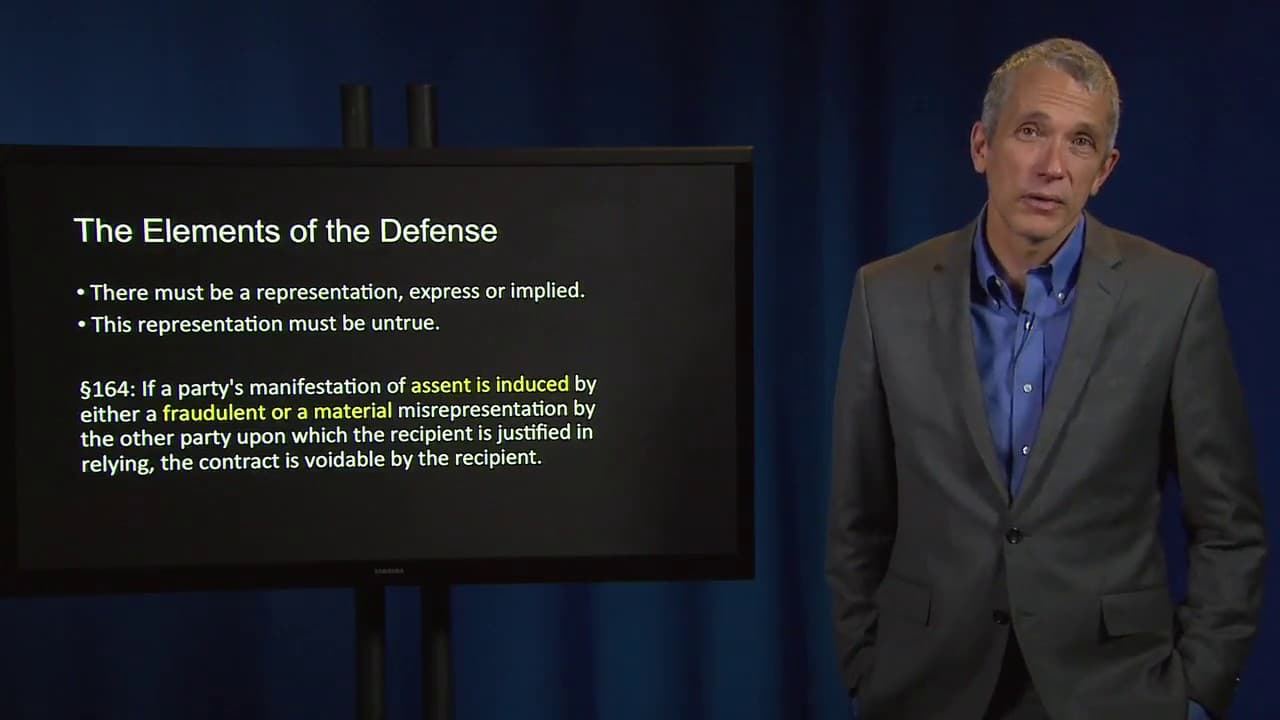
Misrepresenting opinions can qualify as fraud in contract law, as seen in the 1968 Florida case, Volks v. Arthur Murray.
Transcript
in this lecture we continue our discussion of fraud we do so by looking at a 1968 Florida case Volks versus Arthur Murray where the court considered whether misrepresenting statements of opinion could qualify as fraud Vokes was a 51 year old widow who desired to become an accomplished dancer she spent over $31,000 and that's in 1968 dollars over 16... Read More
Key Insights
- 🖤 Misrepresentations of opinion can be considered fraudulent in contract law in certain circumstances, such as when there is a fiduciary relationship, artifice or trick, lack of equal opportunity, or superior knowledge involved.
- 🧑🏭 Courts have interpreted misrepresentation in contract law to cover more than just statements of fact or expressions of opinion, including acts of concealment and failures to disclose.
- 🥳 In contract law, a misrepresentation must be material and the deceived party must have justifiably relied on it to enter into the contract in order for the contract to be voidable.
Install to Summarize YouTube Videos and Get Transcripts
Explore YouTube Video Summarizer or Get YouTube Transcript Extractor
Questions & Answers
Q: Can a contract be rescinded for fraud if misrepresentations involve opinions?
Yes, in certain situations. While contracts are generally rescinded for misrepresentations of fact, exceptions can apply when there is a fiduciary relationship, artifice or trick employed, lack of equal opportunity, or superior knowledge on the part of the representor.
Q: What factors did the court consider in determining whether Vokes had a legitimate claim?
The court considered whether there was a fiduciary relationship, artifice or trick employed, lack of equal opportunity, or superior knowledge on the part of the defendant. It concluded that the defendant had superior knowledge about Vokes' dancing abilities and potential, making misrepresentations of opinion potentially fraudulent.
Q: How did the court view the defendant's actions in this case?
The court viewed the defendant's actions as potentially deceptive and aimed at inducing Vokes into purchasing additional dance lessons. It suggested that the defendant's flowery encouragements stemmed from an urge to profit, rather than an honest assessment of Vokes' progress.
Q: What impact did the procedural posture of the case have on the court's judgment?
The procedural posture, an appeal from the trial court's dismissal of Vokes' complaint, required the court to assume all the facts alleged by the plaintiff as true and determine if they stated an actionable claim. This is why the court took a more favorable view of Vokes' allegations.
Summary & Key Takeaways
-
Vokes, a widow, spent $31,000 on dance lessons based on the defendant's assurances that she was improving, but she alleged that she was actually a poor dancer and deceived into purchasing more lessons.
-
Vokes sued to rescind the contracts and get a refund. The trial court dismissed her complaint, but the appellate court reversed, stating that a contract can be rescinded for fraud involving misrepresentations of opinion in certain circumstances.
-
The court held that there may be exceptions to the general rule that contracts can only be rescinded for misrepresentations of fact, such as when there is a fiduciary relationship, artifice or trick employed, lack of equal opportunity, or superior knowledge on the part of the representor.
Read in Other Languages (beta)
Share This Summary 📚
Summarize YouTube Videos and Get Video Transcripts with 1-Click
Try YouTube Summary with ChatGPT & Claude or YouTube Transcript Generator
Explore More Summaries from YaleCourses 📚


Summarize YouTube Videos and Get Video Transcripts with 1-Click
Try YouTube Summary with ChatGPT & Claude or YouTube Transcript Generator