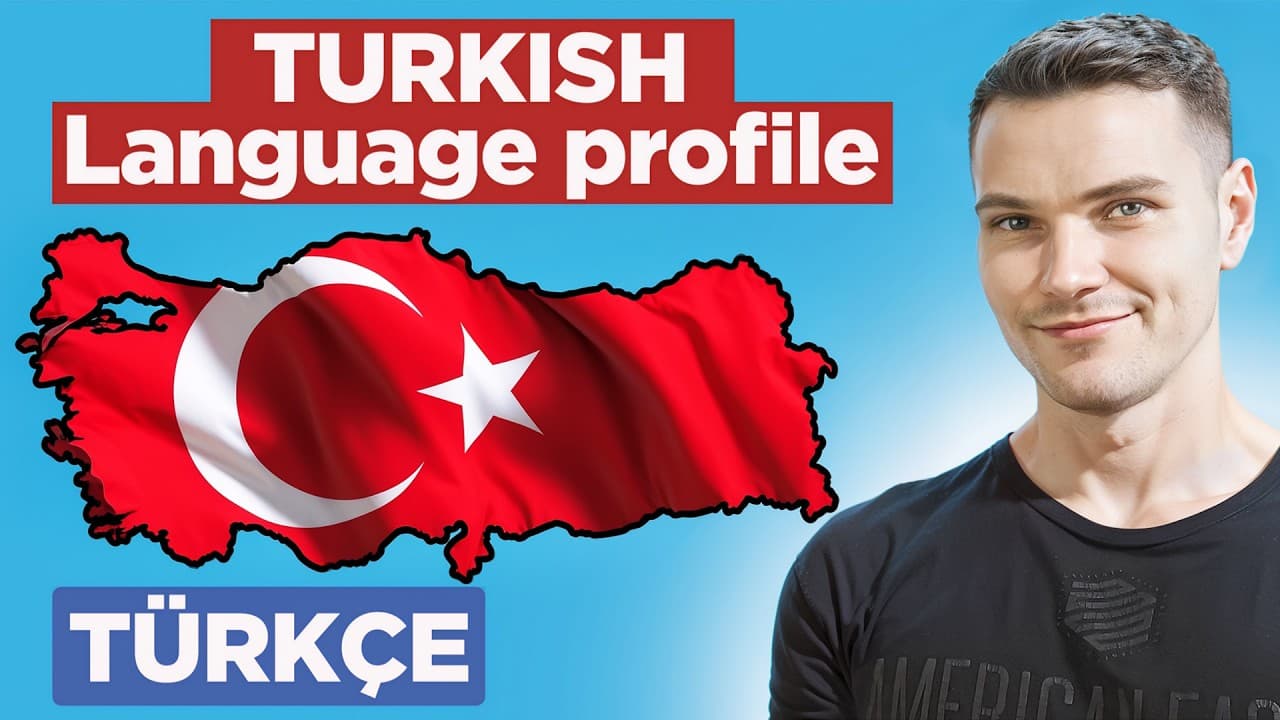
TURKISH - A Language Profile | (TÜRKÇE)
TL;DR
The video explores the history and features of the Turkish language.
Transcript
back in 2016 I released my first video on the Turkish language millions of people have seen it but unfortunately it kind of sucked I didn't explain very much about the language and the production quality was a bit hokey so it's time for a reboot the Turkish language is the language of turkey or tur as it's now officially known an incredibly importa... Read More
Key Insights
- Turkish is a member of the Turkic language family and is distinct from Arabic, despite Turkey's geographic proximity to Arabic-speaking regions.
- The Turkic language family has over 170 million native speakers spread across Europe and Northeast Asia.
- Turkish was heavily influenced by Persian and Arabic during the Ottoman Empire, resulting in a large number of loanwords.
- The Republic of Turkey's language reform in 1923 aimed to replace Ottoman Turkish with a more standardized language based on the Istanbul dialect.
- Modern Turkish uses a modified Latin script, replacing the Arabic script used in Ottoman Turkish.
- Turkish is an agglutinative language, meaning that words are formed by adding suffixes to a root, each with a specific grammatical function.
- Vowel harmony is a key feature of Turkish, ensuring that vowels within a word share certain phonetic features.
- Turkish sentence structure typically follows a subject-object-verb (SOV) order, and the language lacks grammatical gender.
Install to Summarize YouTube Videos and Get Transcripts
Explore YouTube Video Summarizer or Get YouTube Transcript Extractor
Questions & Answers
Q: What is the historical background of the Turkish language?
The Turkish language has its roots in the Turkic language family, which spans Europe to Northeast Asia. Historically, Turkish was influenced by Persian and Arabic during the Ottoman Empire, resulting in many loanwords. The Republic of Turkey's language reform in 1923 aimed to replace Ottoman Turkish with a standardized language based on the Istanbul dialect, adopting a modified Latin script.
Q: How is Turkish different from Arabic?
Turkish is part of the Turkic language family, while Arabic belongs to the Afro-Asiatic language family. Despite Turkey's proximity to Arabic-speaking regions, Turkish is distinct in its structure and vocabulary. It uses a modified Latin script and features like agglutination and vowel harmony, which are not present in Arabic.
Q: What are some unique features of the Turkish language?
Turkish is an agglutinative language, meaning words are formed by adding suffixes to a root, each with a specific function. It also features vowel harmony, ensuring that vowels within a word share certain phonetic properties. Additionally, Turkish follows a subject-object-verb (SOV) sentence structure and lacks grammatical gender.
Q: How did the Republic of Turkey's language reform impact Turkish?
The language reform initiated by Mustafa Kemal Atatürk in 1923 aimed to replace Ottoman Turkish with a standardized version based on the Istanbul dialect. This reform included replacing the Arabic script with a modified Latin script and reducing the number of Persian and Arabic loanwords, although many still remain in modern Turkish.
Q: What role did French play in the development of the Turkish language?
During the Ottoman Empire, French was the main language of international diplomacy, leading to close relations between the Ottomans and the French. This resulted in the adoption of numerous French loanwords into Turkish, particularly in areas related to modernity and technology.
Q: What is the significance of vowel harmony in Turkish?
Vowel harmony is a significant phonological feature in Turkish, requiring that vowels within a word share certain features, such as backness and roundness. This ensures a harmonious vowel pattern, particularly important in the agglutinative structure of the language where suffixes are added to root words.
Q: What is the 'Turkish Uncovered' course mentioned in the video?
'Turkish Uncovered' is a language learning course recommended in the video, created by Olly Richards. It uses a storytelling approach to teach Turkish, aiming to take learners from a beginner level to a lower intermediate level (B1). The course includes reading and listening lessons, video lessons, and exercises to enhance language acquisition.
Q: How does Turkish handle grammatical gender?
Turkish does not have grammatical gender. Unlike many Indo-European languages, Turkish nouns, adjectives, and verbs do not change form based on gender. This simplifies some aspects of grammar for learners, as there is no need to memorize gender-specific forms of words.
Summary & Key Takeaways
-
The video provides an in-depth exploration of the Turkish language, its historical influences, and its unique linguistic features. It highlights the language's Turkic roots and its development through various historical periods, including the Ottoman Empire and the Republic of Turkey's language reforms.
-
Key features of Turkish include its agglutinative nature and vowel harmony, which influence how words are formed and conjugated. The video also discusses the impact of Persian, Arabic, and French on Turkish vocabulary, as well as the transition from the Arabic to the Latin script.
-
The video also introduces a language learning course, 'Turkish Uncovered,' which uses storytelling to help learners progress from beginner to intermediate levels. The course is recommended for those interested in learning Turkish in an engaging and systematic way.
Read in Other Languages (beta)
Share This Summary 📚
Summarize YouTube Videos and Get Video Transcripts with 1-Click
Try YouTube Summary with ChatGPT & Claude or YouTube Transcript Generator
Explore More Summaries from Langfocus 📚

Summarize YouTube Videos and Get Video Transcripts with 1-Click
Try YouTube Summary with ChatGPT & Claude or YouTube Transcript Generator