How Does PKR Evolve Against Viral Mimicry?
TL;DR
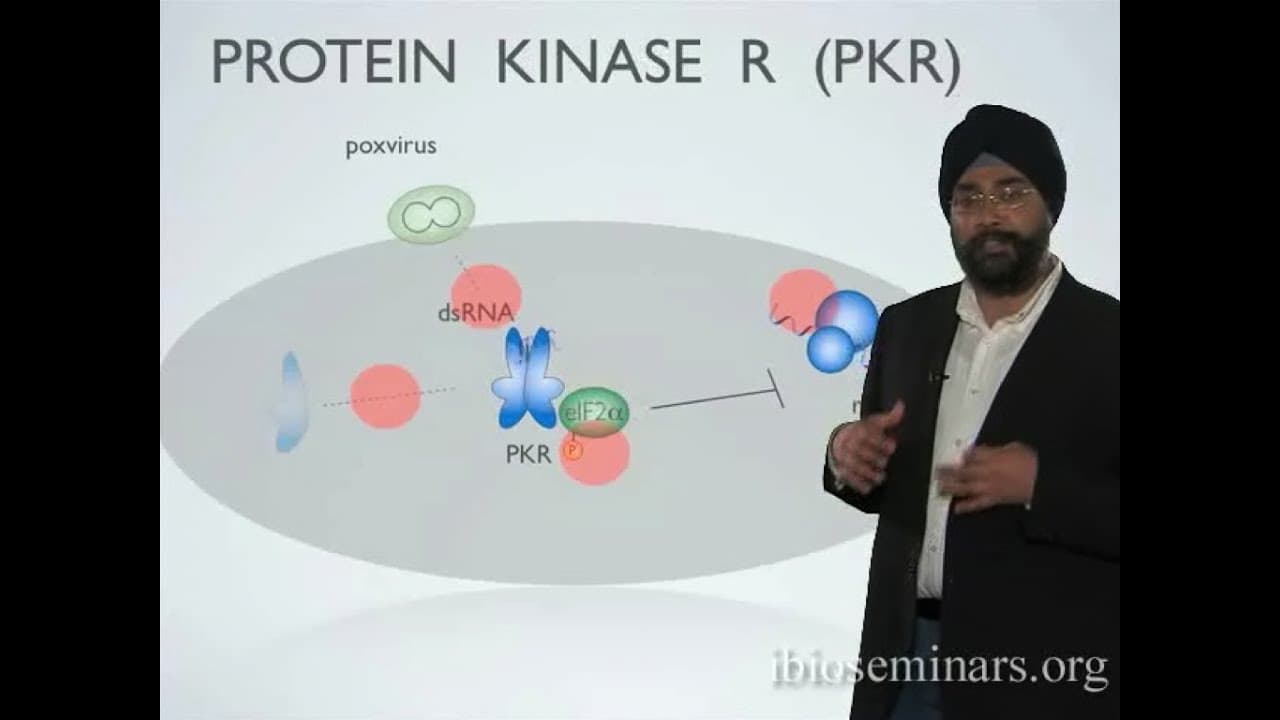
PKR, an antiviral protein, evolves rapidly to counteract viral mimicry strategies. Viruses like poxvirus develop proteins like K3L to mimic host proteins and evade PKR's defense mechanisms. This evolutionary arms race involves PKR adapting through positive selection to maintain its ability to discriminate between actual host proteins and viral mimics, ensuring effective antiviral responses.
Transcript
in today's seminar we're going to focus on a very specific example of viral antagonism that is mediated by mimicry and this example in involves the host antiviral protein protein kyes R so protein kyes R is actually expressed when the organism senses it's under some sort of viral attack by virtue of an interferon detection pathway but it's actually... Read More
Key Insights
- PKR is an antiviral protein activated by detecting double-stranded RNA, signaling viral infection.
- Viruses employ mimicry to evade PKR, producing proteins that imitate host proteins to disrupt PKR's function.
- The poxvirus protein K3L mimics eIF2α, a key substrate of PKR, to inhibit PKR's antiviral response.
- PKR evolves rapidly under positive selection to differentiate between actual host proteins and viral mimics.
- Different viral lineages independently developed mimicry strategies, highlighting mimicry's evolutionary success.
- PKR's evolutionary changes are spread across its entire structure, aiding in its adaptability against viral antagonists.
- The evolutionary arms race between PKR and viral mimics involves constant adaptation and counter-adaptation.
- While eIF2α remains unchanged, both PKR and viral mimics like K3L rapidly evolve, indicating a dynamic evolutionary conflict.
Install to Summarize YouTube Videos and Get Transcripts
Explore YouTube Video Summarizer or Get YouTube Transcript Extractor
Questions & Answers
Q: How does PKR detect viral infections?
PKR detects viral infections by recognizing the presence of double-stranded RNA in the cytoplasm, a signature of viral replication. Upon detection, PKR dimerizes and activates itself, leading to the phosphorylation of eIF2α, which subsequently halts protein synthesis, preventing the production of viral proteins and inhibiting viral replication.
Q: What role does K3L play in viral mimicry?
K3L is a poxvirus protein that plays a critical role in viral mimicry by imitating the host protein eIF2α. This mimicry allows K3L to competitively inhibit PKR, preventing it from phosphorylating the actual eIF2α and thereby evading the host's antiviral response. This strategy enables the virus to continue its replication cycle despite the host's defense mechanisms.
Q: Why is PKR under positive selection?
PKR is under positive selection due to the evolutionary arms race with viral mimics. As viruses develop proteins that mimic host substrates to evade PKR, the protein must continuously adapt to recognize and counteract these mimics. Positive selection drives changes across PKR's structure, enhancing its ability to discriminate between genuine host proteins and viral mimics, maintaining effective antiviral responses.
Q: How does PKR's evolution relate to eIF2α?
PKR's evolution is intricately linked to its interaction with eIF2α, a key substrate. While eIF2α remains evolutionarily stable due to its essential role in translation, PKR evolves rapidly to maintain its ability to phosphorylate eIF2α in response to viral infections. This rapid evolution helps PKR to adapt to viral mimicry strategies that target its interaction with eIF2α, ensuring continued antiviral efficacy.
Q: What is the significance of mimicry in viral evolution?
Mimicry is a significant strategy in viral evolution as it allows viruses to evade host immune responses by imitating host proteins. This strategy forces host proteins like PKR to evolve rapidly to distinguish between authentic and mimicked proteins. The success of mimicry highlights the dynamic and adaptive nature of host-pathogen interactions, where both entities continuously adapt to outmaneuver each other.
Q: Why is the evolutionary arms race between PKR and viruses important?
The evolutionary arms race between PKR and viruses is crucial as it drives the continuous adaptation and refinement of host defense mechanisms against viral evasion strategies. This dynamic interaction ensures that PKR remains an effective antiviral protein, capable of countering diverse viral mimicry tactics, thereby maintaining the host's ability to control and limit viral infections.
Q: How do viruses achieve mimicry of host proteins?
Viruses achieve mimicry of host proteins through evolutionary processes that select for viral proteins resembling host substrates. This mimicry allows viral proteins to interfere with host immune responses, such as PKR's ability to phosphorylate eIF2α. The evolution of mimicry involves structural adaptations that enable viral proteins to effectively imitate host proteins, facilitating viral survival and replication.
Q: What evolutionary pressures influence PKR's adaptation?
PKR's adaptation is influenced by intense evolutionary pressures from viral mimicry strategies. Viruses develop proteins that mimic host substrates to evade PKR, prompting the protein to undergo rapid evolution under positive selection. This evolutionary pressure ensures PKR can effectively differentiate between host proteins and viral mimics, maintaining its role as a critical antiviral defense mechanism.
Summary & Key Takeaways
-
PKR is a host antiviral protein that detects viral infections by recognizing double-stranded RNA, leading to its activation. It inhibits viral replication by phosphorylating eIF2α, halting protein synthesis. Viruses counteract PKR through mimicry, with proteins like K3L mimicking eIF2α to evade PKR's defense, prompting PKR to evolve rapidly to maintain its efficacy.
-
The evolutionary arms race between PKR and viral mimics involves PKR adapting through positive selection to distinguish between host proteins and viral mimics. This ongoing adaptation ensures PKR's ability to effectively respond to viral threats despite the mimicry strategies of viruses like poxvirus.
-
Viral mimicry is a successful evolutionary strategy, with different virus lineages independently developing similar mechanisms to evade host defenses. This highlights the dynamic nature of host-pathogen interactions, where both PKR and viral proteins like K3L continuously evolve, driven by the need to outmaneuver each other.
Read in Other Languages (beta)
Share This Summary 📚
Summarize YouTube Videos and Get Video Transcripts with 1-Click
Try YouTube Summary with ChatGPT & Claude or YouTube Transcript Generator
Explore More Summaries from iBiology Techniques 📚



Summarize YouTube Videos and Get Video Transcripts with 1-Click
Try YouTube Summary with ChatGPT & Claude or YouTube Transcript Generator