Nvdia's CES 2025 Event: Everything Revealed in 12 Minutes
TL;DR
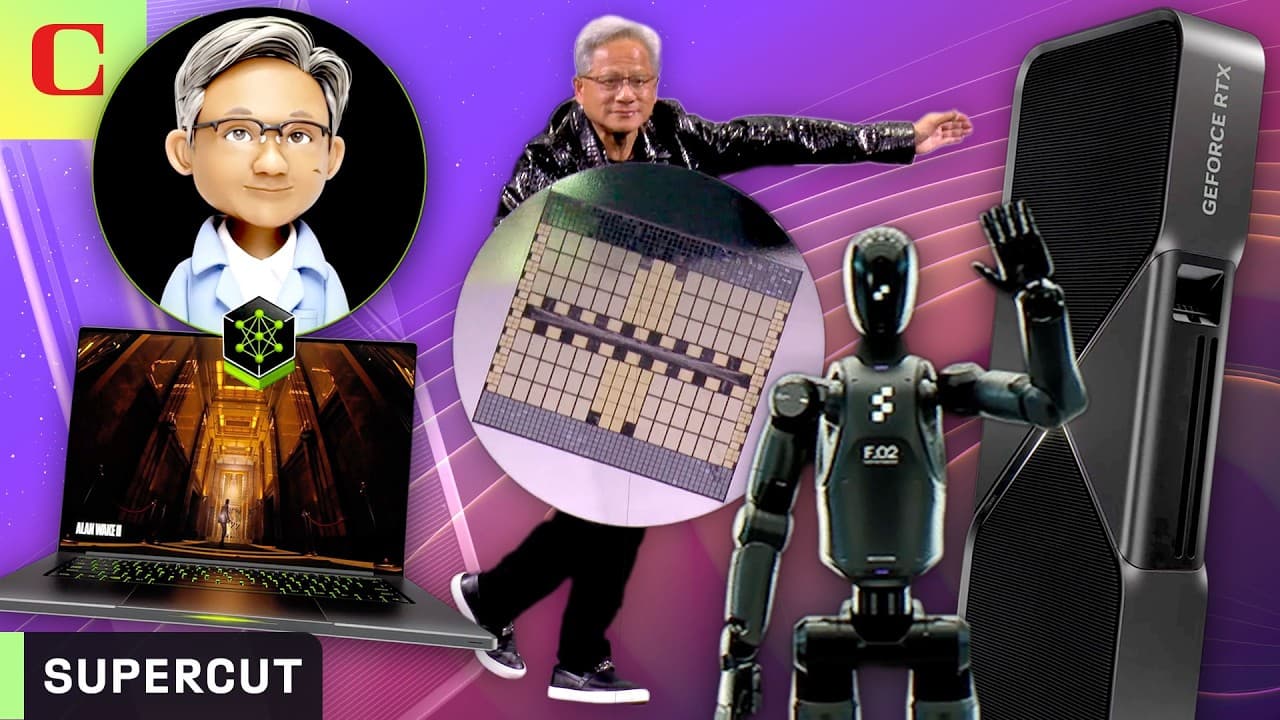
Nvidia introduces RTX 50 Series GPUs with groundbreaking AI capabilities at CES 2025.
Transcript
[Applause] here it [Applause] is our brand new GeForce RTX 50 Series Blackwell architecture the GPU is just a beast 92 billion transistors 4,000 tops four pedop flops of AI three times higher than the last generation Ada and we need all of it to generate those pixels that I showed you 300 80 Ray tracing teraflops so that we could for the pixels tha... Read More
Key Insights
- Nvidia's RTX 50 Series, based on Blackwell architecture, boasts 92 billion transistors and 4,000 tops, offering three times the performance of its predecessor.
- The new GPUs integrate AI workloads with computer graphics, featuring neurot texture compression and neural material shading, enhancing image quality significantly.
- The RTX 5070 provides 4090 performance at a lower price point, and the 5090 can be integrated into thin laptops, demonstrating Nvidia's focus on high performance in portable devices.
- Nvidia's Cosmos platform, a world foundation model, is trained on 20 million hours of video to understand physical dynamics, aiding in robotics and language model training.
- The Cosmos platform includes an auto-regressive model for real-time applications and a diffusion model for high-quality image generation, with an open license available on GitHub.
- Nvidia introduces Thor, a next-generation robotics computer with 20 times the processing power of its predecessor, designed for autonomous vehicles and general robotics.
- The company reveals Project Digits, an AI supercomputer running the entire Nvidia AI stack, featuring a top-secret GB 110 chip developed with Mediatek.
- Nvidia's advancements in AI and robotics suggest a significant shift towards integrating AI capabilities in everyday devices, promising rapid breakthroughs in general robotics.
Install to Summarize YouTube Videos and Get Transcripts
Explore YouTube Video Summarizer or Get YouTube Transcript Extractor
Questions & Answers
Q: What are the key features of Nvidia's RTX 50 Series GPUs?
Nvidia's RTX 50 Series GPUs, based on the Blackwell architecture, feature 92 billion transistors and 4,000 tops. These GPUs offer three times the performance of the previous generation, integrating AI workloads with graphics tasks to enhance image quality through neurot texture compression and neural material shading.
Q: How does the RTX 5070 compare to previous models?
The RTX 5070 offers performance comparable to the 4090 model but at a significantly lower price point of $549. This model can be integrated into thin laptops, showcasing Nvidia's focus on delivering high-performance capabilities in portable devices, making advanced gaming and AI tasks more accessible.
Q: What is the Nvidia Cosmos platform?
The Nvidia Cosmos platform is a world foundation model trained on 20 million hours of video to understand physical dynamics. It aids in robotics and language model training, featuring an auto-regressive model for real-time applications and a diffusion model for high-quality image generation. Cosmos is open-licensed and available on GitHub.
Q: What advancements does the Thor robotics computer offer?
The Thor robotics computer provides 20 times the processing power of its predecessor, Orin, and is designed for autonomous vehicles and general robotics. It processes vast amounts of sensor data, turning it into actionable insights, and is expected to drive rapid advancements in the field of robotics.
Q: What is Project Digits, and what are its capabilities?
Project Digits is Nvidia's AI supercomputer, running the entire Nvidia AI stack and featuring the top-secret GB 110 chip developed with Mediatek. This supercomputer supports diverse AI applications, offering cloud-like accessibility and the ability to run Nvidia's AI software, promising significant advancements in AI processing power.
Q: How does Nvidia plan to integrate AI with robotics?
Nvidia aims to integrate AI with robotics through its advanced platforms like Cosmos and Thor. These platforms enhance AI's understanding of physical dynamics, enabling the training of robotics models and supporting autonomous vehicle technologies. Nvidia's advancements suggest a future with rapid breakthroughs in general robotics.
Q: What are the potential applications of the Nvidia Cosmos platform?
The Nvidia Cosmos platform can be used for training robotics models, generating synthetic data, and improving language models. Its understanding of physical dynamics allows it to simulate realistic scenarios, aiding in the development of robotics and AI technologies that require a deep understanding of the physical world.
Q: What collaborations were involved in the development of Project Digits?
The development of Project Digits involved collaboration with Mediatek, a leading semiconductor company. Together, they developed the GB 110 chip, which is central to the AI supercomputer's capabilities. This partnership highlights Nvidia's strategy of leveraging external expertise to enhance its AI and computing technologies.
Summary & Key Takeaways
-
At CES 2025, Nvidia unveiled its latest RTX 50 Series GPUs, which are based on the Blackwell architecture and offer significant performance improvements, particularly in AI processing capabilities. The GPUs are designed to integrate AI workloads with graphics tasks, enhancing both speed and image quality.
-
Nvidia's Cosmos platform, a world foundation model, is trained on extensive video data to improve AI understanding of physical dynamics. This model supports various applications, including robotics and language model training, and is accessible via an open license on GitHub.
-
The introduction of the Thor robotics computer and Project Digits AI supercomputer highlights Nvidia's commitment to advancing AI technology. Thor offers unprecedented processing power for autonomous vehicles, while Project Digits provides a comprehensive AI stack for diverse applications.
Read in Other Languages (beta)
Share This Summary 📚
Summarize YouTube Videos and Get Video Transcripts with 1-Click
Try YouTube Summary with ChatGPT & Claude or YouTube Transcript Generator
Explore More Summaries from CNET 📚





Summarize YouTube Videos and Get Video Transcripts with 1-Click
Try YouTube Summary with ChatGPT & Claude or YouTube Transcript Generator