What Is Cross-Validation in Machine Learning?
TL;DR
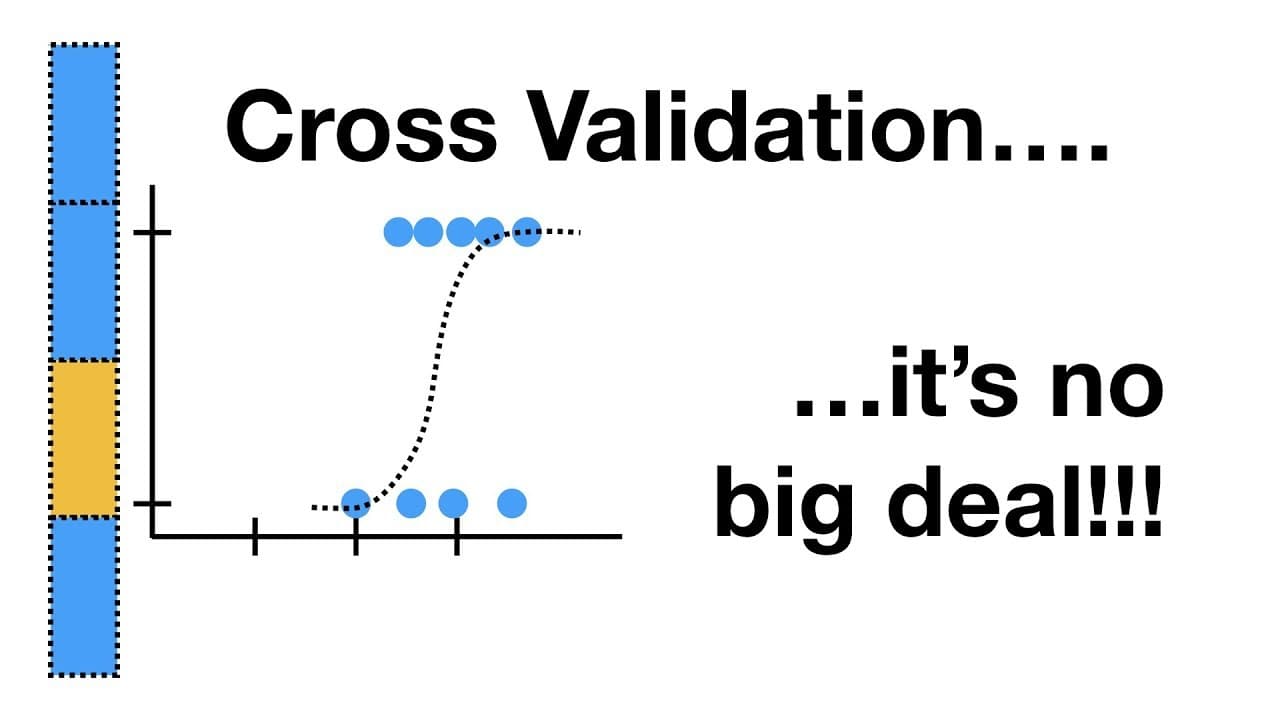
Cross-validation is a technique used to evaluate and compare different machine learning methods by dividing data into multiple training and testing sets. It helps to estimate parameters and determine which method performs best on unseen data. Commonly, 10-fold cross-validation is used, where data is divided into ten blocks to assess the effectiveness of each model.
Transcript
StatQuest Check it out talking about Machine-learning. Yeah StatQuest Check it out Talking about cross-validation StatQuest Hello, I'm Josh stormer and welcome to StatQuest today we're going to talk about cross validation and it's gonna be clearly explained Okay, let's start with some data We want to use the variables chest pain good blood circulat... Read More
Key Insights
- 😵 Cross-validation is a technique used to compare different machine learning methods and select the best one for a given task.
- 😫 It involves dividing the data into training and testing sets to estimate parameters and evaluate the performance of the methods.
- 😒 Cross-validation uses various combinations of training and testing sets to assess the performance of each method.
- 😫 It is important to have separate training and testing sets to evaluate how well the method will work on new, unseen data.
- 😵 The number of blocks or folds used in cross-validation can vary, with 10-fold cross-validation being a common choice.
- 😵 Cross-validation can also be used to find the best value for tuning parameters in methods like Ridge regression.
- 🏆 The performance of each method is evaluated based on how well it categorizes the test data.
Install to Summarize YouTube Videos and Get Transcripts
Explore YouTube Video Summarizer or Get YouTube Transcript Extractor
Questions & Answers
Q: What is the purpose of cross-validation in machine learning?
The purpose of cross-validation is to compare different machine learning methods and determine which one works best for predicting outcomes. It allows us to estimate parameters and evaluate the performance of the methods.
Q: Why is it important to have separate training and testing sets?
Using separate training and testing sets is important because it allows us to train the machine learning methods on known data and then evaluate their performance on unseen data. This ensures that we can assess how well the method will work on new data.
Q: What would happen if we used all the data to train the algorithm and had none left for testing?
Using all the data to train the algorithm would leave us with no data to evaluate the performance of the method. It is important to have separate training and testing sets to assess how well the method will work on unseen data.
Q: How does cross-validation help in comparing different machine learning methods?
Cross-validation uses multiple combinations of training and testing sets to evaluate the performance of each machine learning method. By comparing their performance on different sets of data, we can determine which method works best.
Key Insights:
- Cross-validation is a technique used to compare different machine learning methods and select the best one for a given task.
- It involves dividing the data into training and testing sets to estimate parameters and evaluate the performance of the methods.
- Cross-validation uses various combinations of training and testing sets to assess the performance of each method.
- It is important to have separate training and testing sets to evaluate how well the method will work on new, unseen data.
- The number of blocks or folds used in cross-validation can vary, with 10-fold cross-validation being a common choice.
- Cross-validation can also be used to find the best value for tuning parameters in methods like Ridge regression.
- The performance of each method is evaluated based on how well it categorizes the test data.
- Support vector machines performed the best in this example of cross-validation.
Summary & Key Takeaways
-
Cross-validation is used to compare different machine learning methods and determine which one is best for predicting outcomes.
-
The data is divided into training and testing sets to estimate parameters and evaluate the performance of the methods.
-
Cross-validation uses multiple combinations of training and testing sets to assess the performance of each method.
Read in Other Languages (beta)
Share This Summary 📚
Summarize YouTube Videos and Get Video Transcripts with 1-Click
Try YouTube Summary with ChatGPT & Claude or YouTube Transcript Generator
Explore More Summaries from StatQuest with Josh Starmer 📚

Summarize YouTube Videos and Get Video Transcripts with 1-Click
Try YouTube Summary with ChatGPT & Claude or YouTube Transcript Generator