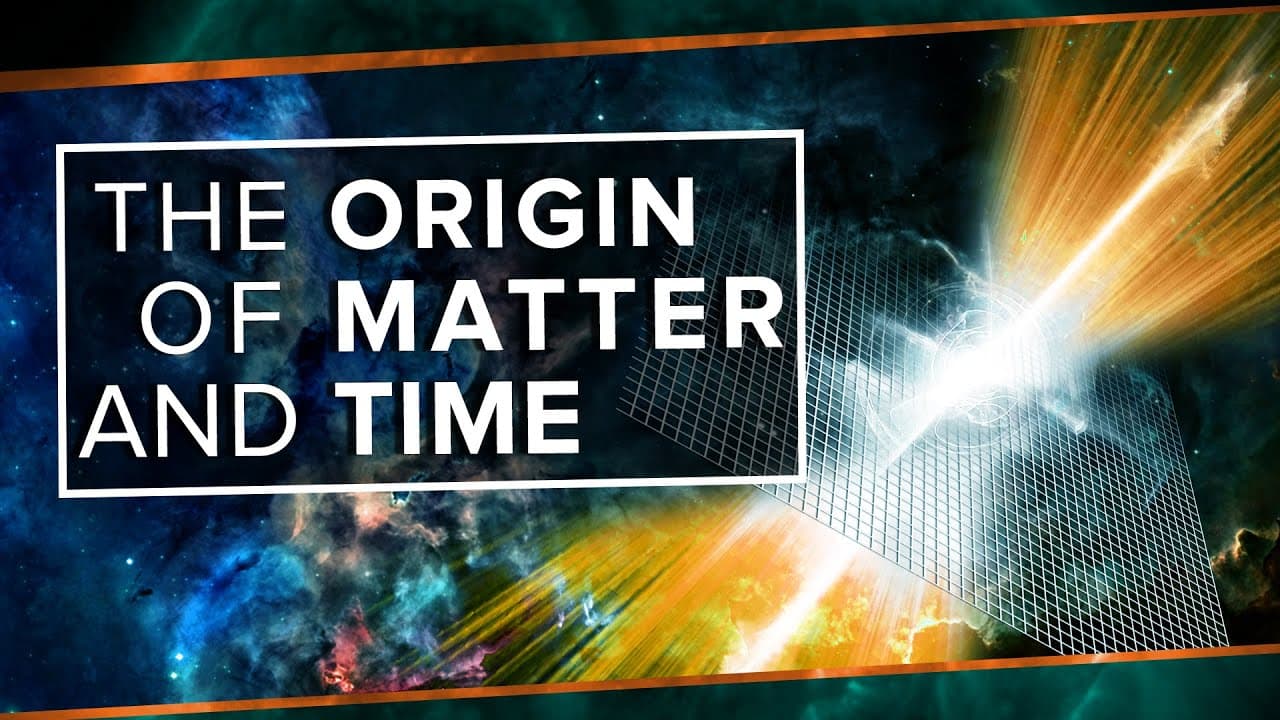
The Origin of Matter and Time
TL;DR
Explores the nature of matter and time through Einstein's relativity.
Transcript
[MUSIC PLAYING] Einstein's theory of special relativity has shown us mass and time are not the concrete things we imagine them to be. In recent episodes, we started breaking apart our preconceived notions of these ideas. In this episode, we're going to rebuild our understanding and explore the origin of matter and time. What is a thing? No mystery... Read More
Key Insights
- Einstein's theory of special relativity challenges traditional notions of mass and time, showing them as not concrete.
- A space-time diagram helps visualize an object's path through time and space, known as its world line.
- The speed of light remains constant across all frames of reference, influencing time dilation phenomena.
- Time is not universal; it varies locally for each observer, lacking a global rate of flow.
- Objects are composed of massless particles interacting at light speed, creating emergent properties like mass and time.
- Causal connections define the order of events, establishing a consistent sequence of cause and effect.
- Time dilation paradoxes, like the twin paradox, are resolved through general relativity, accounting for acceleration.
- Warp drives theoretically avoid time dilation, maintaining synchronization with the origin's timeline.
Install to Summarize YouTube Videos and Get Transcripts
Explore YouTube Video Summarizer or Get YouTube Transcript Extractor
Questions & Answers
Q: What is the significance of a space-time diagram?
A space-time diagram is a visual representation of an object's trajectory through time and space, known as its world line. It helps illustrate how objects move and interact within the four-dimensional space-time framework. By plotting position against time, it shows how various paths and speeds relate to the constancy of light speed, providing insights into phenomena like time dilation and the relative nature of time.
Q: How does time dilation occur according to Einstein's relativity?
Time dilation occurs due to the constancy of the speed of light across all frames of reference, as described by Einstein's theory of relativity. When an object moves at a significant fraction of the speed of light, its time appears to pass slower relative to a stationary observer. This effect is a result of the relativistic nature of time and space, where the speed of light remains the same, causing moving clocks to tick slower from the perspective of stationary ones.
Q: What role does light play in defining time and mass?
Light plays a crucial role in defining time and mass through its invariant speed, which serves as a fundamental constant in relativity. The interactions of massless particles traveling at light speed give rise to emergent properties like mass and time. These interactions, occurring at light speed, govern the rate of change within matter, influencing how time is perceived and how mass is formed at the quantum level, leading to a deeper understanding of these concepts.
Q: Why is there no universal flow of time?
There is no universal flow of time because time is a local phenomenon, varying for each observer based on their relative motion and position in space-time. According to relativity, time is not an absolute entity but is influenced by the observer's frame of reference. This means that different observers can experience time differently, depending on their velocity and gravitational influences, leading to the conclusion that time's flow is not globally consistent but locally defined.
Q: How does the twin paradox illustrate relativity?
The twin paradox illustrates relativity by demonstrating the effects of time dilation in a scenario where one twin travels at a high speed while the other remains on Earth. Upon reuniting, the traveling twin is younger due to experiencing less time, as predicted by special relativity. The paradox is resolved by considering the effects of acceleration, which require general relativity for a complete explanation, showing how time is affected by changes in motion and gravity.
Q: What are causal connections in space-time?
Causal connections in space-time refer to the ordered sequence of events where one event can influence another through signals traveling at or below the speed of light. These connections establish a consistent order of cause and effect, ensuring that the causal structure of the universe is maintained. Despite varying perceptions of time, the causal order remains the same for all observers, providing a concrete framework for understanding interactions within the space-time continuum.
Q: How do warp drives theoretically avoid time dilation?
Warp drives theoretically avoid time dilation by maintaining the timeline synchronization with the point of origin. In the Alcubierre warp metric, the space around a ship is manipulated to allow faster-than-light travel without the ship itself moving locally at relativistic speeds. This manipulation of space-time creates a bubble where time remains consistent with the origin, preventing the time dilation effects typically associated with high-speed travel.
Q: What defines the rate of time flow in matter?
The rate of time flow in matter is defined by the interactions of its internal components, which occur at the speed of light. These interactions, involving massless particles and force fields, dictate how matter evolves and changes over time. The rate of these interactions determines the perceived passage of time within the matter, as the internal machinery of particles exchanges energy and properties, leading to the emergent experience of time at the macroscopic level.
Summary & Key Takeaways
-
Einstein's relativity redefines our understanding of mass and time, showing them as dynamic rather than fixed concepts. Space-time diagrams illustrate objects' world lines, emphasizing the role of light speed in defining these paths. Time's flow is subjective, varying for each observer.
-
The concept of time dilation reveals how motion and speed affect perceived time, with light's invariant speed playing a crucial role. Causal order remains consistent across perspectives, establishing a universal sequence of events despite varied time experiences.
-
Matter and time emerge from interactions of massless particles traveling at light speed. These interactions create mass and time as emergent properties. Relativity's insights resolve paradoxes like the twin paradox, explaining time differences through acceleration effects.
Read in Other Languages (beta)
Share This Summary 📚
Summarize YouTube Videos and Get Video Transcripts with 1-Click
Try YouTube Summary with ChatGPT & Claude or YouTube Transcript Generator
Explore More Summaries from PBS Space Time 📚

Summarize YouTube Videos and Get Video Transcripts with 1-Click
Try YouTube Summary with ChatGPT & Claude or YouTube Transcript Generator