How to Implement Semantic Storage with Chroma
TL;DR
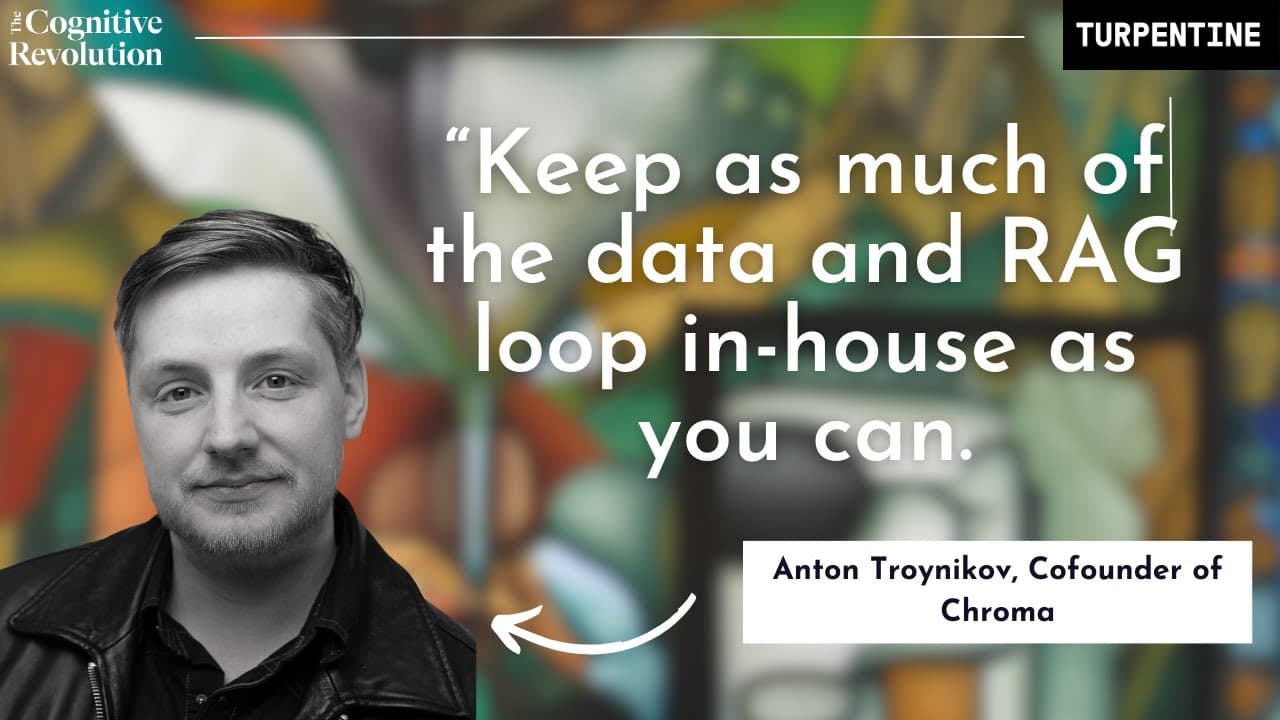
Anton Troynikov, cofounder of Chroma, discusses the importance of retrieval-augmented generation (RAG) and how Chroma is working to make semantic storage and retrieval more efficient. He highlights the need for businesses to keep the RAG loop in-house for better control and optimization, as well as the potential for growth in handling unstructured data.
Transcript
we are conditioned to think about data as this static thing right it like it's sitting somewhere and it has a particular instance in time and then we add access that instance in time and then you know the next time it might be different but it's like it's still essentially mentally we think of it aesthetic I really think of these things more like a... Read More
Key Insights
- Chroma aims to build a horizontally scalable system for vector search and storage, delivering it as a cloud service.
- Retrieval-augmented generation (RAG) is gaining popularity as it allows AI to use external data to enhance responses.
- Keeping the RAG loop in-house allows for better control over data and optimization of AI applications.
- Chroma focuses on providing a unified interface to handle both structured and unstructured data efficiently.
- The company sees a significant amount of data entering Chroma that has never been stored in a database before.
- Chroma plans to bring more intelligence into the data layer, making it easier for developers to build AI applications.
- Interpretability of AI models is crucial, and new tools can make latent spaces more accessible without requiring AI expertise.
- Fine-tuned models can bring more of the RAG loop in-house, enhancing the performance and relevance of AI applications.
Install to Summarize YouTube Videos and Get Transcripts
Explore YouTube Video Summarizer or Get YouTube Transcript Extractor
Questions & Answers
Q: How does Chroma plan to enhance semantic storage and retrieval?
Chroma aims to build a horizontally scalable system for vector search and storage, delivering it as a cloud service. The company focuses on providing a unified interface for handling both structured and unstructured data, making it easier for developers to build AI applications. Chroma is also working on bringing more intelligence into the data layer to improve the performance of AI models.
Q: Why is keeping the RAG loop in-house important?
Keeping the RAG loop in-house allows businesses to have better control over their data and optimize AI applications more effectively. It enables them to adapt the embedding space based on user feedback and ensures that the retrieval process is tailored to their specific needs. This approach can lead to better performance and relevance of AI-generated responses.
Q: What potential does Chroma see in processing unstructured data?
Chroma sees significant potential in processing unstructured data, which has never been stored in databases before. With AI models now capable of interpreting text, images, and sound, there is a vast amount of data that can be utilized for AI applications. This opens up new opportunities for businesses to gain insights and improve their processes using previously untapped data sources.
Q: How does Chroma plan to improve the interpretability of AI models?
Chroma is developing new tools to improve the interpretability of AI models, making latent spaces more accessible without requiring AI expertise. The company believes that interpretability is crucial for understanding how AI models make decisions and ensuring that they provide reliable and relevant responses. By enhancing interpretability, Chroma aims to build trust in AI applications and facilitate their adoption.
Q: What role do partnerships with AI labs play for Chroma?
Partnerships with AI labs are crucial for Chroma to reinforce RAG applications and increase the use of AI models like OpenAI's GPT. By collaborating with AI labs, Chroma can ensure that its semantic storage and retrieval solutions are compatible with the latest AI advancements. These partnerships also provide opportunities for joint research and development, leading to better AI solutions for businesses.
Q: How can fine-tuned models enhance the RAG loop?
Fine-tuned models can bring more of the RAG loop in-house, leading to better performance and relevance of AI applications. By fine-tuning models on specific data sets and tasks, businesses can optimize the retrieval process and improve the accuracy of AI-generated responses. This approach allows for continuous improvement of AI applications based on real-world usage and feedback.
Q: What challenges does Chroma face in scaling its solutions?
Chroma faces challenges in scaling its solutions to handle the vast amount of unstructured data that businesses want to process. The company needs to ensure that its cloud service can handle high volumes of data efficiently while maintaining performance and reliability. Additionally, Chroma must address the complexities of integrating with existing data infrastructures and providing a seamless user experience for developers.
Q: What is Chroma's vision for the future of AI applications?
Chroma envisions a future where AI applications are seamlessly integrated into business processes, providing valuable insights and automating tasks. The company aims to be a key player in enabling this future by offering scalable and intelligent semantic storage and retrieval solutions. Chroma believes that by making AI more accessible and interpretable, businesses can unlock new opportunities and drive innovation across industries.
Summary & Key Takeaways
-
Anton Troynikov discusses Chroma's mission to build a scalable cloud service for semantic storage and retrieval, emphasizing the importance of keeping the RAG loop in-house for better control and optimization. He highlights the potential for growth in processing unstructured data, which has never been stored in databases before.
-
Chroma aims to provide a unified interface for structured and unstructured data, making it easier for developers to build AI applications. The company is working on new tools to improve the interpretability of AI models and make latent spaces more accessible without requiring AI expertise.
-
Anton believes that fine-tuned models can enhance the RAG loop by bringing more of the process in-house, leading to better performance and relevance of AI applications. He sees partnerships with AI labs as crucial for reinforcing RAG applications and increasing the use of models like OpenAI's GPT.
Read in Other Languages (beta)
Share This Summary 📚
Summarize YouTube Videos and Get Video Transcripts with 1-Click
Try YouTube Summary with ChatGPT & Claude or YouTube Transcript Generator
Explore More Summaries from Cognitive Revolution "How AI Changes Everything" 📚




Summarize YouTube Videos and Get Video Transcripts with 1-Click
Try YouTube Summary with ChatGPT & Claude or YouTube Transcript Generator