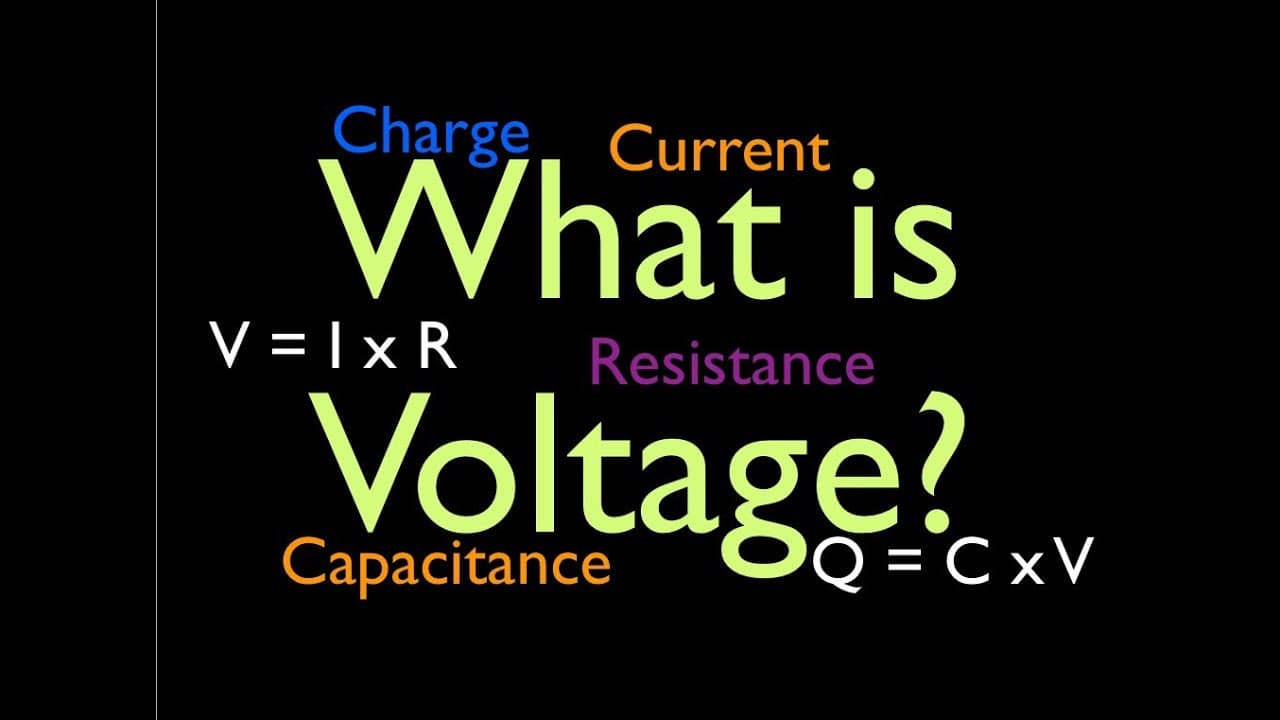
What is Voltage? An Explanation
TL;DR
Voltage is electric potential energy per charge unit; essential in circuits with resistors and capacitors.
Transcript
okay as you can see in today's video I am going to go over what is voltage now I'm not going to go over it in great detail I'm just going to do a little discussion about what voltage is specifically as it relates to circuits with resistors and capacitors there are several different terms that you need to be familiar with voltage is one of them the ... Read More
Key Insights
- 💐 Voltage is electric potential energy per unit charge, essential for energy flow in circuits.
- ⚡ Understanding voltage is crucial in conjunction with current, resistance, capacitance, and charge for circuit analysis.
- 🖐️ In circuits, voltage plays a vital role in determining energy levels carried by electrons.
- ⚡ The relationship between voltage, current, and resistance is explained by Ohm's law, V = IR.
- ⚡ Voltage is measured in volts, with one volt equating to one joule of energy per coulomb.
- ⚡ Familiarity with voltage is necessary for accurate calculations and analysis in circuitry.
- 💦 Students benefit from grasping the concept of voltage to excel in working with circuits efficiently.
Install to Summarize YouTube Videos and Get Transcripts
Explore YouTube Video Summarizer or Get YouTube Transcript Extractor
Questions & Answers
Q: What is voltage and why is it important in circuits?
Voltage is the electric potential energy per unit charge, crucial for understanding energy flow in circuits with resistors and capacitors. It determines how much energy electrons possess and plays a significant role in calculations like Ohm's law.
Q: How is voltage represented and measured?
Voltage is symbolized by 'V' and measured in volts. One volt equals one joule of electric potential energy per coulomb of charge. It is commonly abbreviated as 'V' when written down, for example, 12V.
Q: Can you explain the relationship between voltage, current, and resistance?
Voltage in a circuit determines the energy carried by the electrons. Current is the flow of charge, while resistance opposes this flow, with the relationship expressed in Ohm's law: V = IR.
Q: Why is understanding voltage important for students working with circuits?
Having a grasp of voltage is essential for students to comprehend how energy flows in circuits, enabling them to correctly analyze and calculate circuit behavior.
Summary & Key Takeaways
-
Voltage is a measure of electric potential energy per unit of charge.
-
It is crucial in circuits with resistors and capacitors.
-
Understanding voltage, along with current, resistance, capacitance, and charge, is key to circuit equations like Ohm's law.
Read in Other Languages (beta)
Share This Summary 📚
Summarize YouTube Videos and Get Video Transcripts with 1-Click
Try YouTube Summary with ChatGPT & Claude or YouTube Transcript Generator
Explore More Summaries from Step by Step Science 📚

Summarize YouTube Videos and Get Video Transcripts with 1-Click
Try YouTube Summary with ChatGPT & Claude or YouTube Transcript Generator