Tadashi Tokieda || Toys in Applied Mathematics || Radcliffe Institute
Transcript
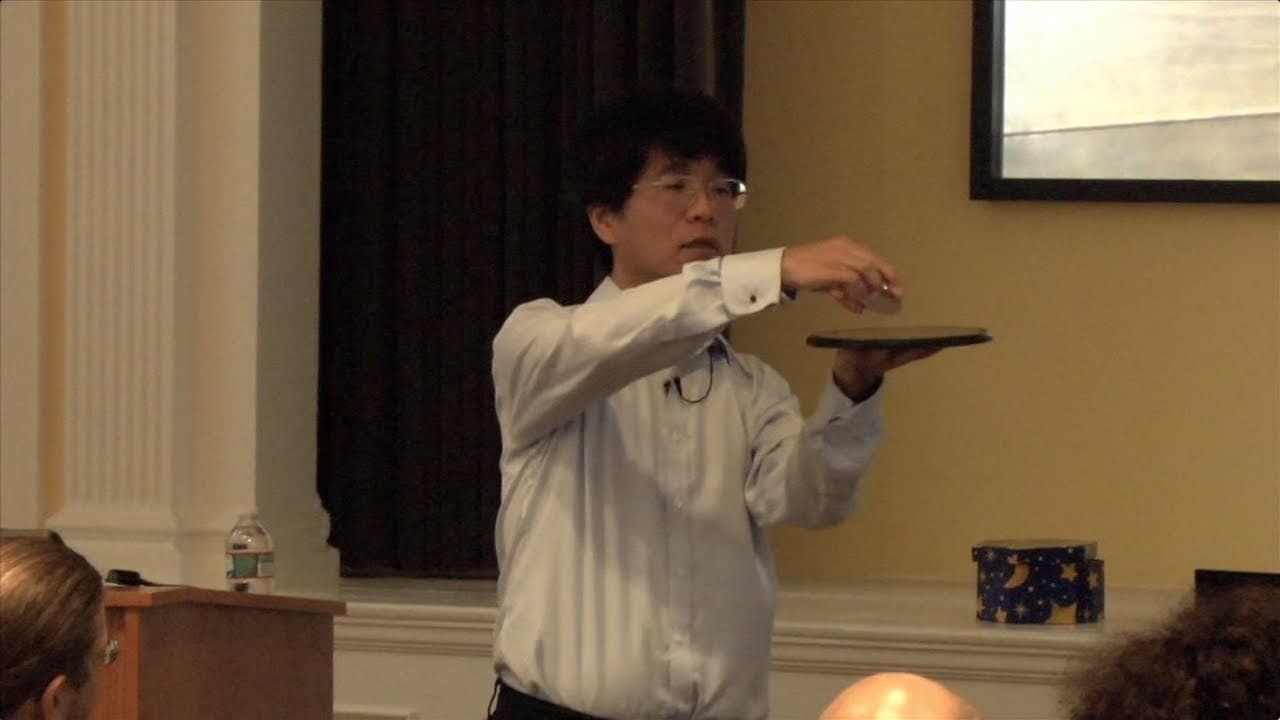
[MUSIC PLAYING] TADASHI TOKIEDA: A tube whose ends are marked orange and black-- I'm afraid, is the color of Princeton University, not Harvard. And I'm going to set its spin by launching it. And you'll see that it spins around the middle. So I'm already trying to misguide you. There is no reason why we should see one end better than the other end. ... Read More
Install to Summarize YouTube Videos and Get Transcripts
Explore YouTube Video Summarizer or Get YouTube Transcript Extractor
Summary
In this video, the speaker discusses various toys and experiments that demonstrate different scientific concepts. The speaker explores topics such as stability to instability transitions, phase transitions, the effects of friction, and singularities. Through these toys and experiments, the speaker aims to show that science is constantly at work in the world around us, even during times when scientists are not actively conducting experiments.
Questions & Answers
Q: Why do we see one end of the spinning tube as black and the other end as orange?
The speaker explains that the color we perceive depends on the relative motion of the tube ends. When the tube is shaken or rubbed, the motion affects the appearance of the ends, creating the perception of one end being black and the other end being orange. The speaker suggests that the perception of color could be related to the frequency at which our eyes are sensitive to certain velocities.
Q: Why do we see four spots on one tube and three spots on another tube?
The number of spots we see on the tube is related to its length-to-diameter ratio. The speaker explains that the first tube, with a length-to-diameter ratio of 4:1, shows four spots because of the specific combination of revolution and rotation. On the other hand, the second tube, with a length-to-diameter ratio of 3:1, shows three spots. The speaker suggests that different ratios will result in different numbers of spots, such as two spots for a 2:1 ratio and five spots for a 5:1 ratio.
Q: What is the difference between revolution and rotation in the context of the spinning tube?
The speaker clarifies that revolution refers to the tube's motion around its center, while rotation refers to the tube's motion around its axis. These two types of motion combine to create the overall movement of the tube. Revolution adds to the velocity of one end of the tube, causing it to move faster, while rotation subtracts from the velocity of the other end, resulting in a slower movement.
Q: Why do the balls in the swirling experiment change direction as more balls are added?
The speaker explains that the change in direction of the balls is a phase transition caused by the interaction between the balls and their neighbors. When there are fewer balls, they can circulate in the same direction as the swirling motion. However, as more balls are added, they start to rub against each other and the walls of the container, causing hesitation and uncertainty in their direction. Eventually, the balls begin to circulate in the opposite direction as a result of this interaction.
Q: How does friction affect the motion of a rotating object?
The speaker demonstrates with a rotating disc that friction plays a role in the motion of an object. As the disc rotates, the friction with the air trapped underneath causes the disc to lose energy, resulting in a flattening motion. This flattening motion accelerates the disc and produces a specific sound. The speaker notes that this phenomenon is not dependent on the presence of air, as it also occurs in a vacuum.
Q: What is the significance of the Karman vortex street pattern?
The Karman vortex street pattern is seen in the flow of fluids past obstacles. The speaker explains that it is a combination of revolving motion and a spiral pattern. It was discovered that all dynamical problems in nature that can be solved exactly exhibit this pattern. The pattern is related to the ratio of the circumference of the circle the fluid is describing to the length of the surface over which it flows.
Q: Why does decreasing friction lead to phenomena like turbulence and singularity?
The speaker explains that decreasing friction, or increasing the Reynolds number, leads to a transition from laminar flow to turbulence in fluid dynamics. This transition occurs because as the friction decreases, the fluid becomes less organized and more chaotic, with vortices forming behind obstacles. In the case of the coin dropping experiment, decreasing friction leads to a singularity, where the speed and flattening motion of the coin increase indefinitely until it shatters. The loss of energy through vibrations is what drives this phenomenon.
Q: Why is it important to study toys and conduct experiments with them?
The speaker suggests that toys and experiments provide a tangible and accessible way to explore scientific concepts. These toys serve as tools to help understand various phenomena and showcase scientific principles in action. By observing and experimenting with toys, we can develop a deeper understanding of the natural world and gain insights into how science works.
Q: Where does science exist when scientists are on holiday?
Science exists regardless of whether or not scientists are actively conducting experiments. The speaker emphasizes that science is constantly happening in the natural world, even when scientists are taking a break. The laws of science continue to be at work in every corner of the universe, shaping and governing the behavior of various phenomena.
Q: Why does the speaker use toys and experiments to demonstrate scientific concepts?
The speaker uses toys and experiments as a means of making scientific concepts more accessible and engaging. By using toys, the speaker can demonstrate complex scientific principles in a simplified and visually appealing way. Toys are a tool to capture the audience's attention and provide a hands-on experience that helps to illustrate the concepts being discussed.
Q: What is the significance of the passage from Aristotle's "Parva Naturalia" about Heraclitus?
The speaker mentions a passage from Aristotle's "Parva Naturalia" that discusses how science exists in even the most mundane places, such as a kitchen. The passage emphasizes that scientific phenomena occur in all aspects of life, and there is something fascinating and scientific even in everyday objects and activities. The speaker uses this idea to highlight how science is always at work, even when we don't realize it.
Read in Other Languages (beta)
Share This Summary 📚
Summarize YouTube Videos and Get Video Transcripts with 1-Click
Try YouTube Summary with ChatGPT & Claude or YouTube Transcript Generator
Explore More Summaries from Harvard University 📚




Summarize YouTube Videos and Get Video Transcripts with 1-Click
Try YouTube Summary with ChatGPT & Claude or YouTube Transcript Generator