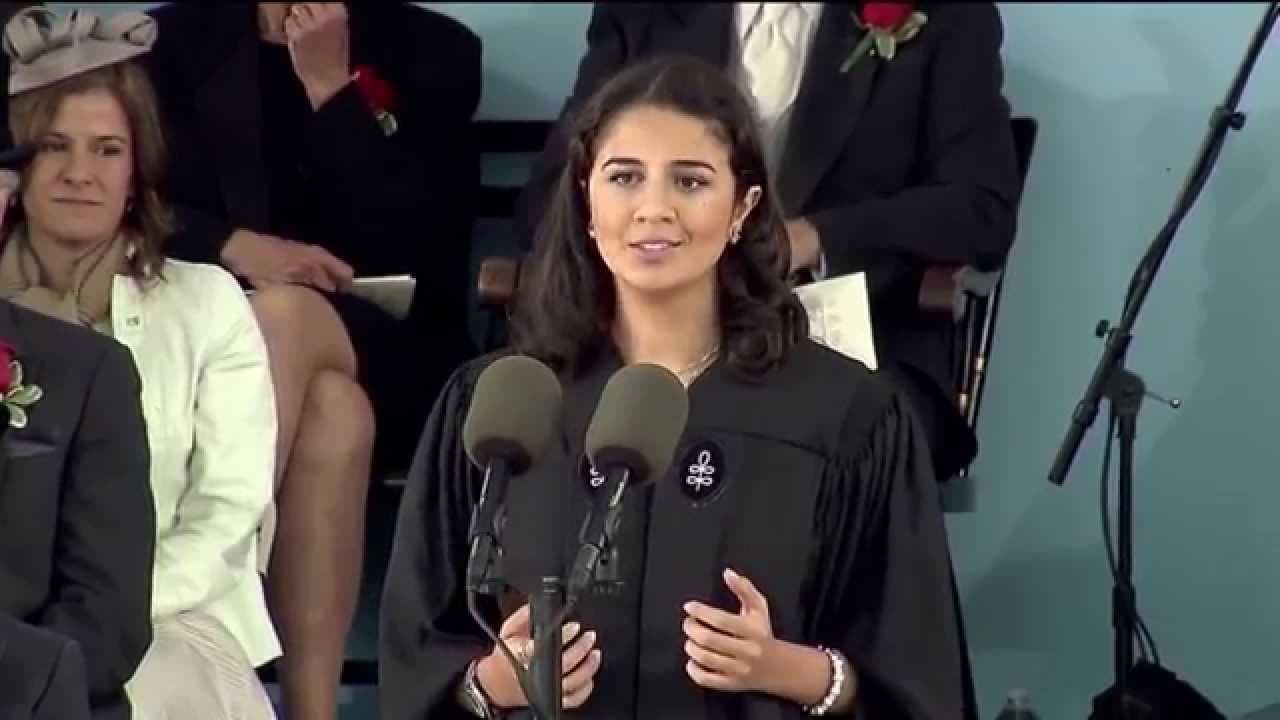
Undergraduate Speaker Sarah Abushaar | Harvard Commencement 2014
TL;DR
Strong institutions and civil society can restore the confidence to shape history instead of being passively shaped by it. Sarah Abushaar argues that Harvard gave graduates a working model of civic possibility, then challenges the class of 2014 to carry its ideas into the world as revolutions of the mind rather than revolutions in arms.
Transcript
when I was around seven my toothless brother and I on long boring taxi rides in Syria would indulge in imperialistic fantasies of how we wanted to take over the country outside our way Windows my parents would quickly Crush these Imperial conquests by warning sh you'll get taken by secret service if they hear you the walls everywhere we were told c... Read More
Key Insights
- Fear of government surveillance shaped Abushaar's Syrian childhood, because she and her brother were warned that secret services could hear their political fantasies and send them to prison. Government power occupied the place that ghosts or the Boogeyman held in the fears of other children.
- Harvard is portrayed as a nation with its own symbolic and institutional infrastructure, including the John Harvard statue, international Harvard clubs, the Harvard Alumni Association, and a large endowment. This comparison helps Abushaar explain the university's unusual social identity, influence, and global recognition.
- Harvard affiliation changed Abushaar's experience at American immigration, where questions about her Middle Eastern background gave way to acceptance after officials noticed her connection to the university. She uses this contrast to illustrate how institutional identity can affect whether a person is viewed with suspicion or trust.
- Civil society is sustained by active invisible institutions, including newspapers, student debates, bulletin boards, conferences, performances, and student projects. Abushaar sees these ordinary forums as evidence of passion, purpose, creativity, and a civic community capable of producing ideas and prompting policy changes.
- Institutional dysfunction can suppress social dynamism and productive civic life. Because Abushaar associated her parents' countries with such dysfunction, Harvard's living institutions offered her a working model of a better world and showed why healthy civic structures matter beyond their buildings or official authority.
- Personal empowerment can begin when institutions treat a student's judgment as consequential. When a professor asked Abushaar to advise Ecuador's president during a negotiations class, the experience convinced her that she could question a shaper of history and potentially become someone who shaped history herself.
- Education becomes part of a graduate's identity through accumulated encounters with people, history, and ideas. Abushaar compares this process to running barefoot and collecting materials that become shoes, suggesting that graduates carry what they absorbed at Harvard and leave its best qualities in new destinations.
- The Harvard Spring represents revolutions of the mind rather than revolutions in arms. Abushaar describes the graduating class as thousands of revolutions entering the world, with the potential to transform institutions, constitutions, hospitals, art houses, and communities through ideas developed during their university years.
Install to Summarize YouTube Videos and Get Transcripts
Explore YouTube Video Summarizer or Get YouTube Transcript Extractor
Questions & Answers
Q: How did Harvard change Sarah Abushaar's view of personal agency?
Harvard helped Sarah Abushaar believe that she could shape history instead of being passively shaped by it. The clearest example came during a negotiations class, when her professor asked her to tell Ecuador's president what to do about a possible war with Peru. Being invited to question and advise a historical decision-maker showed her that her perspective had value and restored her confidence to think ambitiously.
Q: What does Sarah Abushaar mean by the Harvard Nation?
The Harvard Nation is Abushaar's metaphor for the university as a country-like community with distinctive symbols, organizations, resources, and international influence. She compares the John Harvard statue to a national monument, Harvard clubs to embassies, and the Harvard Alumni Association to a tax collection agency. More importantly, she identifies debates, publications, projects, and civic participation as the invisible institutions that keep this community alive.
Q: Why does Sarah Abushaar emphasize Harvard's invisible institutions?
Abushaar emphasizes invisible institutions because buildings and formal organizations alone do not create a vibrant society. She points to the Crimson newspaper, energetic student debates, crowded bulletin boards, conferences, performances, and dorm-room projects as expressions of civic life. These activities reveal passion, creativity, purpose, and participation, providing a contrast with places where institutional dysfunction has weakened social dynamism and productive community action.
Q: How did Sarah Abushaar's childhood in Syria influence her speech?
Her childhood in Syria established the speech's central contrast between fear and civic empowerment. As children, she and her brother imagined taking over the country during taxi rides, but their parents warned that secret services might hear them and send them to prison. Those memories of spying walls made Harvard's open debate, institutional vitality, and encouragement of student participation feel especially powerful and valuable to her.
Q: What happened to Sarah Abushaar at immigration in Boston?
At immigration in Boston's Logan Airport, officials questioned Abushaar about traveling from the Middle East and why she was entering the country. She says their attitude changed after they recognized that she attended Harvard, especially when she wore clothing displaying the university's name. She uses the experience to show how Harvard citizenship, as she jokingly calls it, opened doors and reduced officials' suspicion toward her.
Q: What does the barefoot running metaphor mean in the commencement speech?
The barefoot running metaphor describes how living in a place gradually becomes part of a person's identity. Drawing on an image attributed in the speech to Arab American author Randa Jarrar, Abushaar says bare feet collect sand, seeds, rocks, and grass until those materials become shoes. Likewise, graduates collect people, history, ideas, and experiences, carry those influences on their souls, and leave their own footprints elsewhere.
Q: Why is Sarah Abushaar hopeful about the graduating class?
Abushaar is hopeful because she has seen students overcome political conflict, exchange ideas, and work together. She recalls dining hall conversations with friends whose countries were fighting bloody wars, yet who could still maintain civil dialogue and create shared projects. She believes graduates will take similarly generative ideas into the world and improve institutions, constitutions, hospitals, art houses, and other parts of public life.
Q: What is the Harvard Spring of 2014?
The Harvard Spring of 2014 is Abushaar's name for the global influence she hopes the graduating class will exercise after commencement. She describes the graduates as thousands of revolutions carrying ideas from Harvard Square into real public spaces. These are not revolutions in arms, but revolutions in minds, intended to create more powerful, permanent, and pervasive change through institutions, ideas, and civic action.
Summary
In this video, the speaker reflects on their experience at Harvard and how it shaped their perspective on the world. They compare the concept of the "Harvard nation" to the invisible institutions and structures that exist within the university. The speaker shares their journey from the Middle East to Harvard, highlighting the privileges they gained as a Harvard student. They also discuss the power of civil society and the value of living, breathing institutions. The speaker concludes by expressing hope for the future, inspired by the transformative potential of the ideas and revolutions sparked within the Harvard community.
Questions & Answers
Q: How did the speaker's upbringing in Syria shape their view of the world?
When the speaker was young, they and their sibling would often fantasize about imperialistic conquests while in taxis in Syria. However, their parents warned them against discussing such ideas due to the fear of being taken by the secret service. They were taught that the walls could hear their revolutionary ideas and send them to prison. This experience instilled a sense of caution and made the speaker aware of the oppressive governance in their home country.
Q: How did the speaker perceive Harvard when they first arrived?
Upon arriving at Harvard, the speaker was struck by the idea that if Harvard shut its gates, it could be its own country, similar to the Vatican. They observed the presence of the "Harvard nation" in various aspects of the university, such as the John Harvard statue, the Harvard Clubs of Boston and London, and the Harvard Alumni Association. The speaker also mentions that they had their own diplomatic passports. The recognition and privileges that came with being a Harvard student were evident, particularly when going through U.S. immigration at Boston Logan Airport.
Q: How did the speaker perceive the "Harvard nation" within the university?
The speaker saw the "Harvard nation" not only in the physical structures and institutions but also in the invisible institutions and scaffolds that support the university. They highlight examples such as the columns of the Crimson newspaper, which fostered lively debates and had the potential to influence policy changes, and the cluttered bulletin boards filled with announcements of student-led conferences and projects. The speaker saw these as representations of passions, purpose, and creativity that brought vibrancy and dynamism to the environment.
Q: How did the speaker's experience at Harvard challenge their initial expectations?
The speaker shares their surprise when, in one of their first classes, they found themselves debating the Ecuadorian president about how to prevent a war between Ecuador and Peru. They had expected to merely listen and learn, but instead, their professor brought in the president to engage with the students. This experience made the speaker realize that they had the ability to shape history and contribute to creating solutions for seemingly intractable problems. They felt a sense of empowerment and infinite possibility, reminiscent of the dreams of childhood.
Q: How did the speaker's identity change after attending Harvard?
Initially known by their name, Sarah, the speaker quickly became identified as "Harvard" by others. People would refer to them as "Hey Harvard," and the speaker humorously mentions how they embodied the entire history, prestige, and physical landmarks of Harvard within their own five-foot-six-inch self. The speaker describes the transformative experience of running barefoot through Harvard Yard, collecting experiences and knowledge, and wearing them as shoes made of everything they picked up along the way. They express hope that these accumulations will continue to shape their identity as they move on from Harvard.
Q: What gives the speaker hope for the future?
The speaker finds hope in observing dinner conversations in their dining hall, where friends from countries at war are still able to engage in civil conversation and work together on meaningful projects. They are inspired by the founding mothers and fathers of revolutionary ideas that emerge from Harvard, who aim to make the world a better place through their contributions to institutions, constitutions, hospitals, and art houses. The speaker sees the graduating class as a collective force, sending out six thousand revolutions into the world, capable of creating positive, impactful change.
...
Takeaways
The speaker's experience at Harvard has profoundly influenced their perspective on the world. They have witnessed the power of institutions and the potential for positive change within them. Through the concept of the "Harvard nation" and the invisible structures that support it, the speaker has come to understand the value of civil society and living, breathing institutions. They believe that the revolutions sparked within the Harvard community can have a transformative impact on the world. The speaker leaves Harvard hopeful for the future, carrying with them the accumulation of knowledge, experiences, and ideas that will shape their journey ahead.
Summary & Key Takeaways
-
Sarah Abushaar contrasts a Syrian childhood shaped by fear of government surveillance with four years at Harvard, where debate and civic participation were encouraged. She portrays Harvard as a nation with visible structures and invisible institutions, emphasizing how its lively intellectual and community life demonstrated the practical value of a functioning civil society.
-
Harvard restored Abushaar's childhood sense of possibility by treating her ideas as worthy of serious attention. A classroom encounter with Ecuador's president showed her that she could question a person who had shaped history. That experience helped her believe she could influence events rather than remain a passive subject of powerful institutions.
-
Abushaar describes graduates as carrying Harvard's people, history, ideas, and experiences into their next destinations. Her hope rests on friends from countries at war who still cooperate, and on graduates prepared to improve institutions, constitutions, hospitals, and art houses. She calls their future contributions a global revolution of minds.
-
Key Insights
Read in Other Languages (beta)
Share This Summary 📚
Summarize YouTube Videos and Get Video Transcripts with 1-Click
Try YouTube Summary with ChatGPT & Claude or YouTube Transcript Generator
Explore More Summaries from Harvard University 📚



Summarize YouTube Videos and Get Video Transcripts with 1-Click
Try YouTube Summary with ChatGPT & Claude or YouTube Transcript Generator