How to Solve the Three-Body Problem
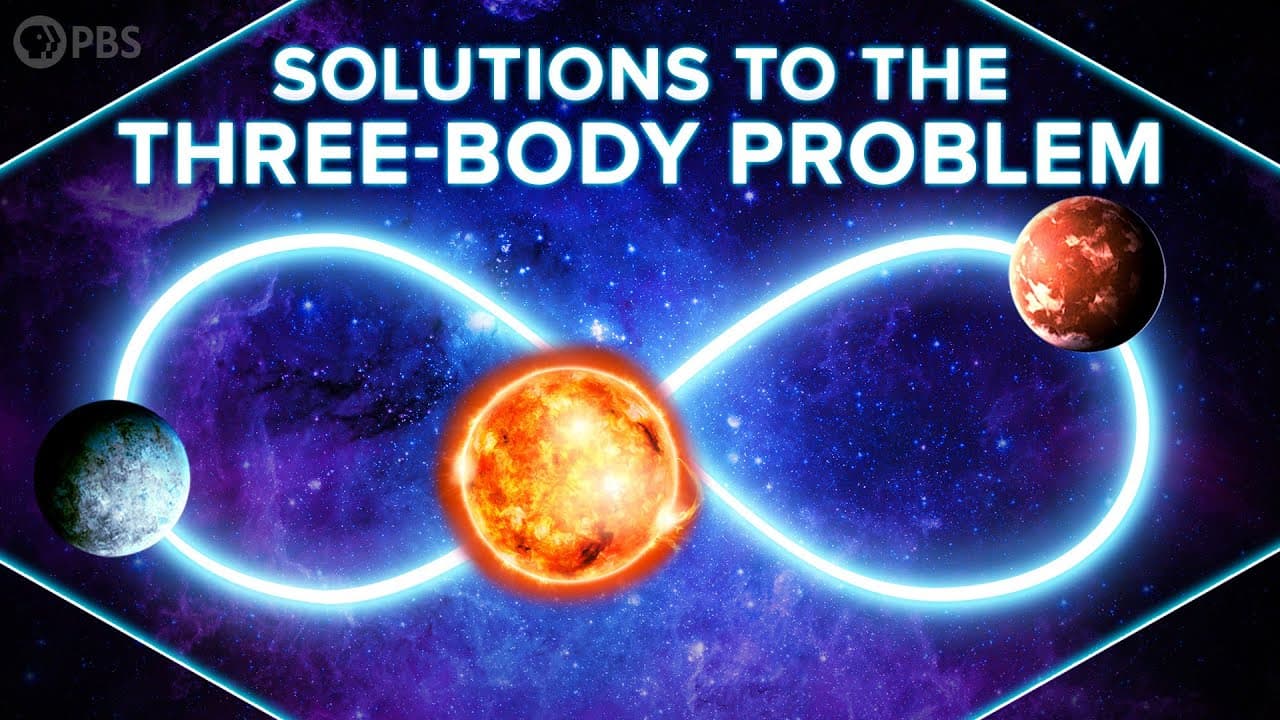
TL;DR
The three-body problem, although traditionally deemed unsolvable, has been approached through various ingenious methods. While exact analytical solutions are rare, approximate solutions using numerical integration and specialized cases like Euler and Lagrange's solutions offer practical insights. Modern computational methods have expanded our ability to simulate and predict complex gravitational interactions.
Transcript
The three body problem is famous for being impossible to solve. But actually it's been solved many times, and in ingenious ways. Some of those solutions are incredibly useful, and some are incredibly bizarre. Physics - and arguably all of science changed forever in 1687 when Isaac Newton published his Principia. Within it were equations of motion a... Read More
Key Insights
- The three-body problem is known for its lack of a general analytic solution due to chaotic dynamics.
- Newton's equations provide simple solutions for two-body systems but become complex with a third body.
- Approximate solutions, like treating a system as a series of two-body problems, are often used.
- Special cases, such as Euler and Lagrange's solutions, offer exact solutions for specific configurations.
- Numerical integration allows for accurate predictions by breaking problems into manageable segments.
- Modern computers enable N-body simulations to predict planetary and galactic movements.
- Periodic three-body orbits, although complex, can be analyzed using the shape-sphere model.
- Recent statistical methods utilize chaotic motion to predict likely outcomes in three-body interactions.
Install to Summarize YouTube Videos and Get Transcripts
Explore YouTube Video Summarizer or Get YouTube Transcript Extractor
Questions & Answers
Q: How is the three-body problem solved?
The three-body problem is approached through approximate solutions and specialized cases. Numerical integration breaks the problem into small segments for practical predictions. Euler and Lagrange found exact solutions for specific configurations. Modern computational methods, like N-body simulations, enable detailed predictions of celestial movements, despite the problem's inherent complexity.
Q: What are Euler and Lagrange's contributions to the three-body problem?
Euler and Lagrange discovered exact solutions for specific three-body configurations. Euler's solutions involve bodies in a straight line, while Lagrange's involve equilateral triangles. These solutions are notable for their simplicity and have been used to define Lagrange points, useful for space missions. They represent rare cases where the three-body problem has an exact, analytical solution.
Q: What is numerical integration in the context of the three-body problem?
Numerical integration is a method used to solve the three-body problem by breaking the system's motion into small, manageable segments. Each segment is solved step-by-step, allowing for accurate predictions of the system's behavior over time. This method is crucial for simulating complex gravitational interactions, especially with the aid of modern computers.
Q: How do modern computers aid in solving the three-body problem?
Modern computers facilitate the solving of the three-body problem through N-body simulations, which use numerical integration to predict the motion of celestial bodies. These simulations can handle complex systems with many interacting bodies, providing accurate predictions of planetary and galactic dynamics. They have revolutionized our ability to understand and predict gravitational interactions.
Q: What is the shape-sphere model in three-body problem analysis?
The shape-sphere model is a visualization technique for analyzing periodic three-body orbits. It represents the changing shape of a triangle formed by three bodies on the surface of a sphere. This model simplifies the analysis by focusing on relative angles and distances, making complex orbits easier to understand and study, despite the absence of simple equations.
Q: Why are approximate solutions important for the three-body problem?
Approximate solutions are crucial for the three-body problem because they allow for practical predictions in systems where exact solutions are impossible due to chaotic dynamics. Methods like treating systems as a series of two-body problems or using reduced three-body models help simplify complex interactions, providing insights and predictions necessary for navigation and space exploration.
Q: How does chaotic motion impact three-body problem solutions?
Chaotic motion in the three-body problem means that small changes in initial conditions can lead to vastly different outcomes, making exact predictions challenging. This chaos prevents general analytic solutions, but it can be harnessed statistically to predict likely outcomes, such as the ejection of a body from the system, providing insights into the dynamics of dense astronomical regions.
Q: What recent advancements have been made in solving the three-body problem?
Recent advancements include the use of statistical mechanics to analyze chaotic three-body systems. Researchers like Stone and Leigh have developed methods to predict likely outcomes of interactions by mapping regions of phase space where certain events, like ejections, are probable. These insights are particularly useful for understanding the dynamics of dense regions in the universe, such as star clusters or black hole interactions.
Summary & Key Takeaways
-
The three-body problem challenges physicists due to its chaotic nature, making general solutions elusive. Despite this, approximate methods and specialized solutions have been developed. Numerical integration and N-body simulations allow for practical predictions, especially with modern computing power.
-
Euler and Lagrange discovered exact solutions for specific three-body configurations, leading to insights into celestial mechanics. Recent advances include statistical approaches that leverage chaotic dynamics to predict outcomes in dense astronomical regions.
-
The shape-sphere model simplifies the analysis of periodic three-body orbits, offering a novel perspective on these complex systems. These insights, while not always practical, enhance our understanding of gravitational interactions and celestial mechanics.
Read in Other Languages (beta)
Share This Summary 📚
Summarize YouTube Videos and Get Video Transcripts with 1-Click
Try YouTube Summary with ChatGPT & Claude or YouTube Transcript Generator
Explore More Summaries from PBS Space Time 📚




Summarize YouTube Videos and Get Video Transcripts with 1-Click
Try YouTube Summary with ChatGPT & Claude or YouTube Transcript Generator