Is Electric Charge Truly Fundamental?
TL;DR
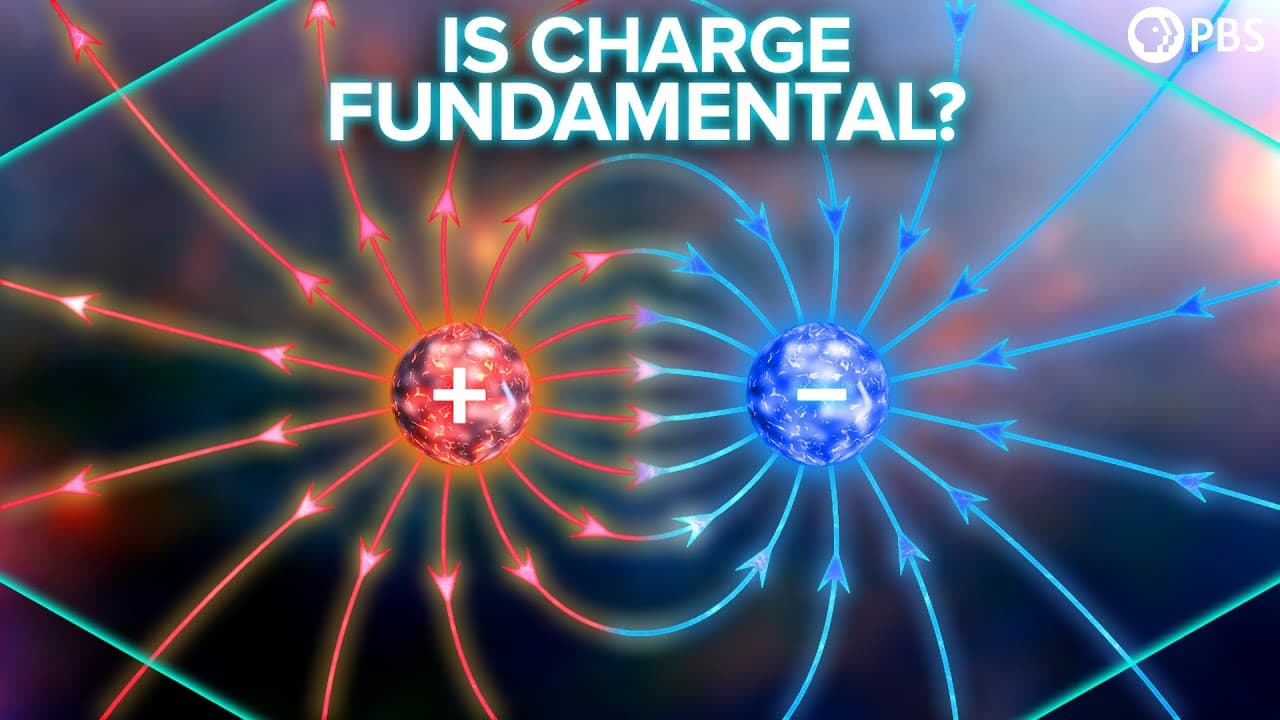
Electric charge, long considered a fundamental property, may not be as fundamental as once thought. It is closely tied to weak isospin and hypercharge, which are linked to the weak force. These properties suggest a deeper connection to the electroweak force from the early universe, indicating that electric charge is a remnant of more ancient forces.
Transcript
If you've studied any physics you know that like charges repel and opposite charges attract. But why? It's as though this thing - electric charge
- is as fundamental a property of an object as its mass. It just sort of ... exists. Well it turns out if you dig deep enough, the fundamental-ness of charge unravels, and in many things, including mass i... Read More
Key Insights
- Electric charge is traditionally seen as a fundamental property of particles.
- Heisenberg proposed isospin to explain similarities between protons and neutrons.
- Isospin and hypercharge are more fundamental than electric charge in particle interactions.
- Gell-Mann linked isospin and hypercharge to a mathematical symmetry called SU(3).
- Quarks, not nucleons, are elementary particles, influencing isospin and hypercharge.
- Electric charge is related to weak isospin and hypercharge, fundamental to the weak force.
- The weak force uniquely transforms particles and acts only on left-handed particles.
- Electromagnetism and the weak force were once unified as the electroweak force.
Install to Summarize YouTube Videos and Get Transcripts
Explore YouTube Video Summarizer or Get YouTube Transcript Extractor
Questions & Answers
Q: How is electric charge related to isospin and hypercharge?
Electric charge is related to isospin and hypercharge through a mathematical relationship discovered by Gell-Mann. In essence, electric charge can be seen as the sum of isospin and half of hypercharge. This relationship suggests that isospin and hypercharge are more fundamental properties, providing a deeper understanding of particle interactions beyond the traditional view of electric charge.
Q: What is the significance of the SU(3) symmetry in particle physics?
The SU(3) symmetry is significant in particle physics as it provides a framework for understanding the organization and interactions of particles. Gell-Mann used this symmetry to explain the patterns observed in the particle zoo, leading to the quark model. SU(3) symmetry helps describe how isospin and hypercharge emerge from the quark compositions of particles, offering insights into the fundamental forces governing particle behavior.
Q: Why is the weak force considered unique among quantum forces?
The weak force is unique among quantum forces because it can transform one type of particle into another, a property not shared by other forces. Additionally, it only acts on particles with left-handed chirality, distinguishing it from other forces that do not have this preference. These unique characteristics make the weak force crucial in understanding fundamental particle interactions and the origins of electric charge.
Q: What role did Heisenberg play in the development of particle physics?
Heisenberg played a pivotal role in the development of particle physics by proposing the concept of isospin to explain the similarities between protons and neutrons. He suggested that these particles might be different states of a single particle, introducing a new conserved quantity analogous to quantum spin. This idea laid the groundwork for further exploration of particle properties and interactions, influencing subsequent discoveries in the field.
Q: How did Gell-Mann's work contribute to the understanding of fundamental particles?
Gell-Mann's work contributed significantly to the understanding of fundamental particles by linking isospin and hypercharge to the SU(3) symmetry. He proposed the quark model, explaining the organization of particles in the particle zoo and predicting the existence of the omega baryon. His insights into the mathematical symmetries underlying particle interactions advanced the field of particle physics and earned him a Nobel Prize.
Q: What is the connection between the electroweak force and electric charge?
The connection between the electroweak force and electric charge lies in their shared origins in the early universe. The electroweak force once unified the electromagnetic and weak forces, with electric charge emerging as a specific combination of weak isospin and hypercharge. This connection reveals that electric charge is not a standalone fundamental property but a remnant of the ancient electroweak force, offering insights into the symmetry-breaking events of the early universe.
Q: How do quarks relate to isospin and hypercharge?
Quarks relate to isospin and hypercharge as they are the fundamental particles that give rise to these properties. The different types of quarks and their combinations within particles determine the isospin and hypercharge values, influencing particle interactions. This relationship highlights the importance of quarks in understanding the deeper symmetries and forces at play in the subatomic world, beyond the traditional view of nucleons as elementary particles.
Q: What does the weak force reveal about the nature of fundamental particles?
The weak force reveals that fundamental particles possess unique properties such as weak isospin and weak hypercharge, which are crucial for understanding their interactions. The force's ability to transform particles and its preference for left-handed chirality suggest a deeper connection to quantum spin and the origins of electric charge. These insights challenge the traditional view of electric charge as a fundamental property, pointing to the weak force's role in shaping the subatomic world.
Summary & Key Takeaways
-
Electric charge is considered a fundamental property, but its true nature is more complex. It is connected to isospin and hypercharge, which are linked to the weak force. These properties suggest that electric charge is not as fundamental as once thought, but rather a manifestation of deeper forces from the early universe.
-
Heisenberg introduced the concept of isospin to explain the similarities between protons and neutrons, suggesting they are different states of the same particle. Gell-Mann further developed this idea, linking isospin and hypercharge to a mathematical symmetry known as SU(3), leading to the discovery of quarks as the true elementary particles.
-
The weak force is unique in its ability to transform particles and only affects left-handed particles. This force, along with weak isospin and hypercharge, reveals that electric charge is a remnant of the electroweak force, which existed in the early universe before splitting into the electromagnetic and weak forces.
Read in Other Languages (beta)
Share This Summary 📚
Summarize YouTube Videos and Get Video Transcripts with 1-Click
Try YouTube Summary with ChatGPT & Claude or YouTube Transcript Generator
Explore More Summaries from PBS Space Time 📚

Summarize YouTube Videos and Get Video Transcripts with 1-Click
Try YouTube Summary with ChatGPT & Claude or YouTube Transcript Generator