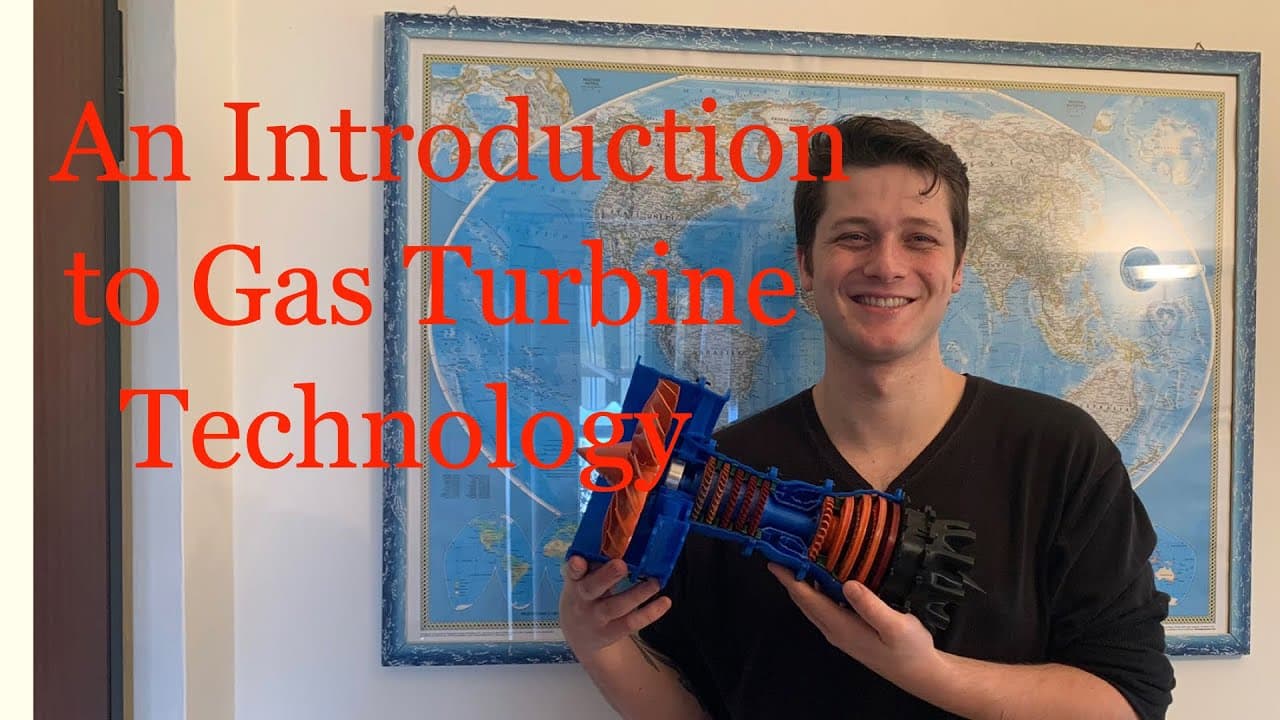
An Introduction to Gas Turbine Technology
TL;DR
Gas turbines are versatile, efficient machines used in various industries, from aviation to power production, known for their simplicity and low maintenance.
Transcript
so hello step-by-step scientists my name is avery swarthout i am a mechanical engineer based in gas turbine development and today we're going to be talking about the gas turbine thermodynamic cycle and having an introduction to gas turbine technology so let's get started and we'll start with a quick introduction to gas turbines and why we use them ... Read More
Key Insights
- 🫢 Gas turbines convert chemical energy into kinetic energy through a continuously burning system, setting them apart from conventional engines.
- 🫢 Gas turbines have discrete components for intake, compression, combustion, and exhaust, leading to higher efficiency and scalability.
- 😘 Gas turbines find applications in aviation, power production, marine engines, remote locations, and military aircraft due to their efficiency, versatility, and low maintenance.
- 🫢 Turbofans and turbojets are common gas turbine configurations in aviation, providing thrust for commercial and military aircraft.
- 🫢 Gas turbines are crucial for power production in remote sites, such as oil rigs and scientific research centers, due to their reliability and independence from the grid.
- 😘 The unique characteristics of gas turbines, including versatility in fuel usage and low emissions, make them attractive for various industries.
- 🫢 Gas turbines have diverse industrial applications, ranging from marine engines to power production for the grid, showcasing their flexibility and efficiency.
Install to Summarize YouTube Videos and Get Transcripts
Explore YouTube Video Summarizer or Get YouTube Transcript Extractor
Questions & Answers
Q: How do gas turbines differ from conventional engines?
Gas turbines have discrete components handling intake, compression, combustion, and exhaust, unlike conventional engines with a piston doing all steps sequentially. This allows gas turbines to be more efficient and compact.
Q: What are the advantages of using gas turbines in aviation?
Gas turbines power various aviation applications, such as turbofans for commercial aircraft and turbojets for military planes. Their efficiency, simplicity, and reliability make them ideal for aviation propulsion.
Q: Why are gas turbines favored for power production in remote locations?
Gas turbines, especially micro turbines, are popular for remote power production due to their reliability, low maintenance, and ability to operate independently from the grid, making them ideal for oil rigs, research centers, and other remote sites.
Q: How are gas turbines utilized in the marine industry?
Gas turbines are used in marine engines for efficient and powerful propulsion. Their ability to maintain high efficiency at constant speeds makes them ideal for cruising across the ocean in various marine vessels.
Summary & Key Takeaways
-
Gas turbines convert chemical energy into kinetic energy through a continuously burning system.
-
Unlike conventional engines, gas turbines have discrete components handling different parts of the thermodynamic cycle.
-
Gas turbines are scalable, efficient, low maintenance, and have a wide range of applications in aviation, power production, and more.
Read in Other Languages (beta)
Share This Summary 📚
Summarize YouTube Videos and Get Video Transcripts with 1-Click
Try YouTube Summary with ChatGPT & Claude or YouTube Transcript Generator
Explore More Summaries from Step by Step Science 📚
Summarize YouTube Videos and Get Video Transcripts with 1-Click
Try YouTube Summary with ChatGPT & Claude or YouTube Transcript Generator