What Is Mutual Information and How Is It Calculated?
TL;DR
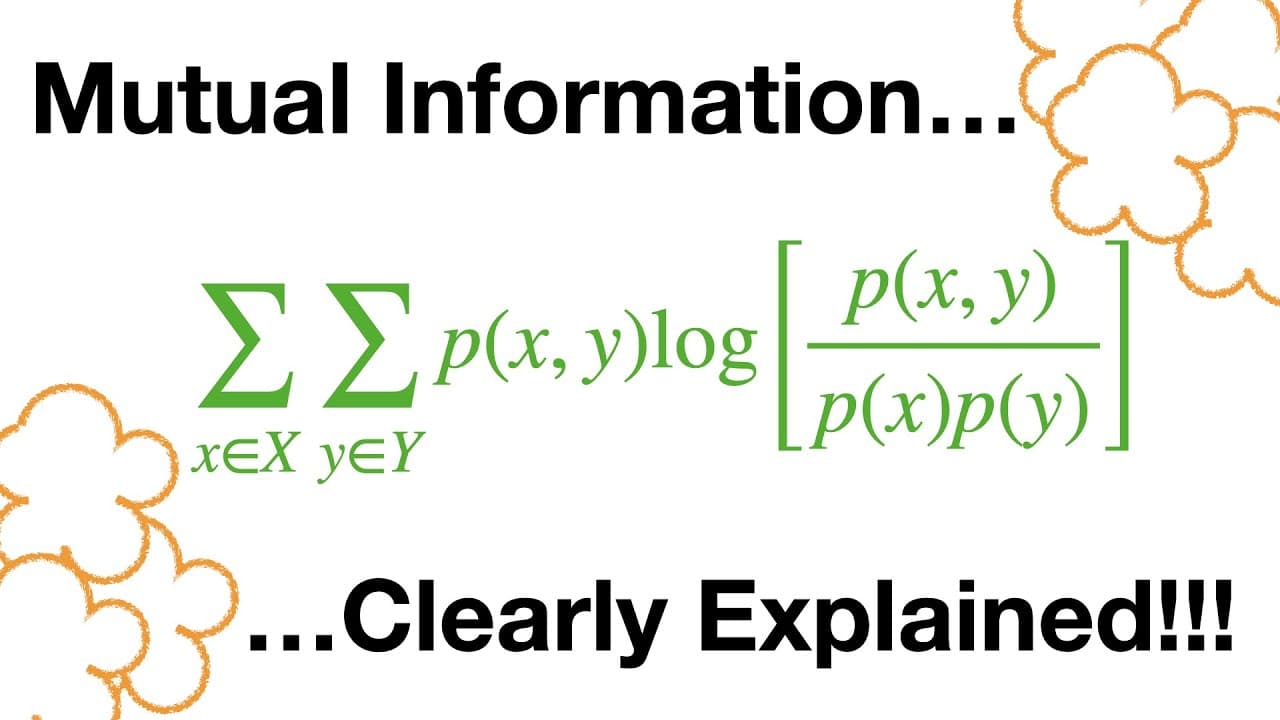
Mutual information quantifies the degree of association between two variables by measuring the information gained about one variable through the other. It involves calculating joint and marginal probabilities, and is applicable to both discrete and continuous variables. A mutual information value of zero indicates no relationship between the variables.
Transcript
Mutual in formation it's really cool gonna check it out now stat Quest hello I'm Josh charmer and welcome to stat Quest today we're going to talk about Mutual information and it's going to be clearly explained I don't want to spend a lot of time scaling up my stuff to work in the cloud I would rather spend my time working all my stuff cause that's ... Read More
Key Insights
- 💁 Mutual information quantifies the relationship between variables.
- ❓ It considers joint and marginal probabilities to calculate the degree of association.
- 💁 Mutual information is zero when one variable does not change, indicating no relationship.
- 💁 For continuous variables, histograms are used to calculate mutual information.
- 😀 MI can help in feature selection by identifying variables with the most information.
- 😀 The equation for MI resembles that of entropy, showcasing their connection.
- 😮 Changes in variables with higher surprise result in greater mutual information.
Install to Summarize YouTube Videos and Get Transcripts
Explore YouTube Video Summarizer or Get YouTube Transcript Extractor
Questions & Answers
Q: What is mutual information, and how is it calculated?
Mutual information quantifies the relationship between variables by considering joint and marginal probabilities. It helps in understanding how variables are related to each other and a specific outcome.
Q: How does mutual information differ from R squared?
Mutual information is used when dealing with discrete data, unlike R squared, which works with continuous data. MI focuses on the relationship between variables irrespective of their type.
Q: What happens to mutual information when one variable does not change?
If one variable never changes, its mutual information with another variable becomes zero. This implies that when there is no variability, there is no information transfer.
Q: How is mutual information calculated for continuous variables?
For continuous variables, a histogram is created to convert them into discrete categories. Joint and marginal probabilities are calculated based on these categories to determine mutual information.
Summary & Key Takeaways
-
Mutual information measures the relationship between variables in a data set.
-
It helps in determining how closely related variables are to a specific outcome.
-
By calculating joint and marginal probabilities, we can quantify mutual information for discrete and continuous variables.
Read in Other Languages (beta)
Share This Summary 📚
Summarize YouTube Videos and Get Video Transcripts with 1-Click
Try YouTube Summary with ChatGPT & Claude or YouTube Transcript Generator
Explore More Summaries from StatQuest with Josh Starmer 📚

Summarize YouTube Videos and Get Video Transcripts with 1-Click
Try YouTube Summary with ChatGPT & Claude or YouTube Transcript Generator