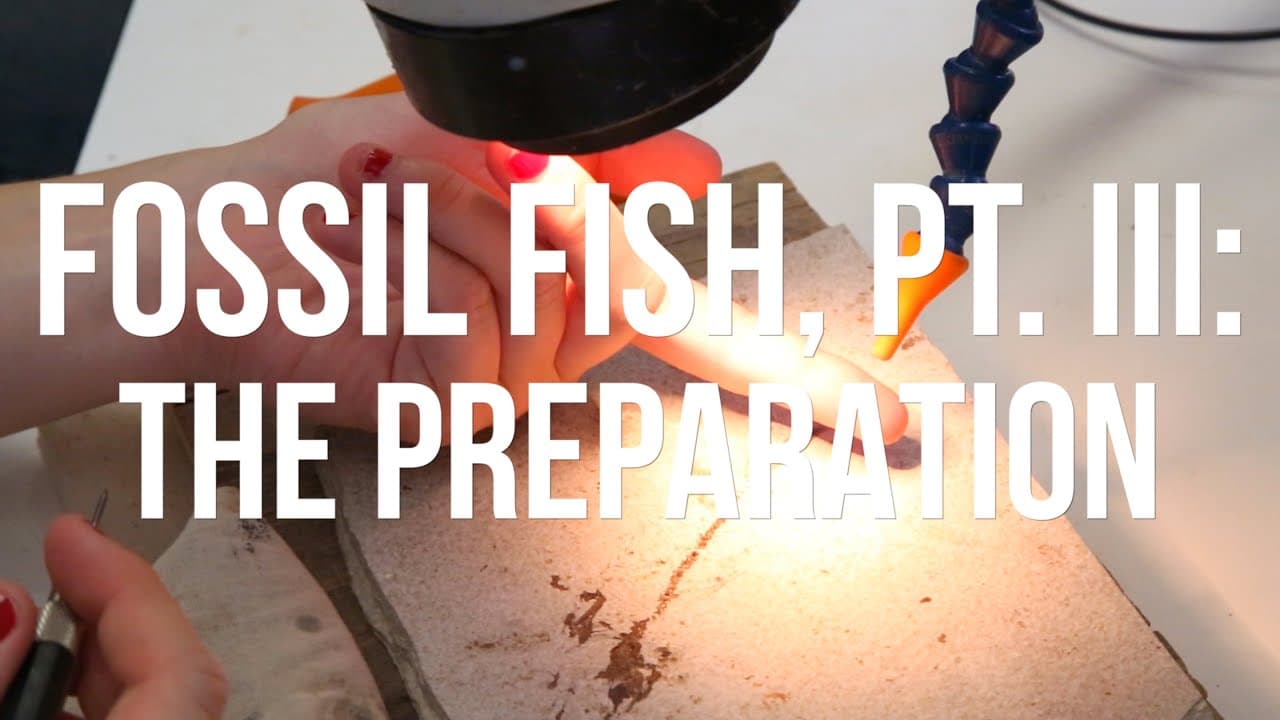
Fossil Fish, PT. III: The Preparation
TL;DR
Learn about the tools and techniques used in fossil preparation, including manual scraping, air scribing, and air abrasive machines.
Transcript
Hey, we're here back at The Field Museum with Akiko, who is the Fossil Preparator. - Yep!
- And we are going to be working on some of the fish that we excavated from Wyoming. What's next? So what kind of tools and things are necessary to prepare a fossil? - Well, you're holding the basic tool, it's called a pin vice. It's a pin vice holder with a ... Read More
Key Insights
- 😴 Fossil preparation involves the manual removal of matrix using tools like pin vices and high-powered microscopes.
- 💨 Despite advancements, such as improved microscopes, the basic process of scraping away matrix has remained largely unchanged.
- 👱 Air scribes are mechanized tools that use compressed air to vibrate a needle, providing more efficiency in fossil preparation.
- 👱 Air abrasive machines use fine powder and compressed air to blast matrix away from fossils, offering another method of preparation.
- ✋ Each technique has its advantages and disadvantages, with manual scraping requiring more time and precision, while mechanized tools increase efficiency but carry a higher risk of damaging the specimen.
- 🛩️ Fossil preparation requires patience and attention to detail, as it can be a time-consuming process even for small areas.
- 🤪 The appreciation for the work that goes into preparing fossils grows when seeing the labor-intensive nature of the process.
Install to Summarize YouTube Videos and Get Transcripts
Explore YouTube Video Summarizer or Get YouTube Transcript Extractor
Questions & Answers
Q: How have fossil preparation techniques changed over the years?
While technology has improved with better microscopes, the fundamental process of manually scraping away matrix from fossils has remained similar. There have been advancements, like the introduction of air scribing, which is more efficient but carries a higher risk of damaging the specimen.
Q: What are the tools used in fossil preparation?
Tools used in fossil preparation include pin vices for manually scraping, high-powered microscopes for better visibility, and air scribes for mechanized scraping. An air abrasive machine is also used, which blasts fine powder onto the fossil to remove matrix.
Q: What is the purpose of an air abrasive machine in fossil preparation?
An air abrasive machine is used to remove matrix from fossils by blasting fine powder onto the surface with compressed air. This method, similar to sandblasting, allows for more efficient removal of matrix and uncovering of fossils.
Q: How long does it take to prepare a fossil using different techniques?
The time it takes to prepare a fossil depends on the size and complexity of the specimen, as well as the technique used. Manual scraping can be time-consuming, while air scribing and air abrasive machines offer more efficiency. However, caution must be exercised to avoid damaging the specimen.
Summary & Key Takeaways
-
The fossil preparation process involves using tools like pin vices and high-powered microscopes to scrape away matrix from fossils.
-
Despite advancements in technology, such as improved microscopes, the basic process of manually removing matrix from fossils has remained largely unchanged.
-
Air scribing is a mechanized method that uses compressed air to vibrate a needle, making the process more efficient but also more risky for damaging the specimen.
Read in Other Languages (beta)
Share This Summary 📚
Summarize YouTube Videos and Get Video Transcripts with 1-Click
Try YouTube Summary with ChatGPT & Claude or YouTube Transcript Generator
Explore More Summaries from thebrainscoop 📚



Summarize YouTube Videos and Get Video Transcripts with 1-Click
Try YouTube Summary with ChatGPT & Claude or YouTube Transcript Generator