Why Magnetic Monopoles SHOULD Exist
TL;DR
Magnetic monopoles might exist, but remain undetected.
Transcript
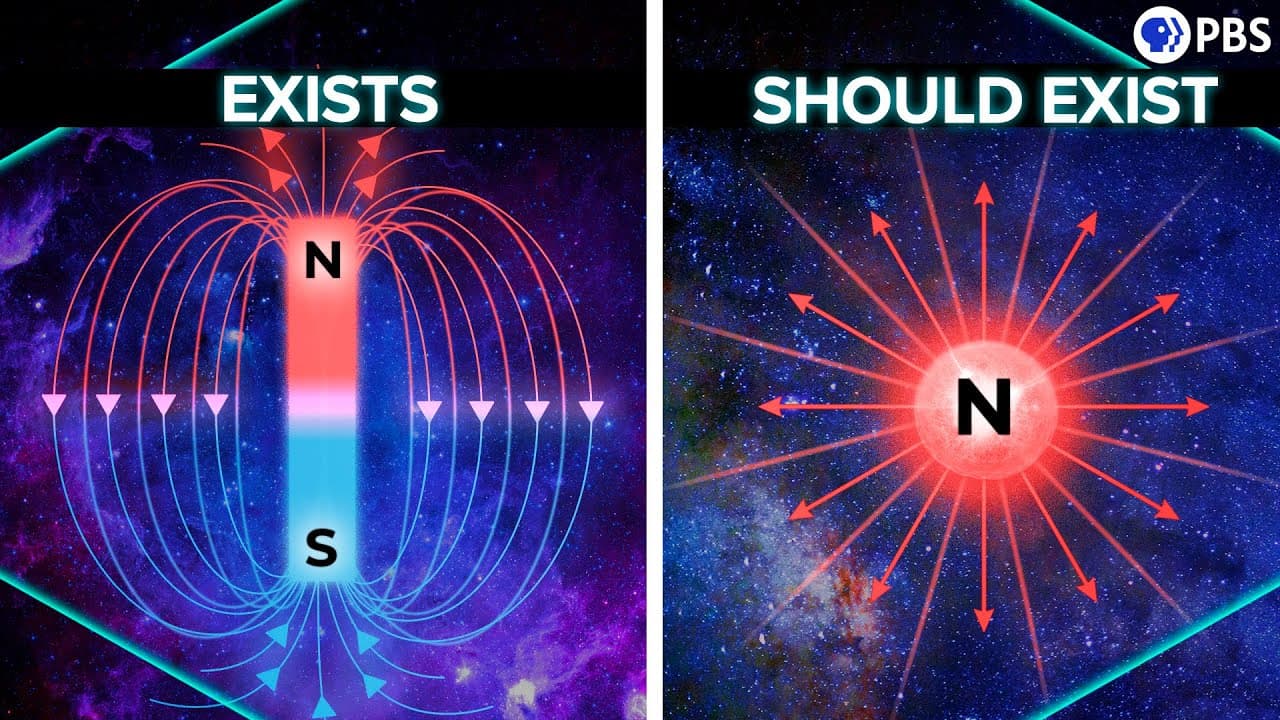
Physicists have been hunting for one particle longer than perhaps any other. It’s not the tachyon or some supersymmetric particle. It’s the magnetic monopole - and of all the fantastical beasts of particle physics, this is perhaps the most likely to actually exist. So where are they all? Let’s try an experiment. Take a metal bar and force all the e... Read More
Key Insights
- Magnetic monopoles have been a subject of interest in physics, with their existence still unconfirmed despite various theories suggesting their possibility.
- Classical electromagnetism, as described by Maxwell's equations, does not predict the existence of magnetic monopoles, but quantum mechanics and grand unified theories allow for their possibility.
- Magnetic monopoles, if they exist, could explain why electric charge is quantized, as proposed by Paul Dirac in 1931.
- In grand unified theories, magnetic monopoles are predicted to be very massive and were likely formed in the early universe, but their abundance is reduced by cosmic inflation.
- Experiments and observations, including those at the Large Hadron Collider, have yet to provide conclusive evidence of magnetic monopoles.
- Theoretical constructs like the Dirac string suggest that monopoles could exist without being detected if certain conditions are met.
- Magnetic monopoles could provide insights into the unification of fundamental forces and the symmetry of space-time.
- Despite the lack of evidence, the search for magnetic monopoles continues due to their potential to unlock new physics beyond the standard model.
Install to Summarize YouTube Videos and Get Transcripts
Explore YouTube Video Summarizer or Get YouTube Transcript Extractor
Questions & Answers
Q: What are magnetic monopoles, and why are they significant?
Magnetic monopoles are hypothetical particles that have a single magnetic pole, either north or south, unlike a dipole magnet which has both. They are significant because their existence could explain why electric charge is quantized and provide insights into the unification of fundamental forces, potentially leading to new physics beyond the standard model.
Q: How do Maxwell's equations relate to magnetic monopoles?
Maxwell's equations, which describe classical electromagnetism, do not predict the existence of magnetic monopoles. Specifically, Gauss's law for magnetism states that the divergence of a magnetic field is zero, implying no isolated magnetic charges. However, theoretical modifications to these equations could allow for monopoles, suggesting they might exist under certain conditions.
Q: What role does quantum mechanics play in the theory of magnetic monopoles?
Quantum mechanics provides a framework where magnetic monopoles could exist. Paul Dirac's theoretical work showed that if magnetic monopoles exist, they would require electric charge to be quantized. This quantization is a fundamental aspect of quantum mechanics and suggests that monopoles could be consistent with quantum theory, despite their absence in classical electromagnetism.
Q: What is the Dirac string, and how does it relate to magnetic monopoles?
The Dirac string is a theoretical construct that represents the invisible line of magnetic field connecting two magnetic monopoles. If this string is undetectable, it implies that monopoles could exist as independent entities. Dirac's theory suggests that the string's undetectability is linked to the quantization of electric charge, allowing for the theoretical possibility of monopoles.
Q: Why have magnetic monopoles not been detected despite extensive searches?
Magnetic monopoles have not been detected due to their predicted rarity and the high energy levels required to produce them, which are beyond the capabilities of current experiments like those at the Large Hadron Collider. Additionally, cosmic inflation may have dispersed monopoles formed in the early universe, making them difficult to observe within our observable universe.
Q: How do grand unified theories (GUTs) predict the existence of magnetic monopoles?
Grand unified theories, which aim to unify the fundamental forces, predict the existence of magnetic monopoles as a result of symmetry breaking. These theories suggest that monopoles were formed during the early universe's high-energy conditions and are massive particles that could provide insights into the unification of forces and the structure of the universe.
Q: What is cosmic inflation, and how does it affect the abundance of magnetic monopoles?
Cosmic inflation is a theory that proposes a rapid expansion of the universe shortly after the Big Bang. This expansion could have dispersed magnetic monopoles, reducing their abundance in the observable universe. As a result, even if monopoles were produced in large numbers initially, they may be too spread out to be easily detected now.
Q: What would be the implications of discovering magnetic monopoles?
Discovering magnetic monopoles would have profound implications for physics. It would confirm aspects of grand unified theories and provide evidence for the quantization of electric charge. It could also lead to new insights into the symmetry of space-time and the unification of fundamental forces, potentially opening up new avenues of research in theoretical and experimental physics.
Summary & Key Takeaways
-
Magnetic monopoles remain one of the most intriguing unsolved mysteries in physics. Despite being predicted by various theories, including grand unified theories, they have yet to be observed experimentally. Their existence could explain the quantization of electric charge and provide insights into the unification of fundamental forces.
-
The concept of magnetic monopoles challenges classical electromagnetism, which predicts only dipole magnetic fields. However, quantum mechanics and theoretical constructs like the Dirac string suggest that monopoles could exist under certain conditions, potentially offering new perspectives on the symmetry of space-time.
-
Efforts to detect magnetic monopoles have been ongoing for decades, with experiments at facilities like the Large Hadron Collider and cosmic ray observatories. Although no conclusive evidence has been found, the pursuit continues, driven by the potential breakthroughs that discovering monopoles could bring to our understanding of the universe.
Read in Other Languages (beta)
Share This Summary 📚
Summarize YouTube Videos and Get Video Transcripts with 1-Click
Try YouTube Summary with ChatGPT & Claude or YouTube Transcript Generator
Explore More Summaries from PBS Space Time 📚
Summarize YouTube Videos and Get Video Transcripts with 1-Click
Try YouTube Summary with ChatGPT & Claude or YouTube Transcript Generator