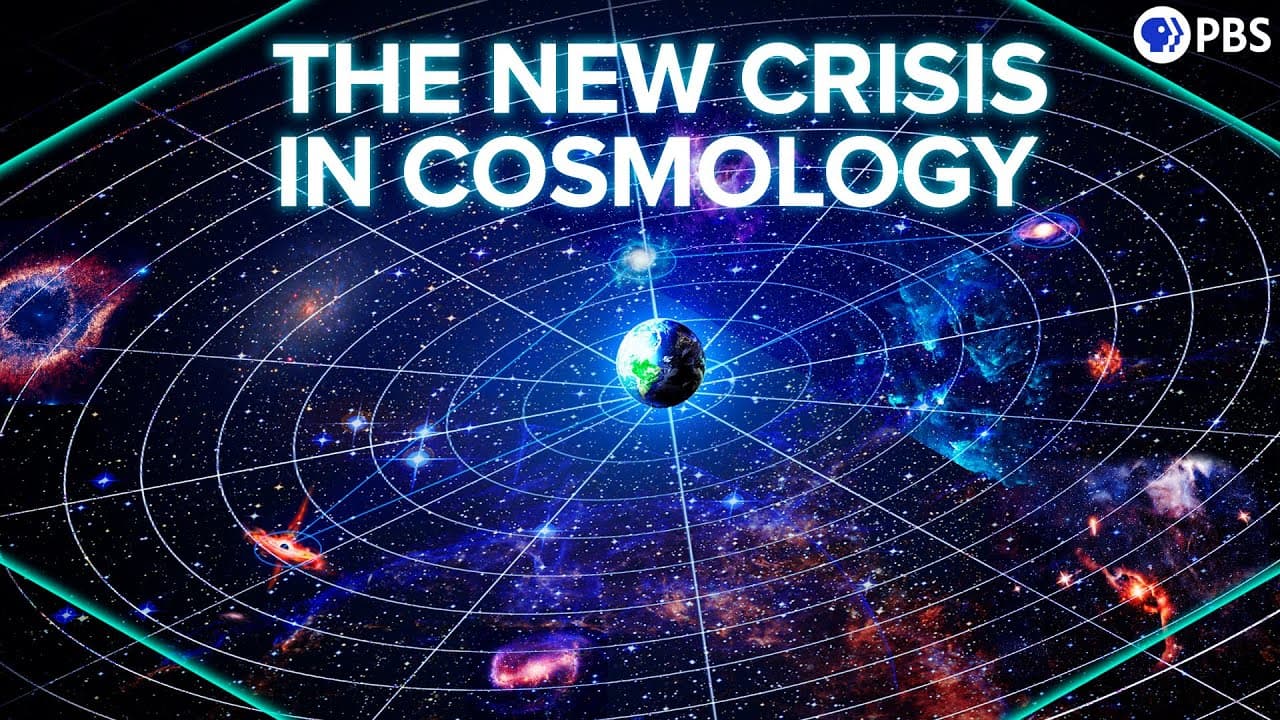
The NEW Crisis in Cosmology
TL;DR
Hubble tension highlights discrepancies in universe's expansion measurements.
Transcript
I have good news and bad news. Bad news first: two years ago we reported on the Crisis in Cosmology. Since then, it’s only gotten worse. And actually the good news is also that the crisis in cosmology has actually gotten worse, which means we may be onto something! The most exciting thing for any scientist is when something they thought they knew... Read More
Key Insights
- The Hubble tension refers to the discrepancy between two precise measurements of the universe's expansion rate, which should agree but do not.
- The crisis in cosmology has intensified, leading scientists to consider rethinking cosmological models and theories.
- Two primary methods of measuring the universe's expansion are the supernova method and the cosmic microwave background (CMB) method.
- The supernova method relies on the cosmic distance ladder, which has been refined by the Gaia mission's parallax measurements.
- The Planck satellite's CMB measurements provide a Hubble constant of 67.6 km/s/Mpc, while the supernova method suggests 73.2 km/s/Mpc.
- Potential explanations for the discrepancy include changes in the nature of dark energy over time.
- Alternative measurement methods, such as baryon acoustic oscillations and gravitational lensing, are being explored to resolve the tension.
- The ongoing investigation into the Hubble tension could lead to groundbreaking discoveries about the universe's expansion and dark energy.
Install to Summarize YouTube Videos and Get Transcripts
Explore YouTube Video Summarizer or Get YouTube Transcript Extractor
Questions & Answers
Q: What is the Hubble tension?
The Hubble tension refers to the discrepancy between two precise measurements of the universe's expansion rate. These measurements, which should theoretically agree, do not, leading to a crisis in cosmology. The tension challenges existing cosmological models and theories, prompting scientists to explore alternative explanations and measurement methods.
Q: What are the primary methods used to measure the universe's expansion?
The two primary methods for measuring the universe's expansion are the supernova method and the cosmic microwave background (CMB) method. The supernova method relies on the cosmic distance ladder, which involves measuring distances to various astronomical objects. The CMB method uses measurements from the Planck satellite to determine the expansion rate based on the oldest light in the universe.
Q: How has the Gaia mission contributed to the measurement of the universe's expansion?
The Gaia mission has significantly contributed to the measurement of the universe's expansion by refining the cosmic distance ladder. It has provided highly accurate parallax measurements for many stars, allowing for a more precise calibration of standard candles like Cepheid variables. This, in turn, has improved the accuracy of the supernova method for determining the Hubble constant.
Q: What are some potential explanations for the discrepancy in expansion rate measurements?
One potential explanation for the discrepancy in expansion rate measurements is that the nature of dark energy may have changed over time. The Planck team's measurements assume a constant density for dark energy, but if it has varied, this could account for the differing results. Other possibilities include unknown errors in the measurement methods or a fundamental misunderstanding of cosmological principles.
Q: What are some alternative methods being explored to resolve the Hubble tension?
Alternative methods being explored to resolve the Hubble tension include baryon acoustic oscillations, gravitational lensing, and gravitational wave measurements. Baryon acoustic oscillations involve analyzing the distribution of galaxies, while gravitational lensing uses the bending of light around massive objects. Gravitational wave measurements, known as 'standard sirens,' can also provide insights into the universe's expansion rate.
Q: How might gravitational lensing contribute to resolving the Hubble tension?
Gravitational lensing could contribute to resolving the Hubble tension by providing an independent measurement of cosmic distances. This method involves analyzing the time delay in light paths from distant quasars lensed by nearby galaxies. By measuring these time delays, scientists can calculate the universe's expansion rate without relying on the cosmic distance ladder, potentially offering a different perspective on the Hubble constant.
Q: Why is it important to resolve the Hubble tension?
Resolving the Hubble tension is crucial because it could lead to a deeper understanding of the universe's expansion and the nature of dark energy. The tension highlights potential flaws in current cosmological models, and addressing it may uncover new physics or refine existing theories. This could have profound implications for our comprehension of the universe's past, present, and future.
Q: What role does dark energy play in the universe's expansion?
Dark energy is believed to be a mysterious and ubiquitous force driving the accelerated expansion of the universe. Its discovery was based on observations of distant supernovae, which revealed that the universe's expansion is not only continuing but increasing in speed. Understanding dark energy is crucial for cosmology, as it may hold key insights into the fundamental nature of reality and the ultimate fate of the universe.
Summary & Key Takeaways
-
The Hubble tension highlights a significant discrepancy in the measurements of the universe's expansion rate, challenging existing cosmological models and theories. The crisis has intensified, prompting scientists to explore alternative explanations and measurement methods.
-
Two primary methods, the supernova method and the cosmic microwave background (CMB) method, offer differing results for the Hubble constant. These methods rely on the cosmic distance ladder, which has been refined by the Gaia mission's parallax measurements.
-
Alternative measurement methods, such as baryon acoustic oscillations and gravitational lensing, are being explored to resolve the Hubble tension. This ongoing investigation could lead to groundbreaking discoveries about the universe's expansion and the nature of dark energy.
Read in Other Languages (beta)
Share This Summary 📚
Summarize YouTube Videos and Get Video Transcripts with 1-Click
Try YouTube Summary with ChatGPT & Claude or YouTube Transcript Generator
Explore More Summaries from PBS Space Time 📚
Summarize YouTube Videos and Get Video Transcripts with 1-Click
Try YouTube Summary with ChatGPT & Claude or YouTube Transcript Generator