How to Find the Domain of a Function with Radicals
TL;DR
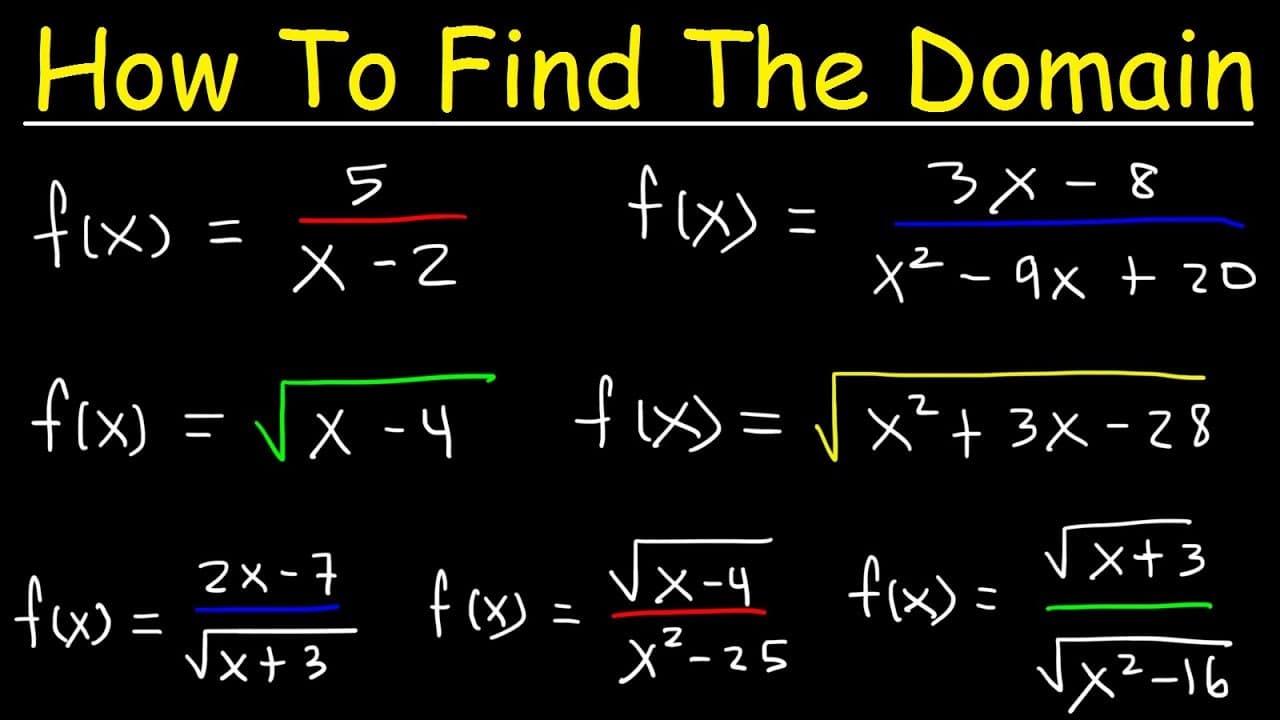
To find the domain of a function, determine the set of allowable x values. For linear, polynomial, and rational functions, the domain is all real numbers unless restricted by factors like zero denominators. For square root functions, ensure the expression inside the root is greater than or equal to zero.
Transcript
so how do you find the domain of a function so consider the function 2x minus 7 what is the domain of this function what is the list of all possible x values that can exist in this function whenever you have a linear function like the one that's listed the domain is all real numbers so in interval notation x can be anything it could range from any ... Read More
Key Insights
- 🫚 Linear, polynomial, and rational functions have a domain of all real numbers, as long as there are no fractions or square roots involved.
- 🤝 When dealing with rational functions, the denominator should not equal zero to find the domain.
- 🫚 For square root functions, the inside must be greater than or equal to zero to ensure a real-valued function.
Install to Summarize YouTube Videos and Get Transcripts
Explore YouTube Video Summarizer or Get YouTube Transcript Extractor
Questions & Answers
Q: How do you find the domain of a linear function?
The domain of a linear function is all real numbers. There are no restrictions on the possible x values.
Q: What is the domain of a quadratic function?
The domain of a quadratic function is also all real numbers, as long as there are no fractions or square roots involved.
Q: How do you find the domain of a rational function?
To find the domain of a rational function, set the denominator not equal to zero and solve for x. The values of x that make the denominator zero are excluded from the domain.
Q: What is the domain of a square root function?
For a square root function, the inside of the square root must be greater than or equal to zero. Any negative values of x would result in an undefined function.
Key Insights:
- Linear, polynomial, and rational functions have a domain of all real numbers, as long as there are no fractions or square roots involved.
- When dealing with rational functions, the denominator should not equal zero to find the domain.
- For square root functions, the inside must be greater than or equal to zero to ensure a real-valued function.
- Complex functions involving both square roots and rational expressions may require separate number lines to find the intersection of the valid domains.
Summary & Key Takeaways
-
Linear, polynomial, and rational functions have a domain of all real numbers.
-
To find the domain of a rational function, set the denominator not equal to zero and solve for x.
-
The domain of a square root function is determined by making sure the inside of the square root is greater than or equal to zero.
-
When there are fractions or square roots in the function, certain values of x may be excluded from the domain.
Read in Other Languages (beta)
Share This Summary 📚
Summarize YouTube Videos and Get Video Transcripts with 1-Click
Try YouTube Summary with ChatGPT & Claude or YouTube Transcript Generator
Explore More Summaries from The Organic Chemistry Tutor 📚
Summarize YouTube Videos and Get Video Transcripts with 1-Click
Try YouTube Summary with ChatGPT & Claude or YouTube Transcript Generator