How to Prove a Quadrilateral Is a Kite
TL;DR
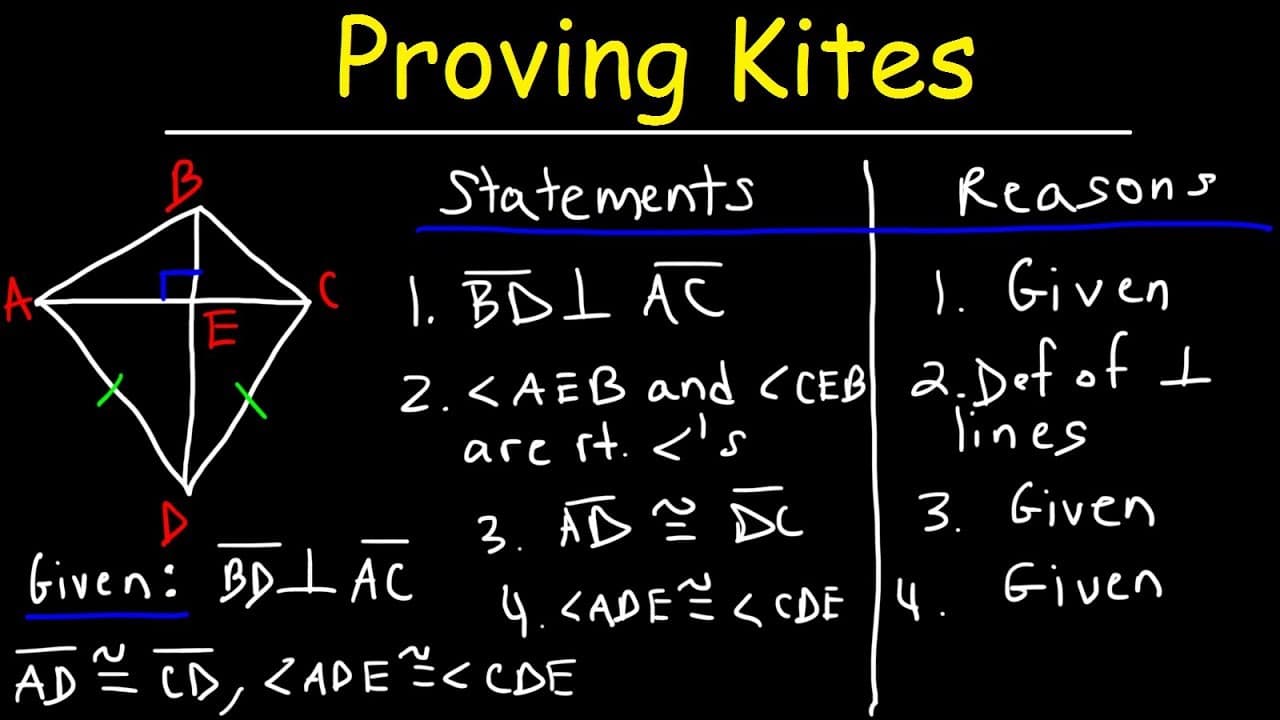
To prove a quadrilateral is a kite, demonstrate that one diagonal is the perpendicular bisector of the other and that the two pairs of adjacent sides are congruent. Use triangle congruence theorems, like the side-angle-side postulate, to establish congruence between triangles formed within the quadrilateral to support your proof.
Transcript
in this video we're going to talk about how to prove if a quadrilateral is indeed a kite so let's call this side a b c and d so one way to prove if we have a kite is to show that bd is the perpendicular bisector of ac so in this example problem we're going to be given the following information so we're given that bd is perpendicular to ac and also ... Read More
Key Insights
- 🫤 Showcasing that the perpendicular bisector of one diagonal is also the perpendicular bisector of the other diagonal is essential in proving a quadrilateral is a kite.
- 🔺 Proving congruence between triangles is a significant step in demonstrating the congruence of sides and angles in the quadrilateral.
- 🔺 Using postulates, such as the side-angle-side postulate, helps in establishing the congruence of triangles within the quadrilateral.
- 👍 The reflexive property is useful when proving congruence between segments or angles.
- 🙃 The CPCTC (Corresponding Parts of Congruent Triangles are Congruent) is a crucial principle in showing congruence between sides of congruent triangles.
Install to Summarize YouTube Videos and Get Transcripts
Explore YouTube Video Summarizer or Get YouTube Transcript Extractor
Questions & Answers
Q: How can you determine if a quadrilateral is a kite?
To prove a quadrilateral is a kite, you need to show that the perpendicular bisector of one of its diagonals is also the perpendicular bisector of the other diagonal. Additionally, you must establish congruence between the sides and angles of the quadrilateral.
Q: What are the properties of a perpendicular bisector?
A perpendicular bisector forms right angles with the line it bisects. In the context of proving a kite, it should create right angles with both diagonals and divide the quadrilateral into two congruent parts.
Q: How can congruence between triangles help prove that a quadrilateral is a kite?
By establishing congruence between triangles, we can show that the corresponding sides and angles of the quadrilateral are congruent. This is crucial in proving that the quadrilateral is a kite.
Q: What postulates do we use when proving a quadrilateral is a kite?
The postulates commonly used in proving a quadrilateral is a kite are the definition of perpendicular bisectors and the side-angle-side postulate. These postulates help establish congruence between parts of the quadrilateral.
Summary & Key Takeaways
-
The video provides a step-by-step process for proving if a given quadrilateral is a kite.
-
It highlights the importance of showing that the given perpendicular bisector is also the perpendicular bisector of the diagonal of the quadrilateral.
-
The video includes examples and explains the use of postulates and properties to establish congruence between triangles.
Read in Other Languages (beta)
Share This Summary 📚
Summarize YouTube Videos and Get Video Transcripts with 1-Click
Try YouTube Summary with ChatGPT & Claude or YouTube Transcript Generator
Explore More Summaries from The Organic Chemistry Tutor 📚




Summarize YouTube Videos and Get Video Transcripts with 1-Click
Try YouTube Summary with ChatGPT & Claude or YouTube Transcript Generator