Newton’s Universal Gravitation vs Coulomb’s Law
TL;DR
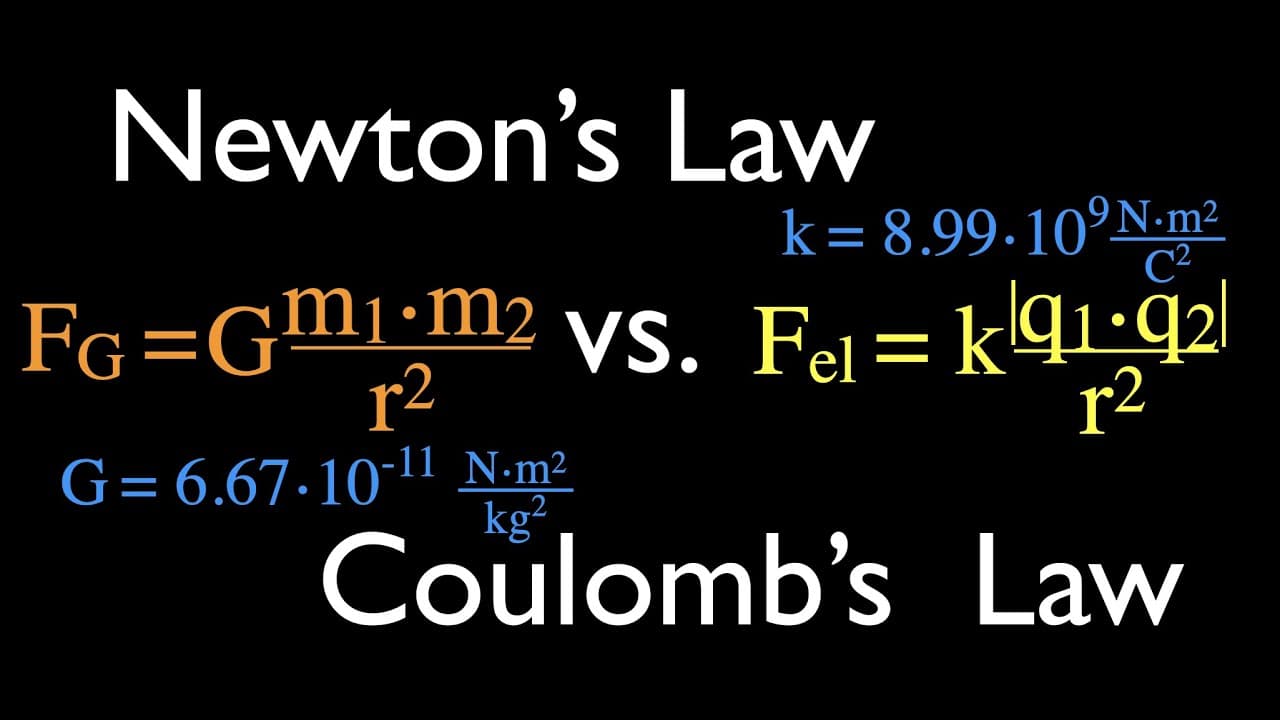
Exploring the striking similarities between Newton's law of universal gravitation and Coulomb's law, highlighting their commonalities and differences.
Transcript
in today's video i am going to go over the differences and actually what i really want to do is try to emphasize the similarities between newton's law of universal gravitation and coulomb's law now before we get started please don't forget to subscribe to our channel step by step science get all of our excellent physics chemistry and math videos pl... Read More
Key Insights
- 👮 Newton's law of universal gravitation and Coulomb's law share structural similarities in their equations, despite relating to different interactions.
- 👮 Both laws follow an inverse square law, demonstrating consistent behavior based on the distance between masses or charges.
- 👮 The forces calculated by these laws exhibit equal magnitudes but opposite directions, reflecting the balance of attraction and repulsion in their interactions.
- 👻 While gravitational forces are always attractive, Coulomb's law allows for both attraction and repulsion based on charge types.
- 🛩️ The gravitational constant is notably smaller than Coulomb's constant, highlighting the contrasting strengths of gravitational and electrical forces.
- 👮 Practical examples involving Newton's law and Coulomb's law showcase how these principles are applied to calculate forces between masses and charges.
Install to Summarize YouTube Videos and Get Transcripts
Explore YouTube Video Summarizer or Get YouTube Transcript Extractor
Questions & Answers
Q: What is the fundamental principle behind Newton's law of universal gravitation?
Newton's law states that every mass exerts an attractive force on every other mass, directly proportional to the product of their masses and inversely proportional to the square of the distance between them.
Q: How does Coulomb's law differ from Newton's law in terms of the forces involved?
While Newton's law involves only attractive forces between masses, Coulomb's law accounts for both attractive and repulsive forces based on the charges of particles involved.
Q: What are the key similarities between the equations for Newton's law of universal gravitation and Coulomb's law?
Both equations involve a constant, the product of masses or charges, and are inversely proportional to the square of the distance between the objects, showcasing remarkable parallels in their formulation.
Q: How do the gravitational constant and Coulomb's constant impact the respective forces calculated in the laws?
The gravitational constant is relatively small, leading to weaker gravitational forces compared to the significantly larger Coulomb's constant, resulting in much stronger electrical forces between charges.
Summary & Key Takeaways
-
Newton's law of universal gravitation states that every mass attracts every other mass, while Coulomb's law relates to the interaction between electric charges.
-
Both laws are conservative and follow an inverse square law, being proportional to the product of masses or charges.
-
Despite differences in attraction and repulsion, the equations for both laws share striking similarities in their structure and calculation methods.
Read in Other Languages (beta)
Share This Summary 📚
Summarize YouTube Videos and Get Video Transcripts with 1-Click
Try YouTube Summary with ChatGPT & Claude or YouTube Transcript Generator
Explore More Summaries from Step by Step Science 📚
Summarize YouTube Videos and Get Video Transcripts with 1-Click
Try YouTube Summary with ChatGPT & Claude or YouTube Transcript Generator