In Da Club - Membranes & Transport: Crash Course Biology #5
TL;DR
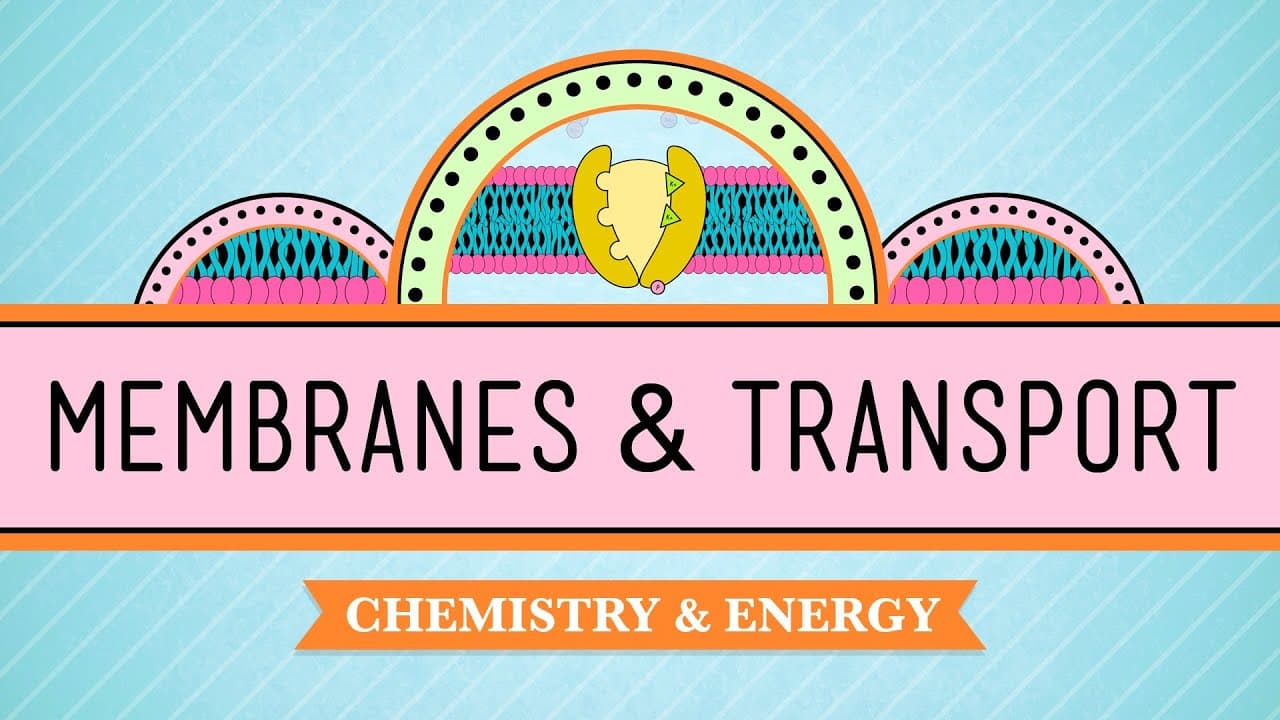
Cells regulate content and communication via membrane transport mechanisms.
Transcript
Oh, hey! I didn't see you up there. How long have you been waiting in this line? I've been here for like 15 minutes and it's freaking freezing out here! I mean, whose banana do you gotta peel in order to get into this club? Well, while we're here I guess this might not be a bad time to continue our discussion about cells—because cells, like nightcl... Read More
Key Insights
- Cell membranes are selectively permeable, allowing only certain substances to pass through, similar to a nightclub's selective entry policy.
- Passive transport, such as diffusion and osmosis, does not require energy and allows essential molecules like water and oxygen to enter cells easily.
- Active transport requires energy, typically in the form of ATP, to move substances against their concentration gradients.
- Channel proteins facilitate the movement of water and ions across cell membranes without using energy, with aquaporins being specific for water.
- The sodium-potassium pump, discovered by Jens Christian Skou, is vital for nerve and muscle cells, working against concentration and electrochemical gradients.
- Vesicular transport, including exocytosis and endocytosis, involves vesicles moving materials in and out of cells, requiring energy.
- Phagocytosis and pinocytosis are forms of endocytosis, with the former engulfing whole particles and the latter absorbing dissolved substances.
- Receptor-mediated endocytosis allows cells to absorb specific molecules like cholesterol, highlighting the importance of specialized receptor proteins.
Install to Summarize YouTube Videos and Get Transcripts
Explore YouTube Video Summarizer or Get YouTube Transcript Extractor
Questions & Answers
Q: What is passive transport and why is it important for cells?
Passive transport is the movement of substances across cell membranes without the use of energy. It is crucial for cells because it allows essential molecules like oxygen and water to enter cells easily through processes such as diffusion and osmosis, maintaining cellular function and homeostasis.
Q: How does active transport differ from passive transport?
Active transport differs from passive transport as it requires energy, usually in the form of ATP, to move substances against their concentration gradients. This process is essential for cells to transport molecules like ions and nutrients to areas of higher concentration, enabling vital cellular functions.
Q: What role do channel proteins play in cell membranes?
Channel proteins facilitate the movement of water and ions across cell membranes without energy expenditure. They create hydrophilic channels that allow these molecules to pass through the otherwise hydrophobic lipid bilayer, essential for processes like osmosis and maintaining ion balance within cells.
Q: Who discovered the sodium-potassium pump and why is it significant?
The sodium-potassium pump was discovered by Danish medical doctor Jens Christian Skou. It is significant because it maintains the electrochemical gradient across cell membranes, particularly in nerve and muscle cells, by pumping sodium out and potassium in, essential for nerve impulses and muscle contractions.
Q: What is vesicular transport and how does it function?
Vesicular transport involves the movement of materials in and out of cells using vesicles, which are small sacs made of phospholipids. This form of active transport requires energy and includes processes like exocytosis, where substances are expelled, and endocytosis, where substances are engulfed into the cell.
Q: Explain the process of phagocytosis in cells.
Phagocytosis is a form of endocytosis where cells engulf large particles or pathogens. The cell membrane extends around the target particle, forming a vesicle that encloses it. This process is crucial for immune cells, like white blood cells, to ingest and destroy harmful bacteria and debris in the body.
Q: How does receptor-mediated endocytosis work?
Receptor-mediated endocytosis involves specialized receptor proteins on the cell membrane that bind to specific molecules. When these receptors attach to their target molecules, they trigger the formation of a vesicle that brings the molecules into the cell. This process is vital for absorbing substances like cholesterol efficiently.
Q: Why is ATP important in cellular transport processes?
ATP, or adenosine triphosphate, is crucial in cellular transport as it provides the energy needed for active transport processes. By breaking a phosphate bond, ATP releases energy that powers transport proteins, like the sodium-potassium pump, enabling cells to move substances against their concentration gradients.
Summary & Key Takeaways
-
The video explains how cell membranes are selectively permeable, allowing only certain substances to pass through, similar to a nightclub's selective entry policy. Passive transport, such as diffusion and osmosis, does not require energy, while active transport requires ATP to move substances against concentration gradients.
-
Channel proteins, like aquaporins, facilitate the movement of water and ions across membranes without energy. The sodium-potassium pump, discovered by Jens Christian Skou, is crucial for nerve and muscle cells, working against concentration and electrochemical gradients to maintain cellular function.
-
Vesicular transport involves moving materials via vesicles, with exocytosis and endocytosis requiring energy. Phagocytosis engulfs whole particles, while pinocytosis absorbs dissolved substances. Receptor-mediated endocytosis uses specialized proteins to absorb specific molecules, underscoring the complexity of cellular transport mechanisms.
Read in Other Languages (beta)
Share This Summary 📚
Summarize YouTube Videos and Get Video Transcripts with 1-Click
Try YouTube Summary with ChatGPT & Claude or YouTube Transcript Generator
Explore More Summaries from CrashCourse 📚


Summarize YouTube Videos and Get Video Transcripts with 1-Click
Try YouTube Summary with ChatGPT & Claude or YouTube Transcript Generator