Discovery of the Nucleus: Rutherford's Gold Foil Experiment
TL;DR
Scientists, led by Ernest Rutherford, disproved the plum pudding model of the atom through the gold foil experiment, revealing the existence of a nucleus in atoms.
Transcript
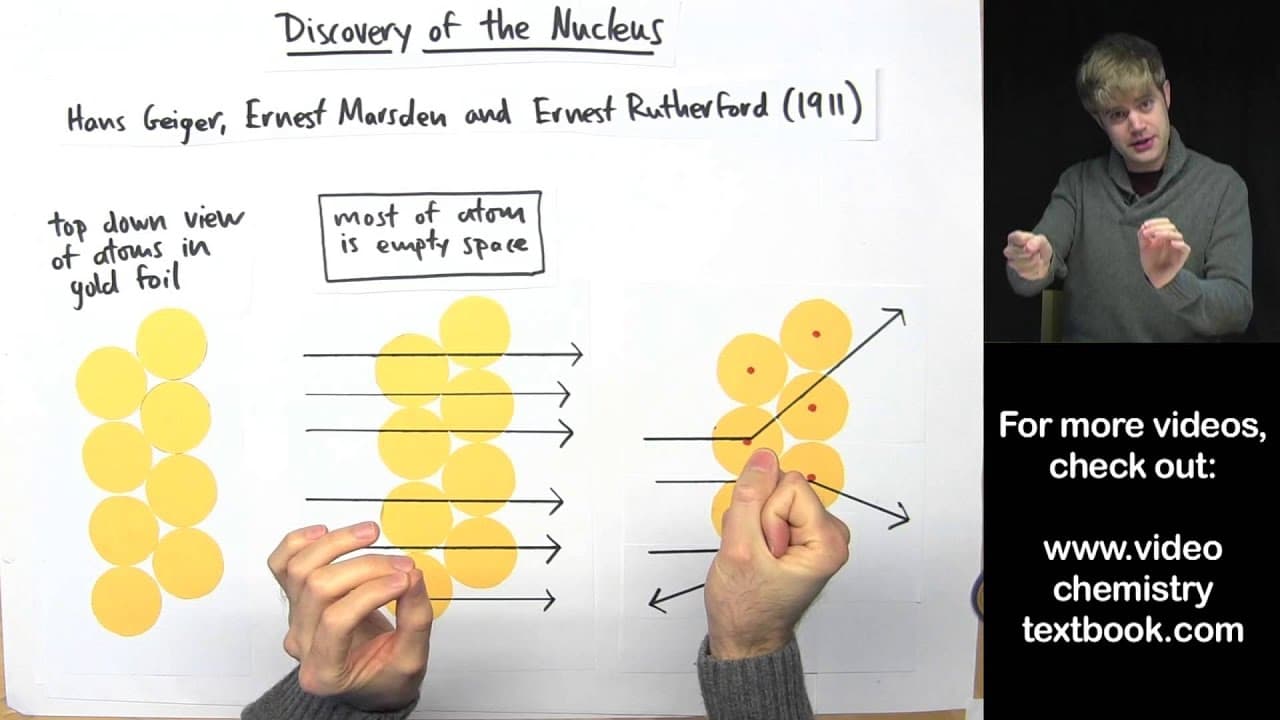
in this video we're going to look at how scientists discover that atoms have a nucleus in them this discovery was made by Ernest Rutherford as well as his colleagues in 1911 and they made this discovery with their famous gold foil experiment and we're going to talk about that here so atoms this is sort of how we think about atoms today with electro... Read More
Key Insights
- 🧑🔬 Before the gold foil experiment, scientists believed in the plum pudding model, where electrons were randomly scattered in a positive dough.
- 🫀 Rutherford and his colleagues showed that atoms have a concentrated, positively charged nucleus.
- 👾 The gold foil experiment demonstrated that most of the atom is empty space, with electrons revolving around the nucleus.
- 🫀 The discovery of the atom's nucleus led to the development of the nuclear model of the atom.
- 💨 Rutherford's experiment paved the way for further discoveries about the structure and behavior of subatomic particles.
- 🫀 The gold foil experiment disproved Dalton's model of the atom, which proposed atoms as hard, indestructible balls.
- ❓ The presence of neutrons in the nucleus was discovered in the 1930s.
Install to Summarize YouTube Videos and Get Transcripts
Explore YouTube Video Summarizer or Get YouTube Transcript Extractor
Questions & Answers
Q: What was the plum pudding model of the atom?
The plum pudding model suggested that the atom is like a blueberry muffin, with positively charged dough and electrons randomly stuck in it.
Q: How did Rutherford's gold foil experiment disprove the plum pudding model?
By shooting alpha particles at a gold foil, Rutherford observed that most particles passed straight through, indicating that the atom is mostly empty space. However, some particles bounced back or veered off course, indicating the presence of a dense nucleus.
Q: Why did Rutherford expect the alpha particles to go through the gold foil?
Rutherford expected the particles to pass through because he believed that the positive dough in the plum pudding model was so light that alpha particles, being larger and heavier, would simply pierce through.
Q: What did the gold foil experiment reveal about the structure of atoms?
The experiment revealed that atoms have a small, hard, and positively charged nucleus at the center, while electrons orbit around it in a cloud-like manner.
Summary & Key Takeaways
-
Scientists in 1911, led by Ernest Rutherford, conducted the gold foil experiment to understand the structure of atoms.
-
They discovered that atoms are not like the plum pudding model, where electrons are randomly stuck in positive dough, but rather have a concentrated, dense nucleus.
-
The experiment showed that most of the atom is empty space, with alpha particles passing through the gold foil, but occasionally bouncing back or veering off course.
Read in Other Languages (beta)
Share This Summary 📚
Summarize YouTube Videos and Get Video Transcripts with 1-Click
Try YouTube Summary with ChatGPT & Claude or YouTube Transcript Generator
Explore More Summaries from Tyler DeWitt 📚




Summarize YouTube Videos and Get Video Transcripts with 1-Click
Try YouTube Summary with ChatGPT & Claude or YouTube Transcript Generator