Physics, Torque (3 of 13) Balance Beam
TL;DR
Understanding torque and balance in a lever system through torque calculations for static equilibrium.
Transcript
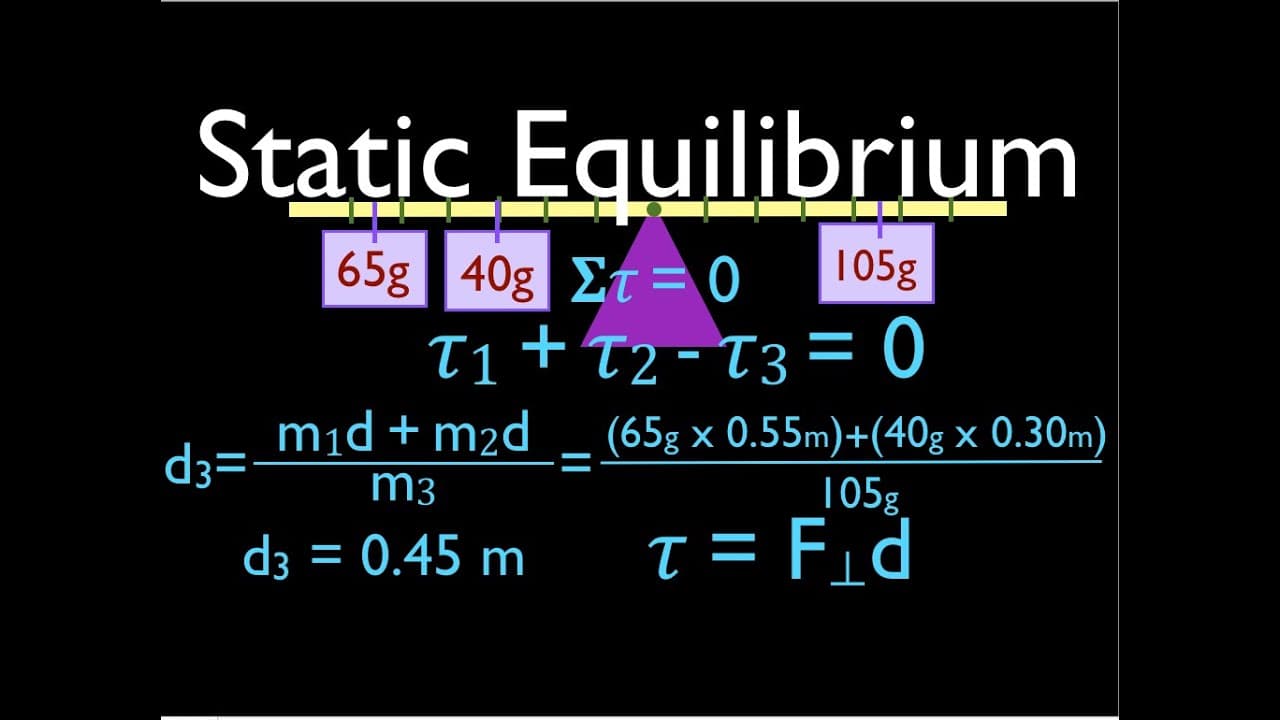
okay in today's video revolving static equilibrium and this is the lever the teeter-totter the seesaw the balanced problem and this is what we want to know we have this mass 65 grams it's hanging 10 20 30 40 55 centimeters away from the pivot point we have this mass number 2 it's hanging 10 20 30 centimeters away from the pivot point and we want to... Read More
Key Insights
- ❓ Torque calculations are essential for understanding rotational motion in static equilibrium.
- 🥺 Forces from hanging masses contribute to torques, leading to rotational balance in a lever system.
- 🍹 Summing up torques and applying torque equations help determine the optimal placement of masses for static equilibrium.
- 😥 Distance from a pivot point plays a crucial role in balancing a lever system.
- 😁 Torques from hanging masses must be considered to achieve rotational equilibrium in a balanced beam.
- 💆 Utilizing mass, acceleration due to gravity, and distance, torque equations can be applied to solve for unknown distances in a lever system.
- ❓ Achieving static equilibrium in a lever system ensures a stable and balanced condition.
Install to Summarize YouTube Videos and Get Transcripts
Explore YouTube Video Summarizer or Get YouTube Transcript Extractor
Questions & Answers
Q: How do forces in a lever system contribute to rotational motion without causing translational movement?
In a lever system, forces from hanging masses produce torques that lead to rotational motion around a pivot point but do not result in translational motion. Torque calculations focus on rotational equilibrium in such systems.
Q: What determines the direction and magnitude of torque in a lever system?
The direction of torque in a lever system is determined by whether the force causes rotational motion in a clockwise or counterclockwise direction. The magnitude of torque is dependent on the force applied and the distance from the pivot point.
Q: Why is static equilibrium crucial in a balanced beam system?
Static equilibrium ensures that a balanced beam remains stationary with no rotational acceleration, indicating a stable condition where torques from all forces cancel out, leading to a balanced system.
Q: How can torque equations be utilized to find the optimal placement of masses for static equilibrium?
By using torque equations, one can calculate the distance at which a mass should be placed in a lever system to achieve static equilibrium. This involves summing up torques from all hanging masses and solving for the unknown distance.
Summary & Key Takeaways
-
Examines torque in static equilibrium for a balanced beam with mass distances from a pivot point.
-
Demonstrates how torques from hanging masses contribute to rotational motion without translational movement.
-
Utilizes torque equations to determine the placement of a mass for static equilibrium in a lever system.
Read in Other Languages (beta)
Share This Summary 📚
Summarize YouTube Videos and Get Video Transcripts with 1-Click
Try YouTube Summary with ChatGPT & Claude or YouTube Transcript Generator
Explore More Summaries from Step by Step Science 📚


Summarize YouTube Videos and Get Video Transcripts with 1-Click
Try YouTube Summary with ChatGPT & Claude or YouTube Transcript Generator