What Is Kinematics in One Dimension and Its Key Concepts?
TL;DR
Kinematics in one dimension describes how objects move along a straight path, focusing on key concepts such as distance, displacement, speed, and velocity. Distance is a scalar quantity representing total travel, while displacement is a vector quantity indicating the change in position with direction. Understanding these concepts is essential for analyzing motion without considering forces.
Transcript
in this video we're going to talk about kinematics which basically describes how objects move without any references to force now we're going to focus on kinematics in one dimension mostly along the x-axis but we can also work on some problems along the y-axis when you get into two-dimensional kinematics it covers projectile motion which is a topic... Read More
Key Insights
- ❓ Kinematics focuses on describing the motion of objects without considering forces.
- ❓ Scalar quantities have magnitude only, while vector quantities have both magnitude and direction.
- 🗺️ Distance is a scalar quantity that measures the total amount traveled, while displacement is a vector quantity that includes both distance and direction.
- 🐎 Speed is a scalar quantity that measures how fast an object is moving, while velocity is a vector quantity that includes both speed and direction.
- ❓ Temperature is a scalar quantity, while acceleration is a vector quantity.
- 🧘 Displacement can be calculated by subtracting the initial position from the final position, while velocity is calculated by dividing displacement by the time taken.
- 💱 Average speed can be equal to average velocity if there is no change in direction, but they can be different if there is a change in direction.
- 💱 Instantaneous velocity is calculated by taking the limit as the change in time approaches zero of the change in position over the change in time.
Install to Summarize YouTube Videos and Get Transcripts
Explore YouTube Video Summarizer or Get YouTube Transcript Extractor
Questions & Answers
Q: What is the difference between scalar and vector quantities?
Scalar quantities have magnitude only, while vector quantities have both magnitude and direction. Scalar quantities include mass and temperature, whereas vector quantities include displacement and velocity.
Q: How does displacement differ from distance?
Displacement is a vector quantity that includes distance and direction, describing the change in position. Distance, on the other hand, is a scalar quantity that only measures the total amount traveled, regardless of direction.
Q: Is speed a scalar or vector quantity?
Speed is a scalar quantity that measures how fast an object is moving. It only includes magnitude and not direction. Velocity, on the other hand, is a vector quantity that includes both speed and direction.
Q: Can temperature be considered a vector quantity?
No, temperature is a scalar quantity because it only has magnitude and does not have a specific direction. It is described by units such as degrees Fahrenheit or Celsius, without any reference to a particular direction.
Q: How can displacement and velocity be calculated?
Displacement can be calculated by subtracting the initial position from the final position. Velocity is calculated by dividing displacement by the time taken. Both displacement and velocity have both magnitude and direction.
Q: Can average speed be equal to average velocity?
Average speed can be equal to average velocity if an object travels in one direction without changing its direction. However, if there is any change in direction, the average speed and average velocity will be different.
Q: How can instantaneous velocity be calculated?
Instantaneous velocity is calculated by taking the limit as the change in time approaches zero, which gives the change in position divided by the change in time. It represents the velocity at an instant of time.
Q: What are the formulas used in kinematics?
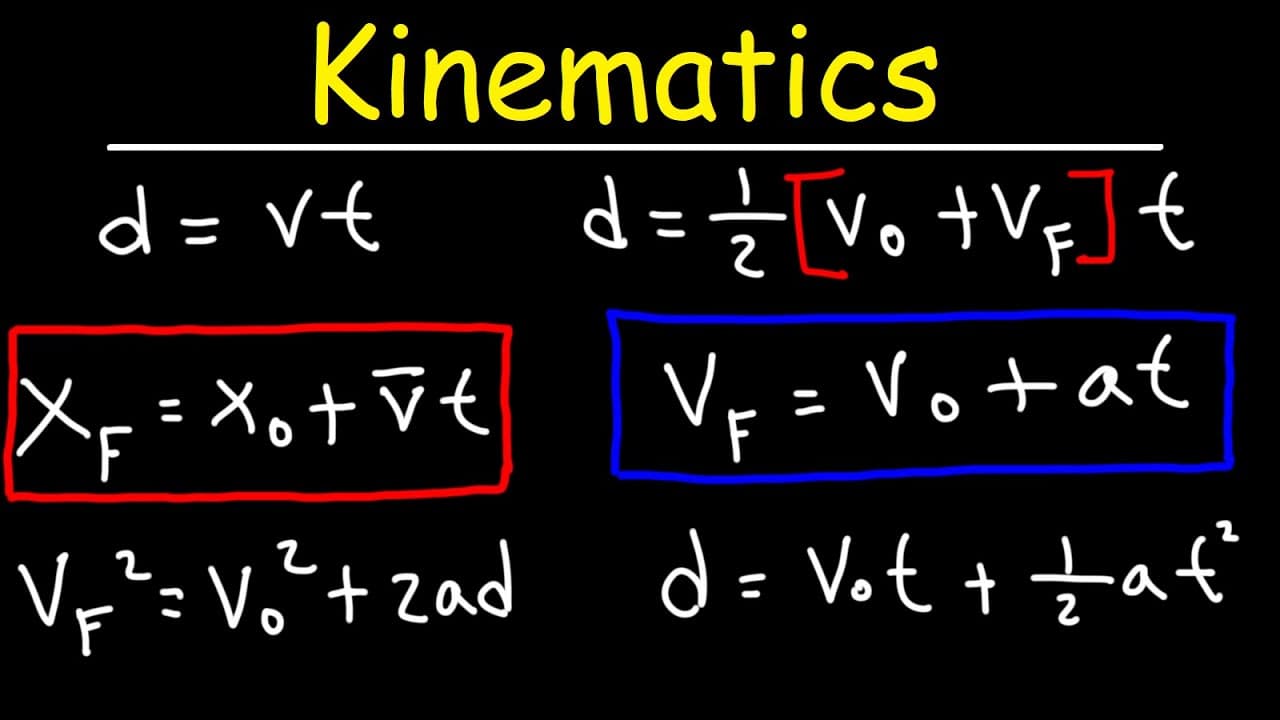
Some of the formulas used in kinematics include d = vt (for constant speed), v = u + at (for constant acceleration), and displacement = initial position + (initial velocity * time) + (0.5 * acceleration * (time^2)).
Summary & Key Takeaways
-
Kinematics describes how objects move without considering forces, primarily focusing on motion along the x-axis.
-
Scalar quantities, such as mass and temperature, have magnitude only, while vector quantities, like displacement and velocity, have both magnitude and direction.
-
Distance is a scalar quantity that measures how far an object has traveled, while displacement is a vector quantity that includes both distance and direction.
Read in Other Languages (beta)
Share This Summary 📚
Summarize YouTube Videos and Get Video Transcripts with 1-Click
Try YouTube Summary with ChatGPT & Claude or YouTube Transcript Generator
Explore More Summaries from The Organic Chemistry Tutor 📚




Summarize YouTube Videos and Get Video Transcripts with 1-Click
Try YouTube Summary with ChatGPT & Claude or YouTube Transcript Generator