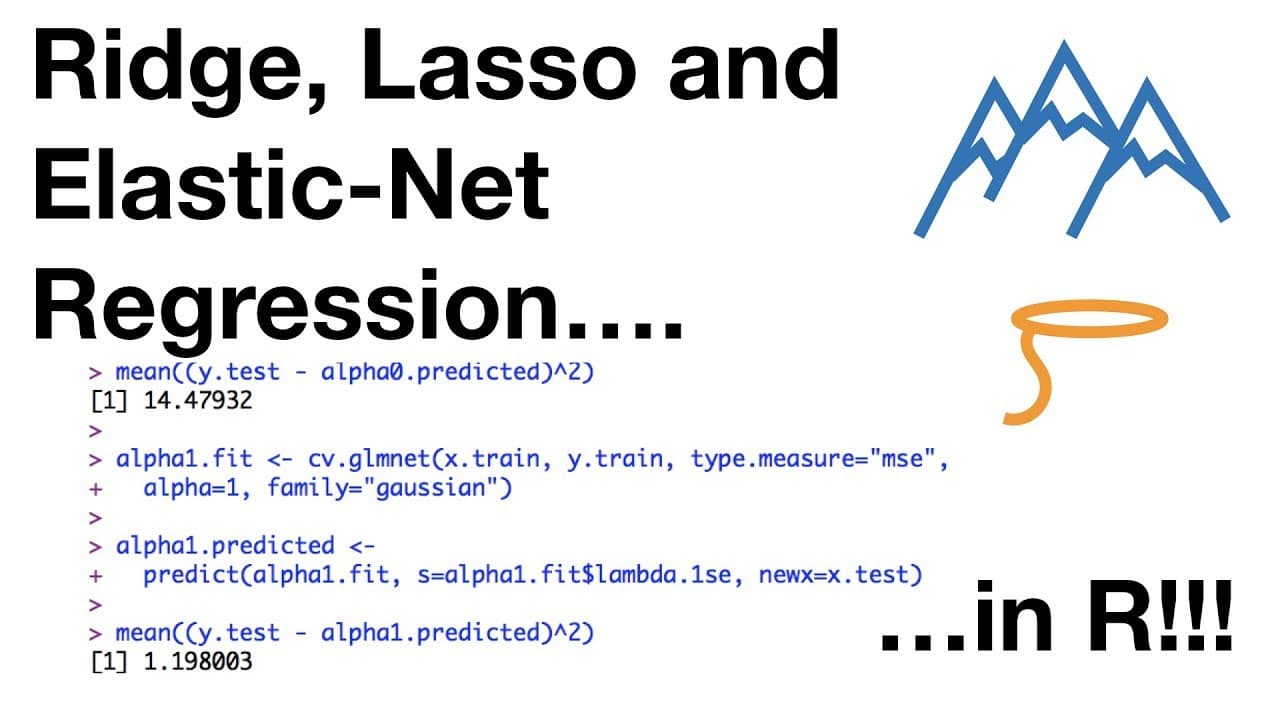
What Are Ridge, Lasso, and Elastic Net Regression in R?
TL;DR
Ridge, Lasso, and Elastic Net regression are statistical techniques used to improve prediction accuracy by applying different penalty methods. Ridge regression minimizes the size of coefficients, Lasso regression can eliminate them entirely, and Elastic Net combines both penalties for optimal parameter estimation. Lasso typically outperforms Ridge in high-dimensional datasets.
Transcript
elastic regression won't help you to sing in tune but if you do it and ah it's not that hard stat quest hello I'm Josh stormer and welcome to stat quest today we're going to talk about Ridge lasso and elastic net regression in our note this stack quest assumes you're already familiar with the concepts behind Ridge lasso in elastic net regression if... Read More
Key Insights
- 🪐 GLM net combines linear and logistic regression models with elastic net capabilities.
- 🪐 Lambda controls the penalty applied in elastic net regression, offering flexibility in parameter estimation.
- 🪐 Alpha in GLM net determines the blend of Ridge and Lasso penalties for optimal model performance.
- ✋ Lasso regression can outperform Ridge regression in high-dimensional datasets.
- 😵 Applying cross-validation aids in finding optimal values for lambda and alpha in GLM net for regression analysis.
- ⚾ The predict function in R can be used to generate predictions based on fitted models.
- ❓ Selecting the optimal value of lambda can impact the complexity and performance of the regression model.
Install to Summarize YouTube Videos and Get Transcripts
Explore YouTube Video Summarizer or Get YouTube Transcript Extractor
Questions & Answers
Q: What is the difference between Ridge, Lasso, and Elastic Net regression?
Ridge, Lasso, and Elastic Net regression differ in the penalties they apply to parameter estimates to prevent overfitting in regression models. Ridge includes a penalty that preserves all variables, Lasso eliminates some variables, while Elastic Net strikes a balance between both.
Q: How does GLM net determine the optimal values for lambda and alpha in Elastic Net regression?
GLM net uses cross-validation to find the best lambda value. Alpha, which defines the mixture of Ridge and Lasso penalties, can take any value between 0 and 1, allowing for flexibility in controlling the shrinkage of parameter estimates.
Q: Why is Lasso regression favored over Ridge in certain cases?
Lasso regression is preferred when dealing with high-dimensional datasets as it tends to shrink coefficients effectively by selecting only a subset of relevant variables, thus aiding in model interpretability and reducing complexity.
Q: How can one apply Ridge, Lasso, and Elastic Net regression using GLM net in R?
By setting lambda and alpha values appropriately, researchers can implement Ridge, Lasso, and Elastic Net regression using the GLM net package in R, adjusting the penalties to fit the data and optimize model performance.
Summary & Key Takeaways
-
StatQuest explores Ridge, Lasso, and Elastic Net regression.
-
GLM net encompasses linear and logistic regression among other models.
-
GLM net uses lambda and alpha to control penalties in elastic net regression.
Read in Other Languages (beta)
Share This Summary 📚
Summarize YouTube Videos and Get Video Transcripts with 1-Click
Try YouTube Summary with ChatGPT & Claude or YouTube Transcript Generator
Explore More Summaries from StatQuest with Josh Starmer 📚




Summarize YouTube Videos and Get Video Transcripts with 1-Click
Try YouTube Summary with ChatGPT & Claude or YouTube Transcript Generator