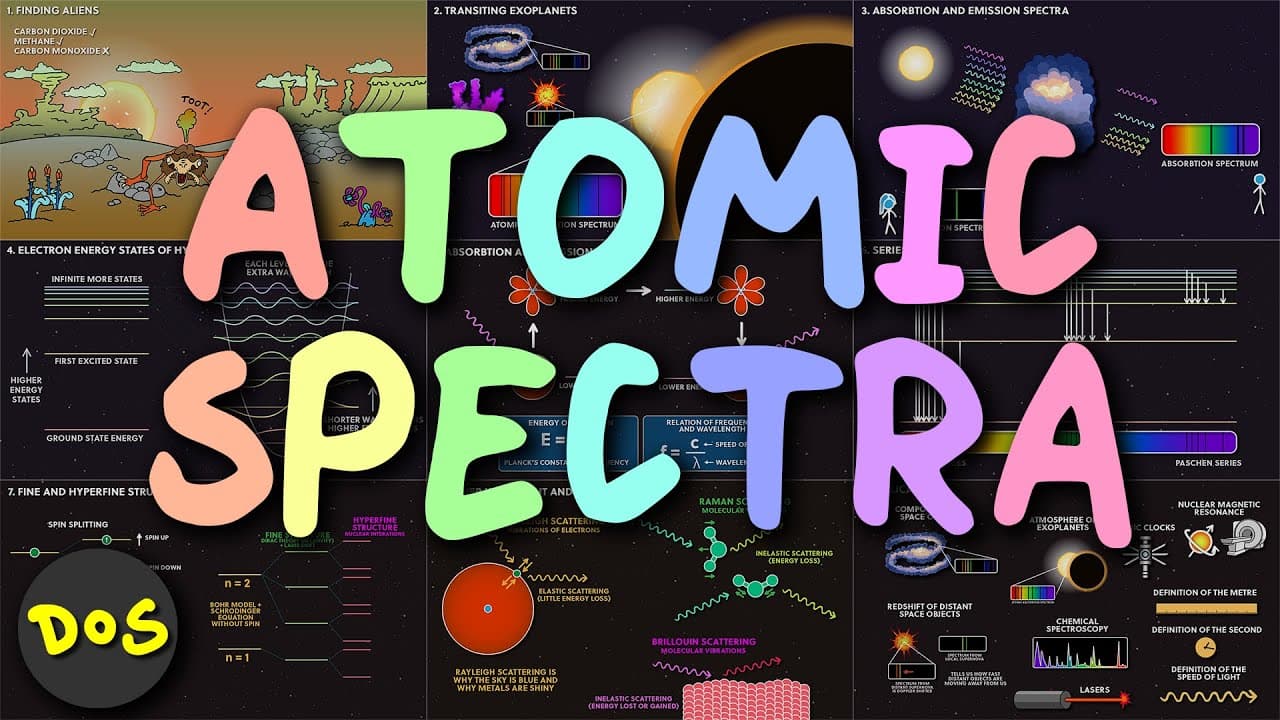
Atomic Spectroscopy Explained in 9 Slides
TL;DR
Alien life detection hinges on atomic spectra analysis to interpret atmospheres of distant planets.
Transcript
If we discover aliens, we’ll probably see them because of their farts. The first signature of extraterrestrial life is likely to be unnatural compositions of gasses in the atmosphere of a distant exoplanet. Think of the Earth, the atmosphere is full of oxygen, and this is only true because it keeps on being replenished by plant and microb... Read More
Key Insights
- 🫢 Detection of alien life may rely on interpreting unusual gas compositions in distant exoplanet atmospheres through atomic spectra analysis.
- 🫢 Atomic spectroscopy using absorption spectra can reveal the gas compositions and proportions in exoplanet atmospheres.
- 🫀 Understanding atomic spectra involves delving into quantum mechanics and electron energy levels within atoms.
- 🫀 Fine and hyperfine structures in atomic spectra explain the splitting and shifts in energy levels due to electron interactions.
- 🙂 Light interactions with matter extend beyond atomic spectra, including phenomena like Rayleigh, Raman, and Brillouin scattering.
- 🫀 Atomic spectra are utilized in astrophysics to study celestial objects and in chemistry labs for composition analysis.
- 🫀 Atomic spectra applications extend to technologies such as atomic clocks and lasers through controlled emissions from specific energy levels.
Install to Summarize YouTube Videos and Get Transcripts
Explore YouTube Video Summarizer or Get YouTube Transcript Extractor
Questions & Answers
Q: How may detecting unnatural gas compositions on distant planets hint at extraterrestrial life?
Detecting inexplicable gas proportions in exoplanet atmospheres through atomic spectroscopy could signify microbial or even larger alien life presence, acting as a biosignature of extraterrestrial existence.
Q: What role does atomic spectroscopy play in understanding the atmospheres of exoplanets?
Atomic spectroscopy using absorption spectra from starlight can reveal the composition and proportions of gases in distant planet atmospheres, providing crucial insights into the potential for life beyond Earth.
Q: How do electron energy levels and quantum mechanics explain the specific lines in atomic spectra?
Electron energy states in atoms are described by discrete energy levels due to wave functions vibrating at specific frequencies constrained within atoms, leading to the distinct lines observed in atomic spectra.
Q: What are the practical applications of atomic spectra in various fields?
Atomic spectra find applications in astrophysics for analyzing celestial objects, in chemistry labs for identifying sample compositions, and in technologies like atomic clocks for accurate timekeeping based on specific energy transitions.
Summary & Key Takeaways
-
Discovering aliens may rely on detecting unnatural gas compositions in exoplanet atmospheres as biosignatures.
-
Atomic spectroscopy uses absorption spectra to analyze starlight, revealing atmospheric gas compositions and proportions.
-
Understanding atomic spectra involves delving into quantum mechanics and interaction of light with matter.
Read in Other Languages (beta)
Share This Summary 📚
Summarize YouTube Videos and Get Video Transcripts with 1-Click
Try YouTube Summary with ChatGPT & Claude or YouTube Transcript Generator
Explore More Summaries from Domain of Science 📚





Summarize YouTube Videos and Get Video Transcripts with 1-Click
Try YouTube Summary with ChatGPT & Claude or YouTube Transcript Generator