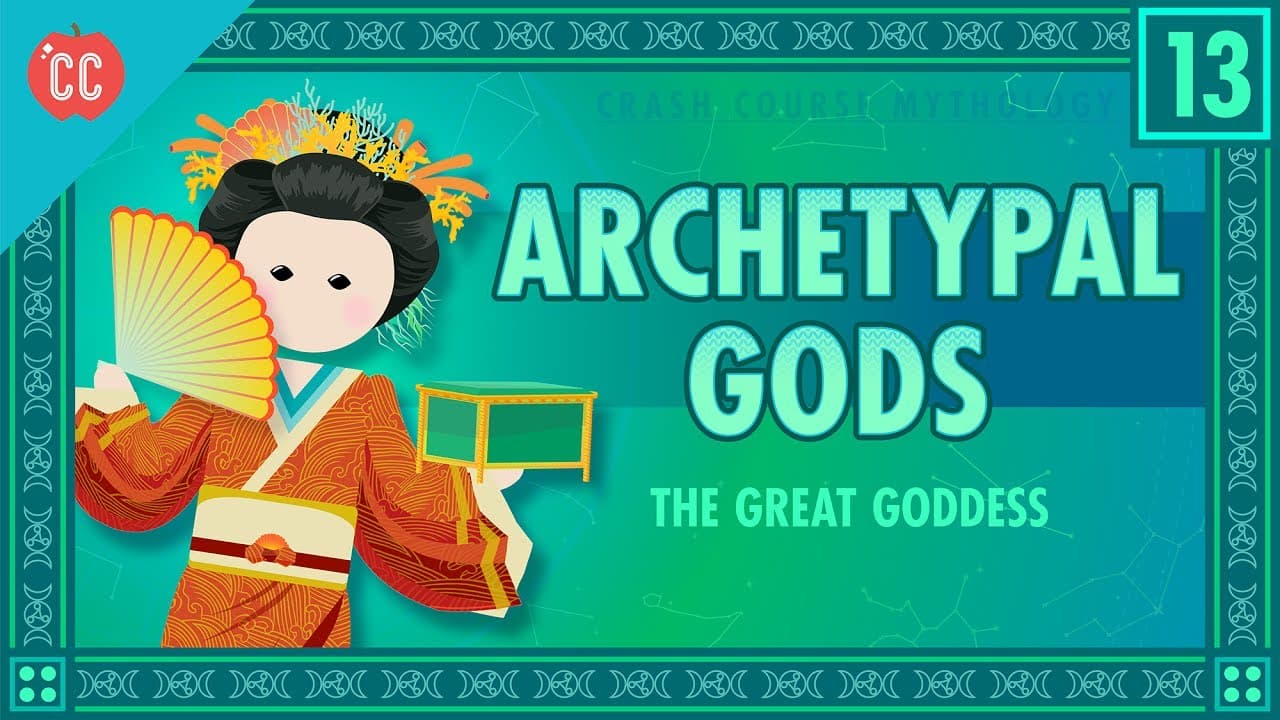
Great Goddesses: Crash Course World Mythology #13
TL;DR
Examines archetypes of female deities in global mythology.
Transcript
Hey there, I'm Mike Rugnetta. This is Crash Course Mythology and today, we're going to talk about symbols, dreams and a couple of very busty figurines. It's the great mother goddess. Are you excited Thoth? Yeah, I know, you don't have a mother, you created yourself, but come on! She's the best! Unless, of course, she doesn't exist and if that's the... Read More
Key Insights
- The mother goddess is an archetype that reflects shared human symbols and ideas, as suggested by Carl Jung's theory of the collective unconscious.
- Archetypes like the great mother and father creator are recurring patterns in myths across different cultures worldwide.
- Some historians argue prehistoric societies were matrifocal and goddess-oriented, focusing on fertility and motherhood.
- Maria Gimbutas connected archaeology to the women's movement, promoting the idea of a primal mother goddess as an appealing alternative to patriarchal systems.
- The goddess movement faces criticism for relying on gender binaries and modern stereotypes, questioning if prehistoric societies shared these views.
- Goddesses of life, death, and regeneration are common in myths, each representing different aspects like fertility, decay, and creativity.
- The triple goddess typology categorizes goddesses into virgin, mother, and crone, though this is criticized for male-centric perspectives.
- Goddesses of regeneration often bestow favors on mortal men, typically leading to unfortunate outcomes, as seen in myths from Ireland and Japan.
Install to Summarize YouTube Videos and Get Transcripts
Explore YouTube Video Summarizer or Get YouTube Transcript Extractor
Questions & Answers
Q: What is the significance of the mother goddess archetype?
The mother goddess archetype is significant as it represents shared human symbols and ideas, reflecting Carl Jung's theory of the collective unconscious. This archetype appears in myths worldwide, highlighting the universal themes of fertility, creation, nurturing, and protection associated with female divinity.
Q: What arguments are made about prehistoric societies and goddess worship?
Some historians and scholars argue that prehistoric societies were matrifocal and goddess-oriented, focusing on fertility and motherhood. This contrasts with the patriarchal systems that followed. The idea suggests that early religions centered around a primal mother goddess, offering an alternative to modern societal structures.
Q: Who was Maria Gimbutas and what was her contribution to the goddess movement?
Maria Gimbutas was an archaeologist who connected her work to the women's movement, promoting the idea of a primal mother goddess. She argued that prehistoric societies were more peaceful and cooperative, with goddess worship offering a counterpoint to the brutality and materialism of patriarchal systems.
Q: What criticisms does the goddess movement face?
The goddess movement faces criticism for relying on modern gender binaries and stereotypes, questioning if prehistoric societies shared these views. Critics argue that it imposes contemporary beliefs on ancient cultures, potentially misrepresenting the role and perception of female divinity in historical contexts.
Q: How are goddesses categorized in myths?
Goddesses in myths are often categorized into roles of life, death, and regeneration. Life goddesses focus on fertility and creation, death goddesses govern the underworld and fate, and regeneration goddesses relate to sexuality and creativity. This categorization reflects the multifaceted nature of female divinity in mythology.
Q: What is the triple goddess typology and its criticisms?
The triple goddess typology categorizes goddesses into virgin, mother, and crone. It is criticized for being male-centric, viewing women through the eyes of men and categorizing them based on sexuality. Critics argue it oversimplifies the roles and complexities of goddesses in myths.
Q: What are some myths involving regeneration goddesses?
Regeneration goddesses often bestow favors on mortal men, leading to unfortunate outcomes. For example, in Irish mythology, Nimah of the Golden Hair takes Oisin to Tir-Nan-Og, and in Japanese mythology, Oto-Hime takes a fisherman to her palace. Both stories end with the mortal aging rapidly upon returning home.
Q: Why are great mother goddesses considered powerful in mythology?
Great mother goddesses are considered powerful due to their complexity and multifaceted nature. They embody creation, fertility, protection, and destruction, often playing contradictory roles in myths. This complexity allows them to represent a wide range of human experiences and emotions, making them central figures in mythology.
Summary & Key Takeaways
-
This episode of Crash Course Mythology explores the archetype of the mother goddess, examining its significance across various cultures. The discussion includes prehistoric fertility goddesses, life and death goddesses, and regeneration goddesses. Key figures like the Venus of Willendorf and theories by Maria Gimbutas are highlighted.
-
The video delves into the idea that early human societies were matrifocal and goddess-oriented, contrasting with modern patriarchal systems. It critiques the goddess movement for relying on modern gender stereotypes and explores the complexities of goddesses in mythological narratives.
-
Goddesses are categorized into roles of life, death, and regeneration, each embodying different mythological themes. The episode discusses the triple goddess typology and highlights myths from Ireland and Japan, illustrating the multifaceted nature of great mother goddesses.
Read in Other Languages (beta)
Share This Summary 📚
Summarize YouTube Videos and Get Video Transcripts with 1-Click
Try YouTube Summary with ChatGPT & Claude or YouTube Transcript Generator
Explore More Summaries from CrashCourse 📚
Summarize YouTube Videos and Get Video Transcripts with 1-Click
Try YouTube Summary with ChatGPT & Claude or YouTube Transcript Generator