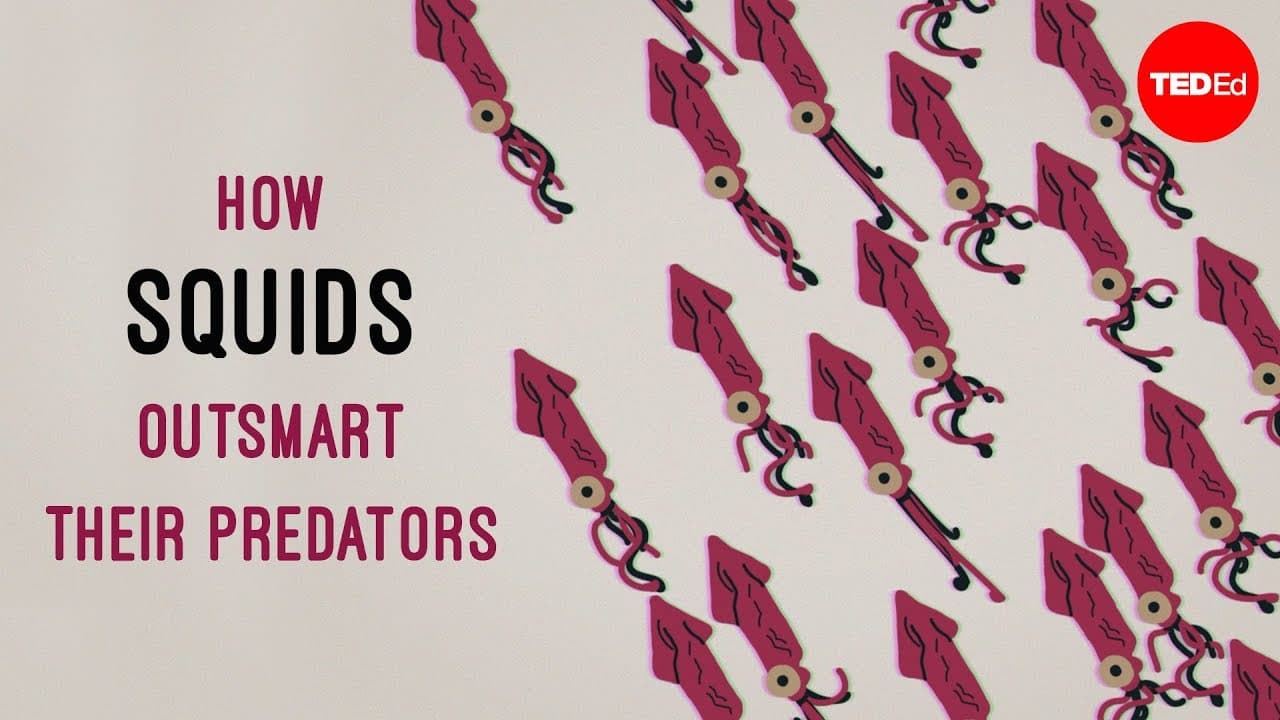
How squids outsmart their predators - Carly Anne York
TL;DR
Squid and sperm whales engage in epic battles of survival in the ocean depths, showcasing impressive adaptations.
Transcript
In the ocean’s depths, two titans wage battle: the sperm whale and the colossal squid. Sperm whales use echolocation to hunt these squid for food, but even against this gigantic animal, squid can put up an impressive fight. Scientists know this because on the bodies of washed-up whales, they frequently find huge, round suction scars, emblazoned t... Read More
Key Insights
- 🐳 Sperm whales and colossal squid engage in intense battles for survival in the ocean depths.
- 😜 Squid possess sophisticated defense mechanisms like large eyes, chromatophores, ink production, and jet propulsion to evade predators.
- ❓ These stealthy cephalopods have thrived for over 500 million years, showcasing their remarkable adaptability.
- 🤢 The diverse adaptations of squid demonstrate their mastery of survival in the deep and unforgiving sea.
- 😉 Squid's ability to camouflage using chromatophores and ink, along with their jet propulsion speed, make them formidable prey.
- 🦑 The unique behaviors of certain squid species highlight their versatility and survival skills.
- 👶 Discovering new squid species continues to unravel the mysteries of their intricate adaptations for ocean survival.
Install to Summarize YouTube Videos and Get Transcripts
Explore YouTube Video Summarizer or Get YouTube Transcript Extractor
Questions & Answers
Q: How do sperm whales hunt colossal squid in the ocean?
Sperm whales use echolocation to track and capture colossal squid, leaving distinctive suction scars on their bodies from these battles. The squid put up a fierce fight despite being prey.
Q: What defensive adaptations do squid possess to evade predators?
Squid have evolved large eyes for detecting predators, chromatophores for camouflage, ink production for distraction, and jet propulsion for rapid escape, showcasing their sophisticated survival strategies in the ocean.
Q: How do squid use their chromatophores for camouflage?
Squid control thousands of chromatophores individually, allowing them to change color and pattern to blend with their surroundings. This countershading helps them avoid predators by eliminating their silhouette.
Q: What unique behaviors have certain squid species developed for survival?
Some squid species exhibit unique behaviors like the deep-sea vampire squid using webbed arms as a cape, the bobtail tossing sand for cover, and the Pacific flying squid using jet propulsion to launch itself out of the water, showcasing their adaptability in different environments.
Summary & Key Takeaways
-
Sperm whales hunt colossal squid using echolocation, leaving suction scars on their bodies.
-
Squid have evolved various defense mechanisms like large eyes, chromatophores for camouflage, ink production, and jet propulsion.
-
The intricate adaptations of squid have enabled their survival for over 500 million years in the ocean's depths.
Read in Other Languages (beta)
Share This Summary 📚
Summarize YouTube Videos and Get Video Transcripts with 1-Click
Try YouTube Summary with ChatGPT & Claude or YouTube Transcript Generator
Explore More Summaries from TED-Ed 📚






Summarize YouTube Videos and Get Video Transcripts with 1-Click
Try YouTube Summary with ChatGPT & Claude or YouTube Transcript Generator