The Food That Fertilizes Itself | Giles E.D. Oldroyd | TED
TL;DR
The soybean plant's microbial relationships can revolutionize sustainable agriculture by reducing reliance on fertilizers.
Transcript
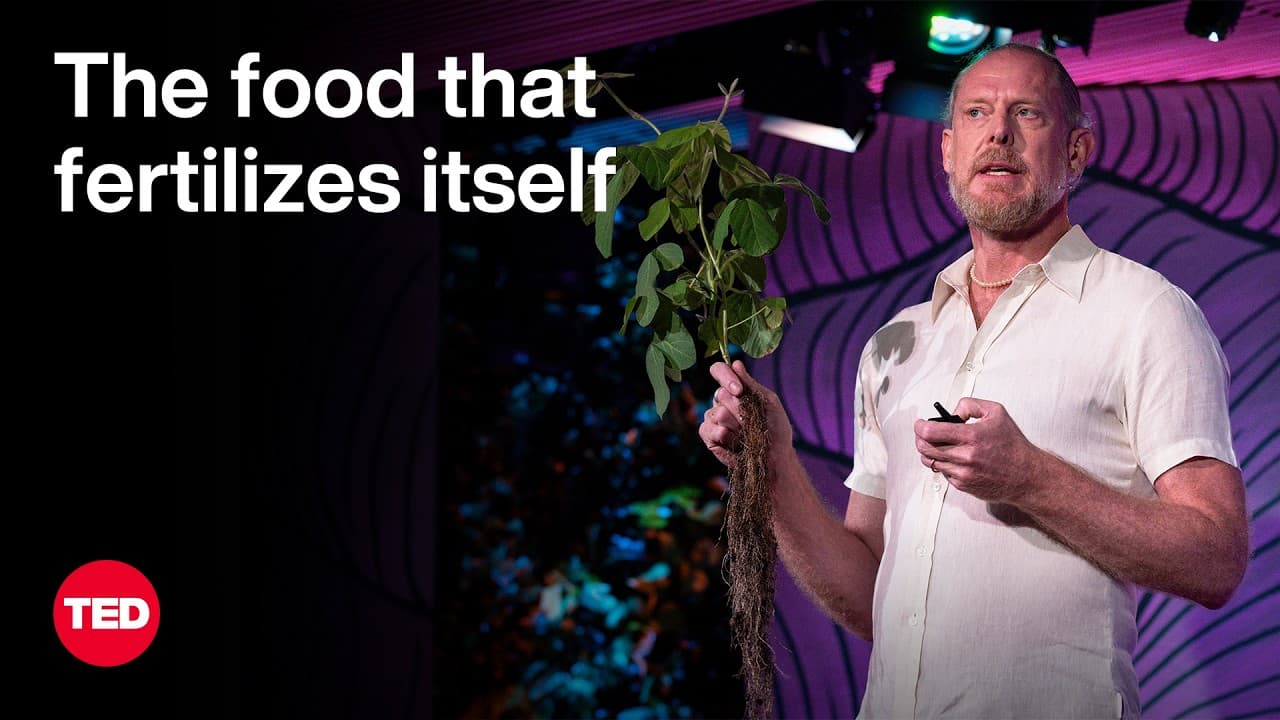
So I believe this soybean plant is a prototype for sustainable food production on this planet. Let me show you why I say that. So on the roots of this soybean plant are nodules. And these nodules do an amazing thing. They harbor millions of bacteria inside the cells of the nodules. And those bacteria are able to capture nitrogen out of the atmosphe... Read More
Key Insights
- 🍄 Soybeans establish symbiotic relationships with certain bacteria and fungi, enabling them to thrive without relying heavily on fertilizers.
- 😒 The use of beneficial microbes in agriculture aims to create systems that naturally fulfill nutrient requirements, potentially transforming modern farming practices.
- 🦻 Understanding the genetic basis of symbiotic relationships can aid in enhancing crop resilience and productivity, combatting reliance on chemical inputs.
- 👨🔬 Current research efforts focus on facilitating beneficial microbial interactions even in fertilized soils, increasing nutrient uptake efficiency in crops.
- 🥺 The genetic engineering of cereals to enable nitrogen-fixation could lead to significant agricultural breakthroughs, particularly in regions with limited access to fertilizers.
- 🥺 The integration of ecological principles in agriculture may lead to healthier ecosystems, fostering a balance that benefits both farming and biodiversity.
- 😋 The potential of microbes in agriculture showcases the need for innovative solutions in addressing food security challenges in a changing climate.
Install to Summarize YouTube Videos and Get Transcripts
Explore YouTube Video Summarizer or Get YouTube Transcript Extractor
Questions & Answers
Q: What role do the nodules on soybean roots play in nutrient acquisition?
The nodules on soybean roots house nitrogen-fixing bacteria, which capture atmospheric nitrogen and convert it into ammonia, a form usable by the plant. This process enables the soybean to secure its nitrogen needs sustainably, illustrating a symbiotic relationship where the bacteria benefit from carbohydrates supplied by the plant in return.
Q: How do mycorrhizal fungi benefit soybean plants?
Mycorrhizal fungi colonize soybean roots and extend into the soil, enhancing nutrient and water uptake efficiency. They create a larger interface with the soil, facilitating the absorption of phosphates, nitrates, and other vital nutrients, which supports the plant’s growth while receiving carbon in return.
Q: Why is there a dependence on inorganic fertilizers in agriculture?
Inorganic fertilizers have been essential for meeting global food demands for the last six decades, but their use leads to environmental pollution and greenhouse gas emissions. Additionally, smallholder farmers often cannot access these fertilizers, resulting in lower crop yields and productivity.
Q: What is the potential impact of transferring nitrogen-fixing capability to cereal crops?
Transferring nitrogen-fixing ability from legumes to cereal crops could significantly reduce the need for chemical fertilizers, thus enhancing sustainability and productivity in agriculture. This would benefit smallholder farmers by lowering costs and improving crop yield without negatively impacting the environment.
Q: How can knowing the existing genetic components help in creating nitrogen-fixing cereals?
By understanding that nitrogen fixation in legumes uses existing genetic components already present in cereal crops, researchers can restructure these components instead of creating them anew. This makes engineering non-legume crops to form nitrogen-fixing nodules more feasible and potentially quicker to accomplish.
Q: What is the ‘microbial revolution’ in agriculture?
The "microbial revolution" refers to the innovative agricultural approach leveraging beneficial microbes, like fungi and nitrogen-fixing bacteria, to enhance nutrient availability. This could provide a sustainable alternative to chemical fertilizers, promoting ecological health and supporting food production accessible to farmers worldwide.
Summary & Key Takeaways
-
The soybean plant utilizes mutualistic relationships with nitrogen-fixing bacteria and mycorrhizal fungi to obtain essential nutrients, thereby minimizing the need for inorganic fertilizers.
-
Research aims to transfer these beneficial relationships from legumes to cereal crops, potentially enabling them to access nutrients sustainably, which could improve global food production.
-
Advances in understanding genetic components involved in these symbiotic relationships offer a pathway to engineering nitrogen-fixing bacteria into cereal crops, marking the potential for a new sustainable agricultural revolution.
Read in Other Languages (beta)
Share This Summary 📚
Summarize YouTube Videos and Get Video Transcripts with 1-Click
Try YouTube Summary with ChatGPT & Claude or YouTube Transcript Generator
Explore More Summaries from TED 📚





Summarize YouTube Videos and Get Video Transcripts with 1-Click
Try YouTube Summary with ChatGPT & Claude or YouTube Transcript Generator