Products
Features
YouTube Video Summarizer
Summarize YouTube videos
Web & PDF Highlighter
Highlight web pages & PDFs
Chat with PDF
Ask any PDF questions with AI
Ask AI Clone
Chat with your highlights & memories
Audio Transcriber
Transcribe audio files to text
Glasp Reader
Read and highlight articles
Kindle Highlight Export
Export your Kindle highlights
Idea Hatch
Hatch ideas from your highlights
Integrations
Obsidian Plugin
Notion Integration
Pocket Integration
Instapaper Integration
Medium Integration
Readwise Integration
Snipd Integration
Hypothesis Integration
Apps & Extensions
Chrome Extension
Safari Extension
Edge Add-ons
Firefox Add-ons
iOS App
Android App
Discover
Discover
Ideas
Discover new ideas and insights
Articles
Curated articles and insights
Books
Book recommendations by great minds
Posts
Essays and notes from readers
Quotes
Inspiring quotes collection
Videos
Curated videos and summaries
Explore Glasp
Glasp Newsletter
Weekly insights and updates
Glasp Talk
Interview series with great minds
Glasp Blog
Latest news and articles
Glasp Use Cases
Learn how others use Glasp
Build & Support
Glasp API
Access Glasp's API for developers
MCP Connector
Connect Glasp to Claude & ChatGPT
Community
Glasp Reddit Community
Students
Student discount and benefits
FAQs
Frequently Asked Questions
AboutPricing
DashboardLog inSign up

A brief history of numerical systems - Alessandra King
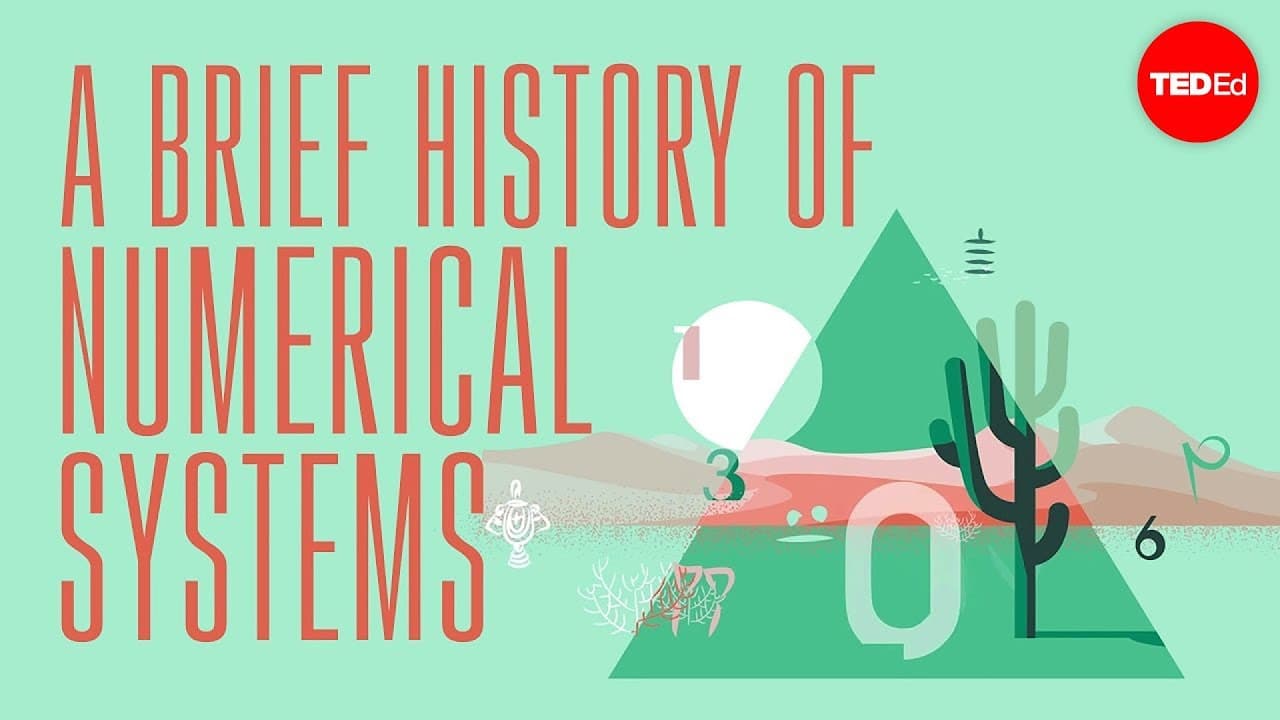
1.0M views
•
January 19, 2017
by
TED-Ed
YouTube video player
A brief history of numerical systems - Alessandra King

TL;DR

From tally marks to positional notation, different civilizations developed various number systems to represent larger magnitudes efficiently.

Transcript

One, two, three, four, five, six, seven, eight, nine, and zero. With just these ten symbols, we can write any rational number imaginable. But why these particular symbols? Why ten of them? And why do we arrange them the way we do? Numbers have been a fact of life throughout recorded history. Early humans likely counted animals in a flock or members... Read More

Key Insights

  • 〽️ Early humans counted using body parts and tally marks.
  • 🤬 Different civilizations extended tally marks with new symbols for higher values.
  • ⚾ The Hindu-Arabic numeral system, based on positional notation, replaced Roman numerals.
  • #️⃣ The number zero was a crucial innovation for efficient numbering.
  • ⚾ Base systems like ten, 20, and 60 offer various advantages and are used in diverse contexts.
  • ⚾ The base 12 system is highly composite and useful for representing common fractions.
  • ⚾ Binary systems are crucial for digital devices, while programmers also use base eight and base 16 for compact notation.

Install to Summarize YouTube Videos and Get Transcripts

Explore YouTube Video Summarizer or Get YouTube Transcript Extractor

Questions & Answers

Q: What was the key innovation that led to more efficient number representation?

The development of positional notation allowed for reusing symbols with different values based on their position, making it easier to express larger numbers with fewer symbols.

Q: How did the Hindu-Arabic numeral system impact everyday life?

The Hindu-Arabic system replaced Roman numerals, becoming the predominant number system globally due to its efficiency in representing numbers with just ten unique glyphs.

Q: Why was the number zero a crucial breakthrough in number systems?

Zero served as both a value and a placeholder, distinguishing between different magnitudes and ensuring a consistent and reliable notation system.

Q: Why do different civilizations use varying base systems for numbers?

The choice of base systems, like base ten, base 20 (vigesimal), or base 60 (sexigesimal), depends on factors like divisibility and practical applications in everyday life.

Summary & Key Takeaways

  • Early humans used body parts and tally marks to count, but as life complexities increased, new systems emerged.

  • Civilizations like Greeks, Hebrews, and Egyptians extended tally marks with new symbols for higher values.

  • The Hindu-Arabic numeral system, based on positional notation, replaced Roman numerals as the most commonly used number system.


Read in Other Languages (beta)

English

Share This Summary 📚

Summarize YouTube Videos and Get Video Transcripts with 1-Click

Download browser extensions on:

Try YouTube Summary with ChatGPT & Claude or YouTube Transcript Generator

Explore More Summaries from TED-Ed 📚
The myth of Hercules: 12 labors in 8-bits - Alex Gendler thumbnail
The myth of Hercules: 12 labors in 8-bits - Alex Gendler
TED-Ed
Are there universal expressions of emotion? - Sophie Zadeh thumbnail
Are there universal expressions of emotion? - Sophie Zadeh
TED-Ed
Does time exist? - Andrew Zimmerman Jones thumbnail
Does time exist? - Andrew Zimmerman Jones
TED-Ed
How to build a fictional world - Kate Messner thumbnail
How to build a fictional world - Kate Messner
TED-Ed
The myth of Sisyphus - Alex Gendler thumbnail
The myth of Sisyphus - Alex Gendler
TED-Ed
If you're an adult mayfly you'll probably die before the end of this video - Luke M. Jacobus thumbnail
If you're an adult mayfly you'll probably die before the end of this video - Luke M. Jacobus
TED-Ed

Summarize YouTube Videos and Get Video Transcripts with 1-Click

Download browser extensions on:

Try YouTube Summary with ChatGPT & Claude or YouTube Transcript Generator

Apps & Extensions

  • Chrome Extension
  • Safari Extension
  • Edge Add-ons
  • Firefox Add-ons
  • iOS App
  • Android App

Key Features

  • YouTube Video Summarizer
  • Web & PDF Summarizer
  • Web & PDF Highlighter
  • Chat with PDF
  • Ask AI Clone
  • Audio Transcriber
  • Glasp Reader
  • Kindle Highlight Export
  • Idea Hatch

Integrations

  • Obsidian Plugin
  • Notion Integration
  • Pocket Integration
  • Instapaper Integration
  • Medium Integration
  • Readwise Integration
  • Snipd Integration
  • Hypothesis Integration

More Features

  • APIs
  • MCP Connector
  • Blog & Post
  • Embed Links
  • Image Highlight
  • Personality Test
  • Quote Shots

Company

  • About us
  • Blog
  • Community
  • FAQs
  • Job Board
  • Newsletter
  • Pricing
Terms

•

Privacy

•

Guidelines

© 2026 Glasp Inc. All rights reserved.