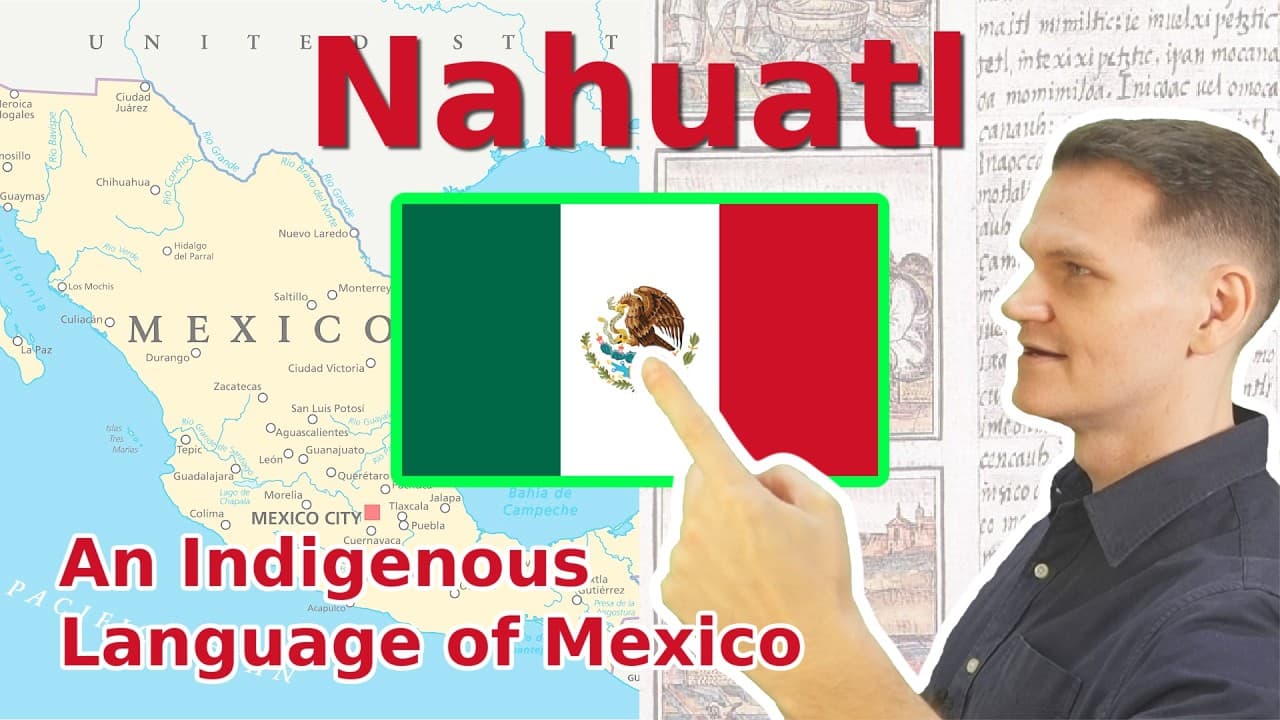
Nahuatl - An Indigenous Language of Mexico
TL;DR
Nahuatl is a diverse indigenous language of Mexico with many dialects.
Transcript
if I asked you what the language of Mexico was you would probably say Spanish and you wouldn't be wrong because Spanish is the most widely spoken language of Mexico but it's not the only one 68 national languages are recognized by The Mexican government including 63 indigenous languages the most widely spoken indigenous language is naal or na I'll ... Read More
Key Insights
- Nahuatl is the most widely spoken indigenous language in Mexico, part of the Uto-Aztecan language family, with many dialects often considered distinct languages.
- Classical Nahuatl, spoken by the Aztecs, has evolved into various modern dialects, each with unique phonetic and grammatical features.
- The Nahuatl language has four main dialect groups: Central and Northern, Western, and Eastern, with significant variations in pronunciation and mutual intelligibility.
- Nahuatl's phonology includes unique sounds not found in English or Spanish, such as the voiceless alveolar lateral affricate represented by 'tl'.
- Modern Nahuatl grammar shows influence from Spanish, with a tendency towards subject-verb-object word order, although flexibility remains.
- Nahuatl uses a complex system of verb bases and prefixes for tense and aspect, with specific markers for past, present, and future tenses.
- Adjectives in Nahuatl are often derived from nouns or verbs through affixation, and plural forms use specific suffixes depending on the noun stem.
- Spanish has heavily influenced Nahuatl vocabulary, resulting in many loanwords, while Nahuatl itself has contributed several words to English.
Install to Summarize YouTube Videos and Get Transcripts
Explore YouTube Video Summarizer or Get YouTube Transcript Extractor
Questions & Answers
Q: What is the significance of Classical Nahuatl?
Classical Nahuatl was the language spoken by the Aztec or Mexica people and served as the basis for the various modern dialects of Nahuatl. It was used in the Aztec Empire, which expanded its influence and language throughout Central Mexico and beyond. Although no longer spoken, Classical Nahuatl remains significant for historical and linguistic studies.
Q: How does Nahuatl handle verb tense and aspect?
Nahuatl uses a system of verb bases and prefixes to indicate tense and aspect. For example, it employs different bases for past, present, and future tenses, with specific markers such as 'o' for past tense and 'yah' for imperfective aspect. This system allows for detailed expression of temporal and aspectual nuances in Nahuatl sentences.
Q: What role does Spanish play in modern Nahuatl?
Spanish has significantly influenced modern Nahuatl, especially in terms of vocabulary and word order. Many Spanish loanwords have been integrated into Nahuatl, and the language shows a tendency towards a subject-verb-object word order due to Spanish influence. However, Nahuatl retains its own unique grammatical structures and phonetic characteristics.
Q: What are some challenges in learning Nahuatl?
One of the main challenges in learning Nahuatl is the variety of dialects, each with distinct features and low mutual intelligibility. Additionally, resources for learning Nahuatl are limited, especially for specific dialects. Learners often achieve proficiency by immersing themselves in Nahuatl-speaking communities to gain practical experience and understanding.
Q: How does Nahuatl handle plurals and adjectives?
In Nahuatl, adjectives are often derived from nouns or verbs through affixation, and plural forms are created using specific suffixes. The plural suffixes vary depending on the noun stem, with common ones including 'meh' for monosyllabic stems and 'tin' for others. Adjectives typically follow nouns but can precede them for emphasis.
Q: What is the significance of the 'tl' sound in Nahuatl?
The 'tl' sound in Nahuatl is a voiceless alveolar lateral affricate, a unique phonetic feature not found in English or Spanish. It is a characteristic sound of the language, especially in the Central and Northern dialects, where it retains its classical pronunciation. This sound contributes to the distinctiveness of Nahuatl phonology.
Q: How does Nahuatl express possession?
Nahuatl expresses possession through the use of possessive prefixes attached to nouns. For example, 'mo-' is used for second person singular possession, as in 'moan' meaning 'your home.' When indicating possession with an explicit possessor, the possessive prefix is retained, and the possessor is added before the noun.
Q: What are some common Nahuatl loanwords in English?
Several English words have origins in Nahuatl, reflecting the language's influence. Common examples include 'coyote' from 'coyotl,' 'avocado' from 'ahuacatl,' 'chili' from 'chilli,' 'guacamole' from 'ahuacamolli,' and 'tomato' from 'tomatl.' These words highlight the cultural and linguistic exchange between Nahuatl and other languages.
Summary & Key Takeaways
-
Nahuatl is an indigenous language of Mexico, with various dialects and a rich historical significance. It belongs to the Uto-Aztecan language family and has evolved from Classical Nahuatl, spoken by the Aztecs, into several modern dialects, each with unique linguistic features.
-
The phonetic system of Nahuatl includes unique sounds not found in many other languages, such as the 'tl' sound. The language's grammar is complex, with a variety of verb bases and prefixes used to indicate tense and aspect, showing both traditional and Spanish influences.
-
Nahuatl vocabulary reflects extensive contact with Spanish, incorporating numerous loanwords. Despite these influences, Nahuatl maintains a logical and structured linguistic system, though learning resources for its dialects can be limited, posing challenges for language learners.
Read in Other Languages (beta)
Share This Summary 📚
Summarize YouTube Videos and Get Video Transcripts with 1-Click
Try YouTube Summary with ChatGPT & Claude or YouTube Transcript Generator
Explore More Summaries from Langfocus 📚




Summarize YouTube Videos and Get Video Transcripts with 1-Click
Try YouTube Summary with ChatGPT & Claude or YouTube Transcript Generator