L25.9 Visit Frequency Interpretation of Steady-State Probabilities
TL;DR
Markov chains reach a steady state, satisfying balance equations. Frequency interpretations provide insight into steady state probabilities and transitions.
Transcript
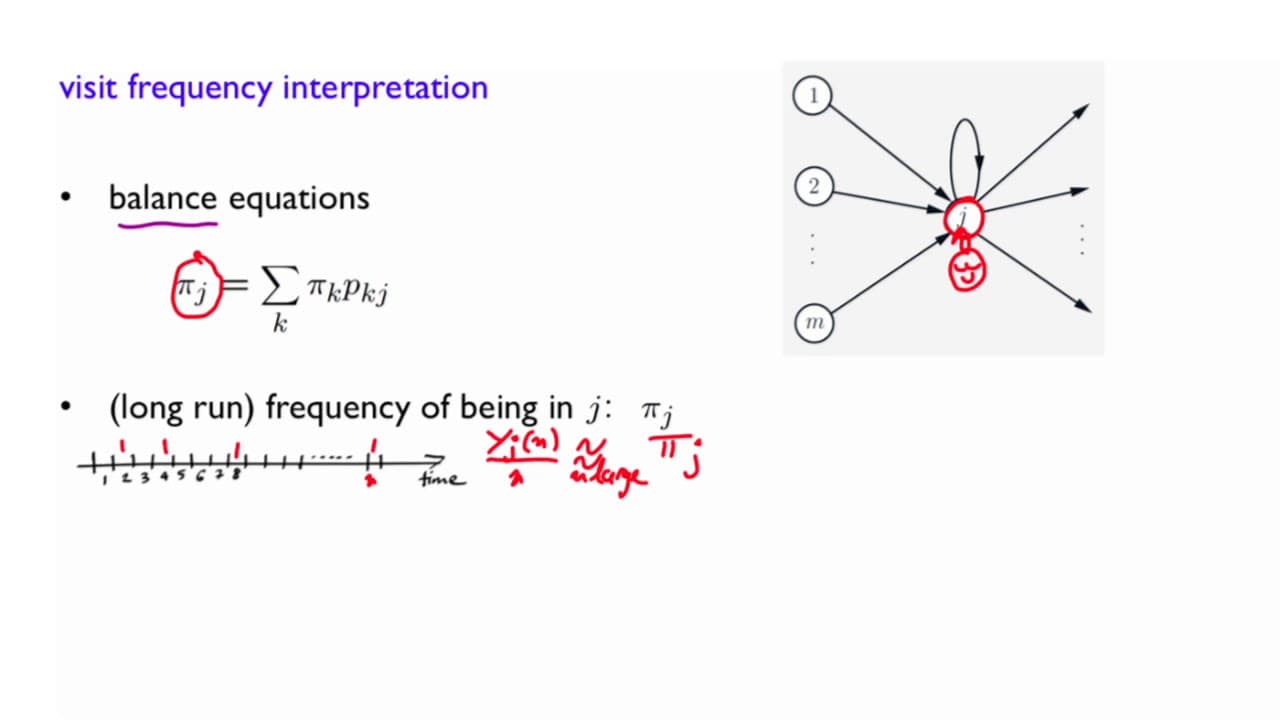
OK, so we have just seen that if we have a single recurrent class, which is not periodic, then the Markov chain reaches steady state, and the steady state probabilities satisfy the following system of equations. These equations are essential in the study of Markov chains, and they have a name. They are called the balance equations. In fact, it's wo... Read More
Key Insights
- 🏛️ Balance equations are essential for analyzing Markov chains with single recurrent classes.
- ⌛ Steady state probabilities can be understood as frequencies of observing the particle in specific states over time.
- ⛓️ Frequency interpretations provide shortcuts for analyzing Markov chains and their transitions.
- ❓ The probability of transitioning between states can be calculated using the product of the probabilities of being in the initial state and transitioning to the final state.
- 🍹 The total frequency of transitions into a state is the sum of the frequencies of all observed transitions.
- ⛓️ The relationship between observing frequencies and steady state probabilities provides a useful intuition for analyzing Markov chains.
- 🌥️ Rigorous mathematical techniques can be employed to make the frequency interpretations more accurate when the number of observations is large.
Install to Summarize YouTube Videos and Get Transcripts
Explore YouTube Video Summarizer or Get YouTube Transcript Extractor
Questions & Answers
Q: What are balance equations in the context of Markov chains?
Balance equations are a system of equations that describe the steady state probabilities of a Markov chain with a single recurrent class. They are fundamental in the study of Markov chains and provide insight into reaching equilibrium.
Q: How can steady state probabilities be interpreted using frequencies?
Steady state probabilities can be seen as the frequency at which an observer in a specific state sees the particle in that state over time. As the number of observations increases, the frequency approaches the steady state probability.
Q: How can transitions between states be understood through frequencies?
Transitions from one state to another can be observed using a new observer who records the number of times the particle passes through the transition. The frequency of such transitions is determined by the product of the probability of being in the initial state and the probability of transitioning to the final state.
Q: What is the relationship between the frequency of transitions into a state and the particle being in that state?
The total frequency of transitions into a state is equal to the sum of the frequencies of all possible transitions observed. This aligns with the intuition that the particle is in a specific state if and only if the last transition was into that state.
Summary & Key Takeaways
-
Markov chains with a single recurrent class that is not periodic reach a steady state, governed by balance equations.
-
Steady state probabilities can be interpreted as frequencies of a particle observer in a specific state over time.
-
Transitions between states can also be understood through frequency interpretations, using the probabilities of being in a certain state and transitioning to another.
Read in Other Languages (beta)
Share This Summary 📚
Summarize YouTube Videos and Get Video Transcripts with 1-Click
Try YouTube Summary with ChatGPT & Claude or YouTube Transcript Generator
Explore More Summaries from MIT OpenCourseWare 📚


Summarize YouTube Videos and Get Video Transcripts with 1-Click
Try YouTube Summary with ChatGPT & Claude or YouTube Transcript Generator