How to Design a Programmable Datapath for Computation
TL;DR
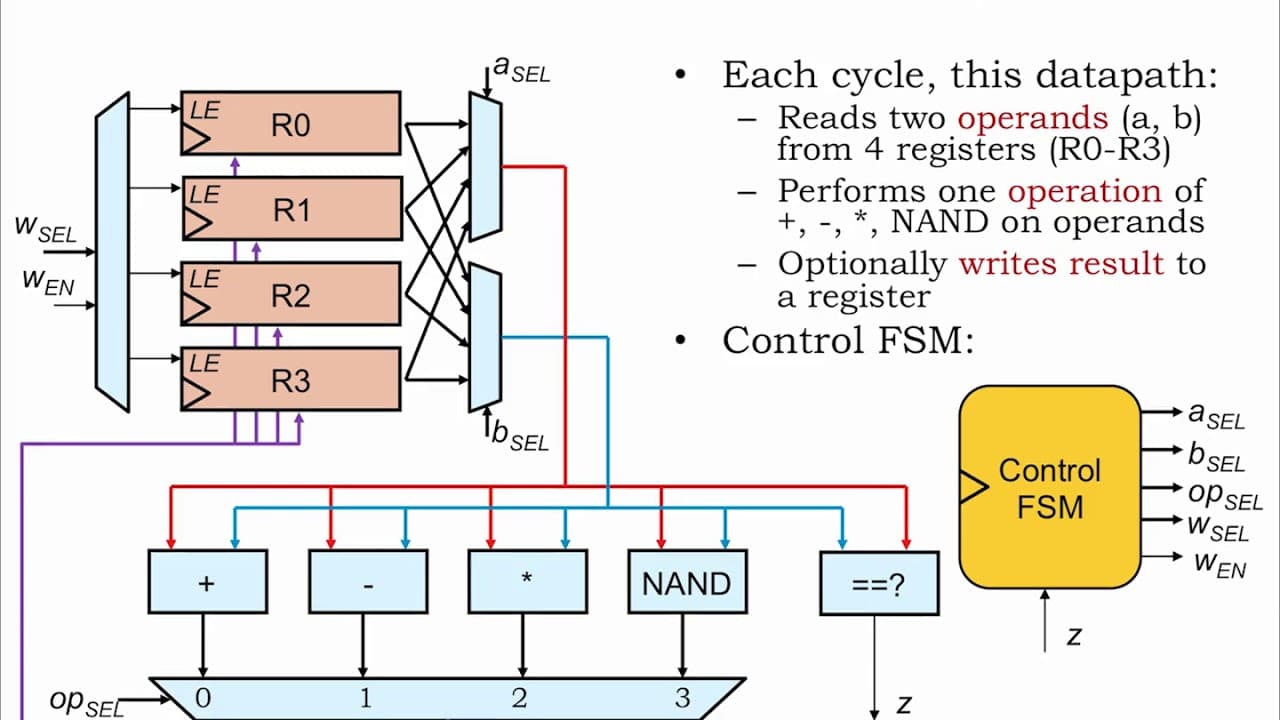
To design a programmable datapath, create a state transition diagram for a finite state machine (FSM) that outlines the sequence of operations. Construct a datapath with registers and combinational logic while developing an FSM to generate the necessary control signals. This approach allows for creating a general-purpose datapath capable of solving various problems through expanded storage and operations.
Transcript
Okay, we've figured out a way to design hardware to perform a particular computation: Draw the state transition diagram for an FSM that describes the sequence of operations needed to complete the computation. Then construct the appropriate datapath, using registers to store values and combinational logic to implement the needed operations. Finally ... Read More
Key Insights
- 👷 Designing hardware for computation involves constructing a state transition diagram for an FSM and a datapath with registers and combinational logic.
- 🫦 The datapath can be considered an FSM but has a large number of state bits, making drawing a truth table impractical.
- 👻 Generalizing the approach allows for the reuse of computer circuits to solve different problems by expanding storage and operations in a general-purpose datapath.
- 🎮 Computer architecture involves designing a control FSM to generate the necessary control signals for the datapath.
Install to Summarize YouTube Videos and Get Transcripts
Explore YouTube Video Summarizer or Get YouTube Transcript Extractor
Questions & Answers
Q: Why is it impractical to draw a truth table for the datapath?
Drawing a truth table for the datapath is impractical because it would require 2^66 rows, which is not feasible due to the large number of state bits in the registers.
Q: How can computer circuits be used to solve different problems?
Computer circuits can be used to solve different problems by expanding storage for operands and results, adding a larger list of allowable operations, and designing a general-purpose datapath that can be reused.
Q: What is the purpose of the control FSM in computer architecture?
The control FSM generates the appropriate sequence of control signals for the datapath, allowing for different computations to be performed by specifying the sequence of operations.
Q: How did early digital computers like ENIAC work?
Early digital computers like ENIAC were programmed by mapping complex sequences of operations onto the machine using switches and cables. The programming process was time-consuming and involved verification, debugging, and step-by-step execution of the program.
Summary & Key Takeaways
-
Designing hardware for computation involves creating a state transition diagram for an FSM that describes the sequence of operations needed and constructing a datapath using registers and combinational logic.
-
The datapath itself can be considered an FSM, but drawing a truth table for it is impractical due to the large number of state bits.
-
Generalizing this approach allows for the reuse of computer circuits to solve different problems by expanding storage and operations in a general purpose datapath.
Read in Other Languages (beta)
Share This Summary 📚
Summarize YouTube Videos and Get Video Transcripts with 1-Click
Try YouTube Summary with ChatGPT & Claude or YouTube Transcript Generator
Explore More Summaries from MIT OpenCourseWare 📚


Summarize YouTube Videos and Get Video Transcripts with 1-Click
Try YouTube Summary with ChatGPT & Claude or YouTube Transcript Generator