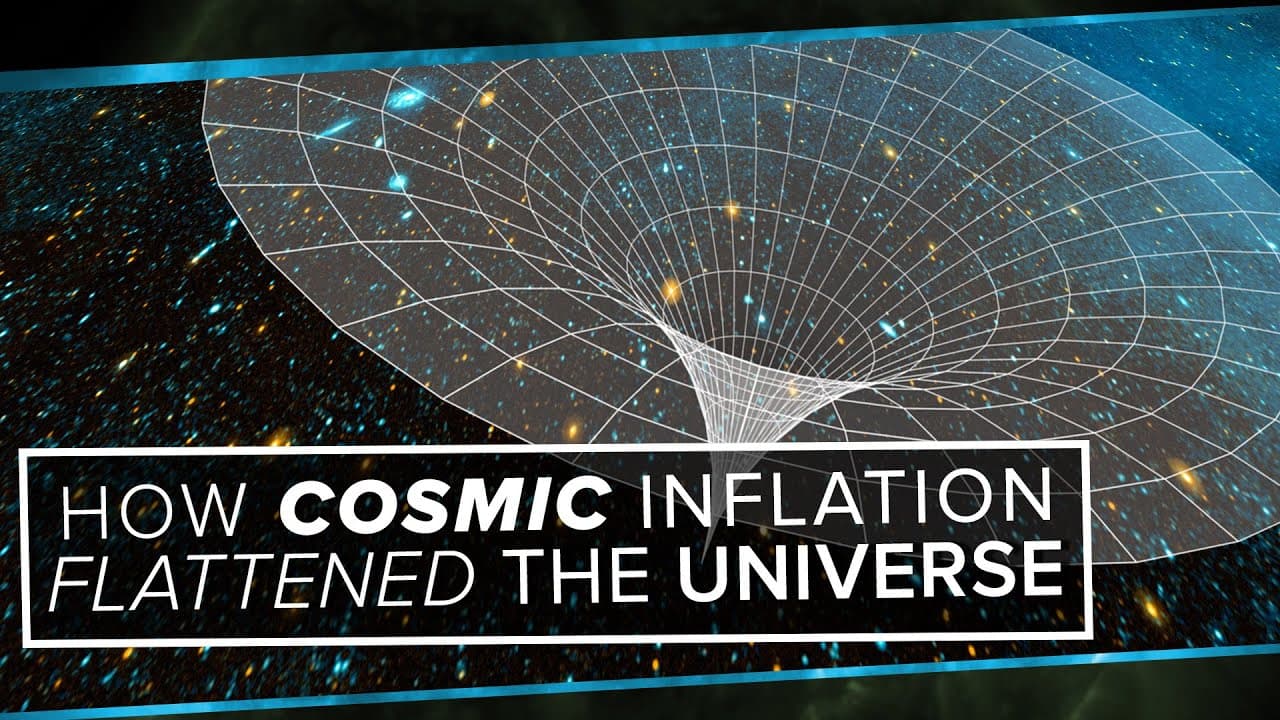
How Cosmic Inflation Flattened the Universe
TL;DR
Cosmic inflation solves the Big Bang's horizon and flatness problems.
Transcript
[MUSIC PLAYING] Cosmic inflation describes a period of insane exponential expansion right after the instant of the Big Bang. It calls into question our very understanding of what the beginning of the universe even means. [MUSIC PLAYING] The Big Bang theory describes the earliest epochs of our universe amazingly well. It has made predictions that ha... Read More
Key Insights
- Cosmic inflation describes a rapid exponential expansion of the universe immediately after the Big Bang, challenging our understanding of the universe's beginning.
- The Big Bang theory is well-supported by observations, but it faces issues like the horizon and flatness problems, suggesting an early period of rapid expansion.
- The horizon problem arises because distant points in the universe appear to have been in contact despite their vast separation, as indicated by the cosmic microwave background (CMB).
- The universe's flatness is measured using the CMB's fluctuations, showing it is within 0.4% of perfect flatness, which is strange for an expanding universe.
- Inflation posits that the universe expanded faster than the speed of light, smoothing and flattening its structure, solving both the horizon and flatness problems.
- Einstein's cosmological constant, initially introduced to describe a static universe, provides the mathematical framework for inflation and is related to dark energy.
- The inflationary period ended, transitioning to the Hubble expansion we observe today, but the exact start of inflation remains unknown, with theories like eternal inflation proposed.
- Inflation redefines the Big Bang, suggesting that time may not have begun with it, and the universe as we know it emerged when inflation ended.
Install to Summarize YouTube Videos and Get Transcripts
Explore YouTube Video Summarizer or Get YouTube Transcript Extractor
Questions & Answers
Q: What is cosmic inflation?
Cosmic inflation is a theory that describes a period of rapid exponential expansion of the universe immediately after the Big Bang. This expansion is believed to have occurred faster than the speed of light, smoothing and flattening the universe's structure. It addresses key issues in cosmology, such as the horizon and flatness problems, by proposing that the universe expanded so quickly that it became homogeneous and isotropic on large scales.
Q: What is the horizon problem in cosmology?
The horizon problem refers to the observation that distant regions of the universe, separated by vast distances, appear to have been in thermal equilibrium at the time of the cosmic microwave background (CMB) formation. This implies that these regions were once in causal contact, despite their separation exceeding the distance light could have traveled since the Big Bang. Inflation solves this by suggesting a rapid expansion that allowed these regions to have once been close enough to interact.
Q: How does inflation solve the flatness problem?
Inflation solves the flatness problem by proposing that the universe underwent a rapid expansion that smoothed out any initial curvature, making the observable universe appear flat. This rapid expansion would have stretched out any initial irregularities, leading to the universe's current state, which is measured to be within 0.4% of perfect flatness. Without inflation, even a slightly curved universe would have become significantly more curved over time, contrary to observations.
Q: What role does Einstein's cosmological constant play in inflation?
Einstein's cosmological constant, initially introduced to describe a static universe, provides the mathematical framework necessary for inflation. It represents an antigravity term in Einstein's field equations, allowing for the rapid expansion required by inflation. This constant is also related to dark energy, which drives the current accelerated expansion of the universe. The cosmological constant adds an energetic component to empty space, driving the expansion during inflation.
Q: What is the significance of a flat universe?
The significance of a flat universe lies in its implications for the universe's overall geometry and fate. A flat universe suggests that the total energy density is precisely balanced, leading to a universe that expands forever but at a decreasing rate. This flatness is unexpected in an expanding universe, as any initial curvature would typically amplify over time. Inflation explains the observed flatness by proposing a rapid expansion that smoothed out any initial curvature.
Q: What is eternal inflation?
Eternal inflation is a theory suggesting that inflationary expansion is the default state of the multiverse. In this scenario, inflation never completely stops but continues in different regions, creating numerous 'bubble universes,' each with different physical properties. Our universe is one such bubble where inflation has ended, allowing for the formation of galaxies and other structures. Eternal inflation implies a vast, possibly infinite, multiverse with diverse regions.
Q: How does inflation redefine the Big Bang theory?
Inflation redefines the Big Bang theory by suggesting that the universe's rapid expansion is the initial 'kick' rather than an explosion from a singularity. The end of inflation marks the beginning of the universe as we know it, with the Big Bang being a transition from the inflationary state to the standard expansion. This perspective removes the need for an initial singularity and suggests that time may not have begun with the Big Bang, challenging traditional cosmological views.
Q: What is the relationship between inflation and dark energy?
The relationship between inflation and dark energy lies in their similar effects on the universe's expansion. Both involve a form of energy that causes space to expand. Inflation is driven by a high-energy vacuum state, causing rapid early expansion, while dark energy, associated with the cosmological constant, drives the current accelerated expansion. Both phenomena suggest that the universe's expansion is influenced by energy inherent to space itself, though they occur at different times.
Summary & Key Takeaways
-
Cosmic inflation describes a rapid exponential expansion of the universe right after the Big Bang. This concept challenges our understanding of the universe's origin. It addresses the horizon and flatness problems, suggesting that an early rapid expansion smoothed and flattened the universe's structure.
-
The horizon problem arises because distant points in the universe appear to have been in contact despite their vast separation, as indicated by the cosmic microwave background (CMB). The universe's flatness is measured using CMB fluctuations, showing it is within 0.4% of perfect flatness, which is unexpected for an expanding universe.
-
Inflation posits that the universe expanded faster than the speed of light, smoothing and flattening its structure, solving both the horizon and flatness problems. Einstein's cosmological constant provides the mathematical framework for inflation and is related to dark energy. The exact start of inflation remains unknown, with theories like eternal inflation proposed.
Read in Other Languages (beta)
Share This Summary 📚
Summarize YouTube Videos and Get Video Transcripts with 1-Click
Try YouTube Summary with ChatGPT & Claude or YouTube Transcript Generator
Explore More Summaries from PBS Space Time 📚





Summarize YouTube Videos and Get Video Transcripts with 1-Click
Try YouTube Summary with ChatGPT & Claude or YouTube Transcript Generator