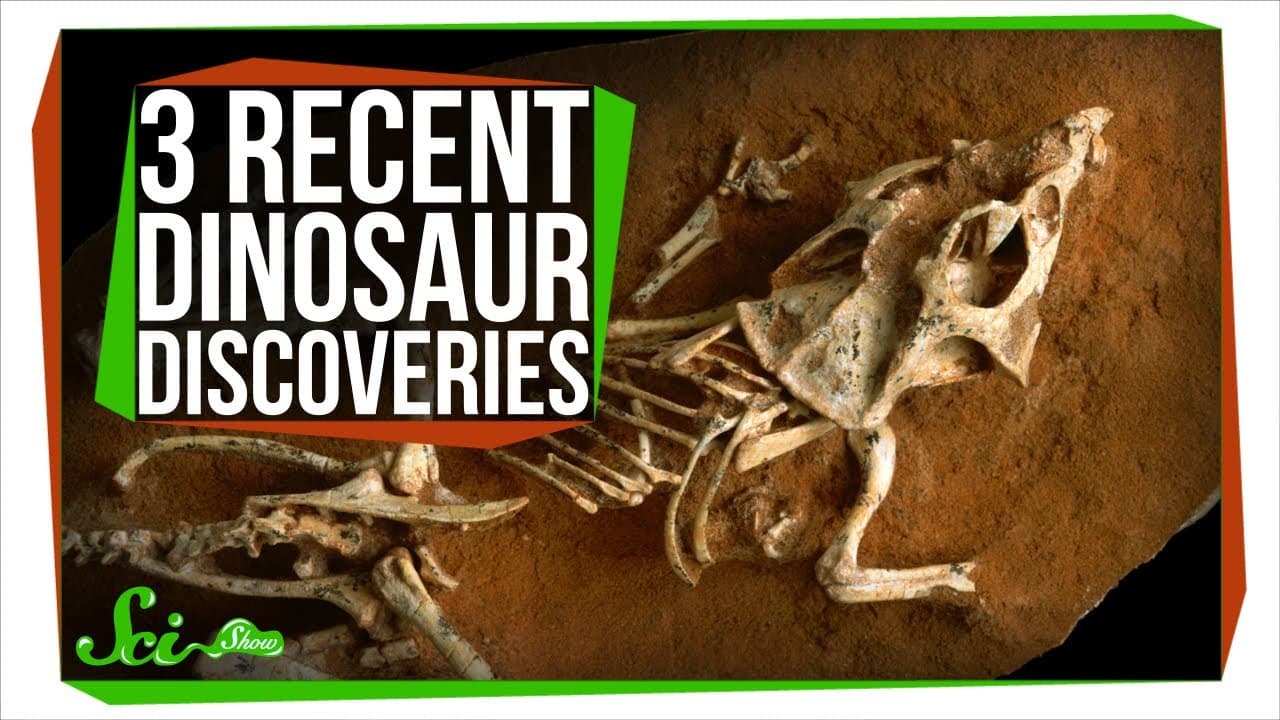
3 Mind-Blowing Recent Dinosaur Discoveries
TL;DR
Recent studies in paleontology have revealed new insights about dinosaur classification, feather structures, and hatching habits, challenging previous assumptions about these ancient creatures.
Transcript
Paleontology may be the study of long-dead creatures, but as a field of science it’s very much alive. Take dinosaurs, whose remains are a scientific treasure trove. Even in the past year, some key studies have taught us huge things about what they are, what they looked like, and how they lived and died. And there’s still lots to discover! There’s a... Read More
Key Insights
- 🦕 Recent research challenges long-held beliefs about dinosaur classification, highlighting the potential for major changes in our understanding of dinosaur relationships.
- 🪶 The discovery of a feathered dinosaur tail trapped in amber provides new insights into the diversity of dinosaur feathers and their evolutionary history.
- 💆 The slow hatching time of dinosaurs may have made them less adaptable to rapid environmental changes, contributing to their mass extinction.
- 👶 The study of paleontology continues to evolve with new discoveries, challenging existing theories and expanding our knowledge of these ancient creatures.
- ☠️ Understanding how dinosaurs lived and died involves studying not only their bones but also external characteristics such as feathers.
- 😒 Paleontologists use advanced technologies and techniques, such as 3D imaging of fossils preserved in amber, to gain a deeper understanding of dinosaur anatomy.
- 🦕 The study of dinosaur development can provide insights into their evolutionary adaptations and how they responded to environmental changes.
Install to Summarize YouTube Videos and Get Transcripts
Explore YouTube Video Summarizer or Get YouTube Transcript Extractor
Questions & Answers
Q: How does the traditional classification of dinosaurs based on the orientation of the pubis bone differ from the new findings?
The traditional classification divides dinosaurs into two groups (Ornithischians and Saurischians) based on the orientation of the pubis bone in the hip. However, a recent study suggests that theropod dinosaurs like the T. rex may be more closely related to Ornithischians than their traditionally-assigned group.
Q: What new details were revealed about dinosaur feathers from the discovery of a 99 million-year-old feathered dinosaur tail?
The feathered dinosaur tail preserved in amber showed alternating branches and tiny barbules, which were different from the feathers of modern birds. The finding suggests the existence of different feather types in extinct dinosaurs that have since died out.
Q: How does the hatching time of dinosaurs compare to modern birds?
Dinosaurs took much longer to hatch than modern birds, with estimates ranging from 3 to 6 months. In contrast, bird eggs hatch much more quickly, taking anywhere from 11 to 85 days on average.
Q: How did the slow hatching time of dinosaurs potentially impact their survival during the mass extinction?
The slow hatching time of dinosaurs may have made them less adaptable to the environmental changes caused by the mass extinction event. Quick-hatching avian theropods, the ancestors of modern birds, may have had an advantage in escaping predators and finding better habitats.
Summary & Key Takeaways
-
Recent studies have challenged the traditional classification of dinosaurs based on the orientation of a hip bone called the pubis.
-
The discovery of a feathered dinosaur tail trapped in amber has provided new details about the structure of dinosaur feathers.
-
Dinosaurs took longer to hatch compared to modern birds, which may have made them less adaptable to environmental changes.
Read in Other Languages (beta)
Share This Summary 📚
Summarize YouTube Videos and Get Video Transcripts with 1-Click
Try YouTube Summary with ChatGPT & Claude or YouTube Transcript Generator
Explore More Summaries from SciShow 📚





Summarize YouTube Videos and Get Video Transcripts with 1-Click
Try YouTube Summary with ChatGPT & Claude or YouTube Transcript Generator