What Are Decoder-Only Transformers and How Do They Work?
TL;DR
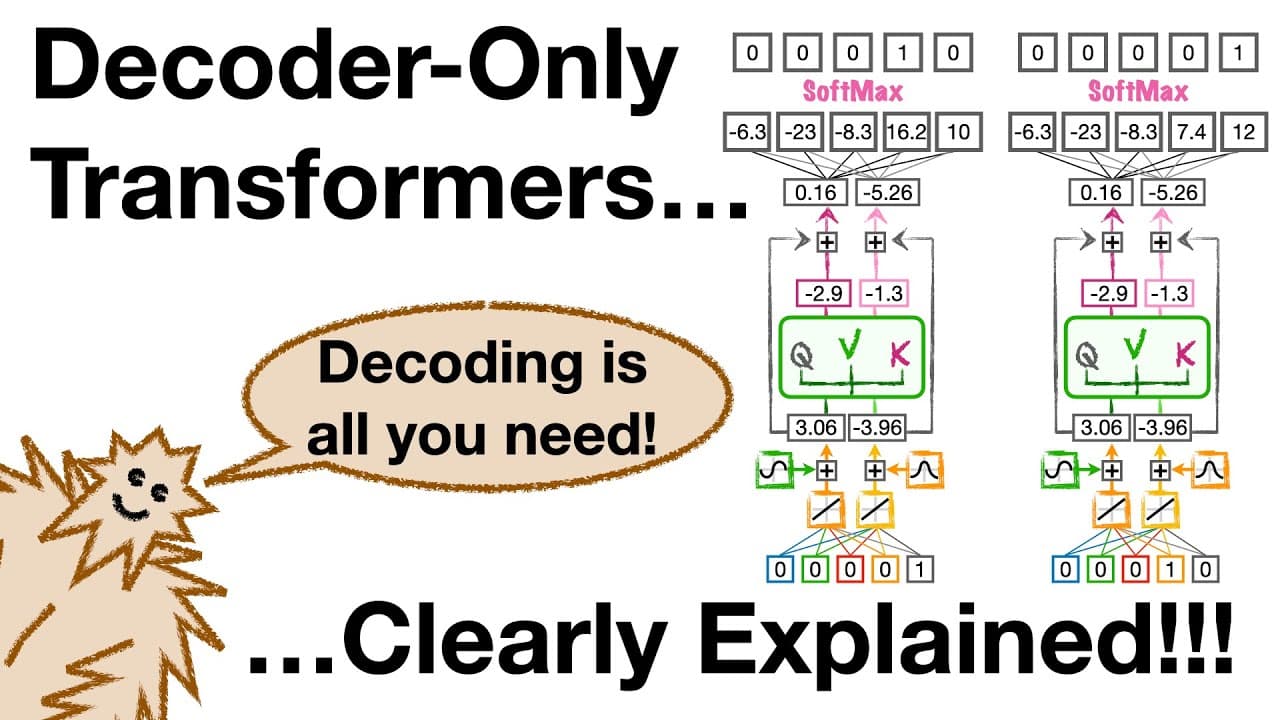
Decoder-only Transformers convert text inputs into numerical values using techniques like word embeddings and positional encodings, which maintain word order and context. They utilize masked self-attention to understand relationships among words in the input and output, facilitating accurate response generation in applications like ChatGPT.
Transcript
decoding is all that you need stat Quest hello I'm Josh starmer and welcome to stat Quest today we're going to talk about decoder only Transformers and they're going to be clearly explained trust me whatever Transformer you want to use it's better with lightning bam right now people are going totally bananas about chat GPT for example stat Squatch ... Read More
Key Insights
- 😷 Decoder-only Transformers simplify sequence generation tasks by combining encoding and decoding processes into a single unit with masked self-attention.
- 🔑 Word embeddings and positional encodings are crucial for maintaining word order and context during sequence conversion and response generation.
- 😷 Masked self-attention ensures accurate relationship tracking among words in both input and output sequences in decoder-only Transformers.
- 🦻 Efficient training is facilitated by residual connections, which aid in maintaining important information flow while training complex neural networks.
- 😒 The differences between decoder-only Transformers and regular Transformers lie in their unified nature, single attention mechanism, and continuous use of masked self-attention for input and output sequences.
- 👊 The decoder-only Transformer's ability to handle varying sequence lengths efficiently makes it ideal for tasks like chat GPT and other natural language processing applications.
- ❤️🩹 Usage of SSH or SOS tokens for sequence initialization and EOS tokens for sequence ending ensures a structured approach to sequence generation in decoder-only Transformers.
Install to Summarize YouTube Videos and Get Transcripts
Explore YouTube Video Summarizer or Get YouTube Transcript Extractor
Questions & Answers
Q: How do decoder-only Transformers handle sequence generation tasks like chatbots?
Decoder-only Transformers utilize word embeddings, positional encodings, and masked self-attention to understand relationships among input and output words for accurate sequence generation in tasks like chat GPT.
Q: What is the significance of masked self-attention in the context of decoder-only Transformers?
Masked self-attention helps decoder-only Transformers track relationships among words in both input and output sequences, enabling accurate response generation and maintaining context throughout the decoding process.
Q: How do decoder-only Transformers differ from regular Transformers in terms of functionality?
Decoder-only Transformers combine encoding and decoding tasks into a single unit using masked self-attention for both input and output, while regular Transformers utilize separate encoders and decoders with different attention mechanisms for inference and training.
Q: Can you explain the role of residual connections in decoder-only Transformers?
Residual connections in decoder-only Transformers help in training complex neural networks by bypassing intermediate layers, allowing the model to establish relationships among words without losing important information, thus aiding in more efficient training processes.
Summary & Key Takeaways
-
Decoder-only Transformers enhance chatbots like chat GPT by efficiently converting text inputs into numerical values as part of the encoding process.
-
The use of word embeddings and positional encodings aids in maintaining word order and context when dealing with sequences in decoding tasks.
-
Masked self-attention plays a critical role in understanding relationships among words in both the input and output, crucial for generating responses accurately.
Read in Other Languages (beta)
Share This Summary 📚
Summarize YouTube Videos and Get Video Transcripts with 1-Click
Try YouTube Summary with ChatGPT & Claude or YouTube Transcript Generator
Explore More Summaries from StatQuest with Josh Starmer 📚
Summarize YouTube Videos and Get Video Transcripts with 1-Click
Try YouTube Summary with ChatGPT & Claude or YouTube Transcript Generator