What Is R-Squared and How Is It Used in Statistics?
TL;DR
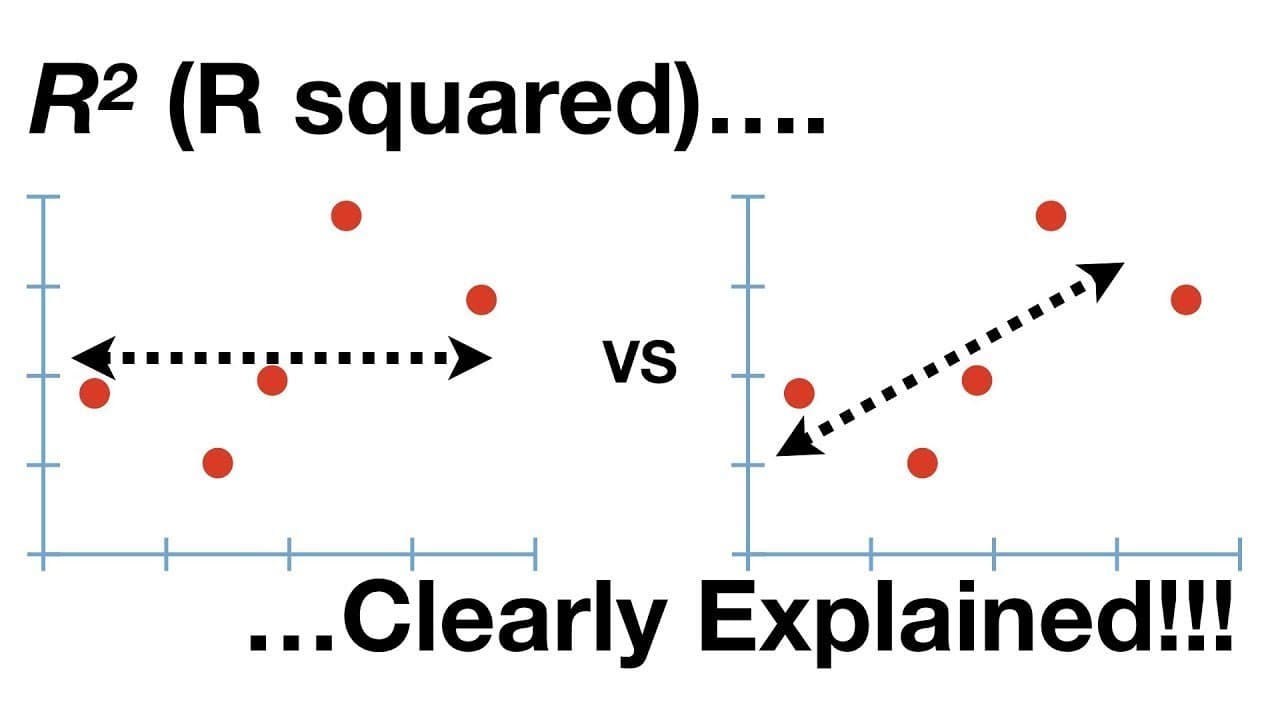
R-squared is a statistic that indicates the percentage of variation in one variable that can be explained by another variable's relationship. It is calculated by comparing the variation around the mean of the data to the variation around a fitted regression line, offering an intuitive way to interpret correlation strength in statistical analysis.
Transcript
step Quest step Quest step Quest stat Quest stat Quest is brought to you by the friendly people in the genetics department at the University of North Carolina at Chapel Hill hello and welcome to stat quest in this video we're going to talk about r squared r squared is a metric of correlation that is easy to compute and intuitive to interpret most o... Read More
Key Insights
- ❎ R squared measures the proportion of variation in the dependent variable that is predictable from the independent variable.
- 🔨 It is a valuable tool in regression analysis for understanding the relationship between variables.
- ✊ Plain correlation (R) only shows the strength and direction of the relationship, while R squared also indicates the explanatory power of that relationship.
- ❎ R squared can help researchers determine the significance of a relationship between two variables in statistical analysis.
- ❎ R squared simplifies the interpretation of statistical results by providing a straightforward percentage value.
- 🦖 It is important to differentiate between R and R squared in statistical analyses to fully understand the relationship between variables.
- 💪 Increasing R squared value indicates a stronger relationship between variables and better model fit.
Install to Summarize YouTube Videos and Get Transcripts
Explore YouTube Video Summarizer or Get YouTube Transcript Extractor
Questions & Answers
Q: What is the difference between R squared and plain correlation (R)?
R squared quantifies the percentage of variation explained by the relationship between two variables, while plain correlation (R) only indicates the strength and direction of the relationship.
Q: How is R squared calculated?
R squared is calculated by comparing the variation around the mean to the variation around a fitted line that represents the relationship between two variables.
Q: Why is R squared easier to interpret than plain correlation (R)?
R squared is easier to interpret because it is a percentage value that directly shows how much of the total variation in the data is explained by the relationship between the two variables.
Q: How does R squared help in understanding the strength of the relationship between two variables?
R squared helps by quantifying the percentage of variation in the data that can be attributed to the relationship between the two variables, providing a clear measure of the relationship strength.
Summary & Key Takeaways
-
R squared is a metric of correlation easy to compute and interpret compared to plain correlation (R).
-
It quantifies the percentage of variation explained by the relationship between two variables.
-
It is calculated by comparing the variation around the mean to the variation around a fitted line.
Read in Other Languages (beta)
Share This Summary 📚
Summarize YouTube Videos and Get Video Transcripts with 1-Click
Try YouTube Summary with ChatGPT & Claude or YouTube Transcript Generator
Explore More Summaries from StatQuest with Josh Starmer 📚


Summarize YouTube Videos and Get Video Transcripts with 1-Click
Try YouTube Summary with ChatGPT & Claude or YouTube Transcript Generator