Transfer Function of Electrical Network Problem 3 - Transfer Function - Control Systems
TL;DR
This video explains how to find the transfer function of an electrical circuit using Laplace transforms.
Transcript
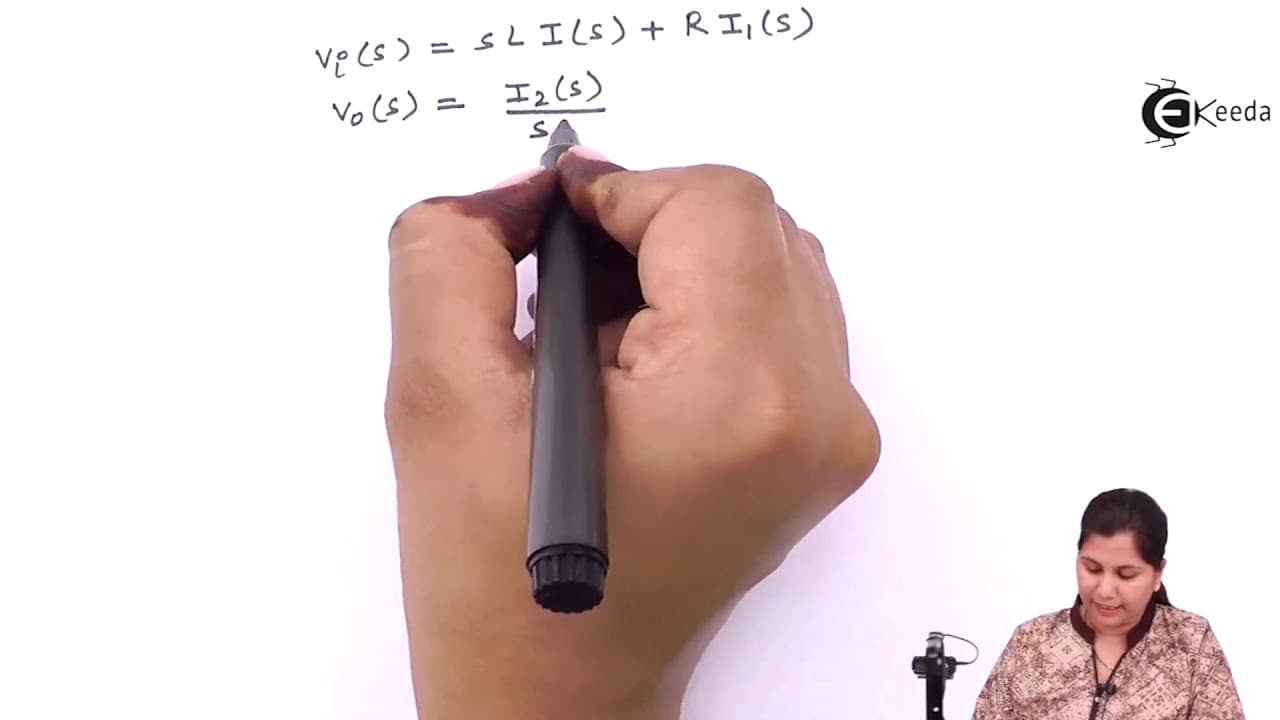
hello friends in this video we are going to solve a problem on finding the transfer function of an electrical network this is the circuit diagram and the electrical network for which we have to find the transfer function in the definition of the transfer function we have to assume that all the initial conditions are zero here we are assuming that t... Read More
Key Insights
- ⚡ The transfer function of an electrical circuit can be found by applying Kirchhoff's Voltage Law and deriving equations for the voltages and currents.
- 💄 Laplace transforms are used to convert the differential equations into algebraic equations, making it easier to analyze the circuit response.
- 🎮 The transfer function represents the relationship between the output and input signals of the circuit, enabling control and analysis of its behavior.
- ⌛ The time constants in the transfer function equation indicate the circuit's response time and can be used to analyze its frequency response.
- 🎨 By understanding the transfer function, engineers can design and optimize circuits for specific applications.
- 👻 The assumption of zero initial conditions simplifies the analysis and allows for a more straightforward derivation of the transfer function.
- 💁 The transfer function provides valuable information about the circuit's stability, damping, and frequency response.
Install to Summarize YouTube Videos and Get Transcripts
Explore YouTube Video Summarizer or Get YouTube Transcript Extractor
Questions & Answers
Q: What is the purpose of finding the transfer function in an electrical circuit?
The transfer function allows us to analyze the behavior and response of the circuit to input signals, such as voltage or current changes.
Q: How do we calculate the current across a resistance in the circuit?
The current across a resistance can be calculated by dividing the voltage drop across the resistance by its resistance value.
Q: How is the current across a capacitor determined?
The current across a capacitor is equivalent to the rate of change of the voltage across it, multiplied by the capacitance value.
Q: What are the key steps involved in finding the transfer function using Laplace transforms?
The key steps include applying Kirchhoff's Voltage Law, obtaining the Laplace transforms of the equations, and solving the resulting equations to determine the transfer function.
Summary & Key Takeaways
-
The video discusses the process of finding the transfer function of an electrical network, assuming all initial conditions are zero.
-
It explains how to calculate the current across a resistance and a capacitor, as well as the voltage across a capacitor in the circuit.
-
Through the application of Kirchhoff's Voltage Law and Laplace transforms, the video demonstrates how to derive the transfer function of the circuit.
Read in Other Languages (beta)
Share This Summary 📚
Summarize YouTube Videos and Get Video Transcripts with 1-Click
Try YouTube Summary with ChatGPT & Claude or YouTube Transcript Generator
Explore More Summaries from Ekeeda 📚




Summarize YouTube Videos and Get Video Transcripts with 1-Click
Try YouTube Summary with ChatGPT & Claude or YouTube Transcript Generator