What Inspired the Creation of the World Wide Web?
TL;DR
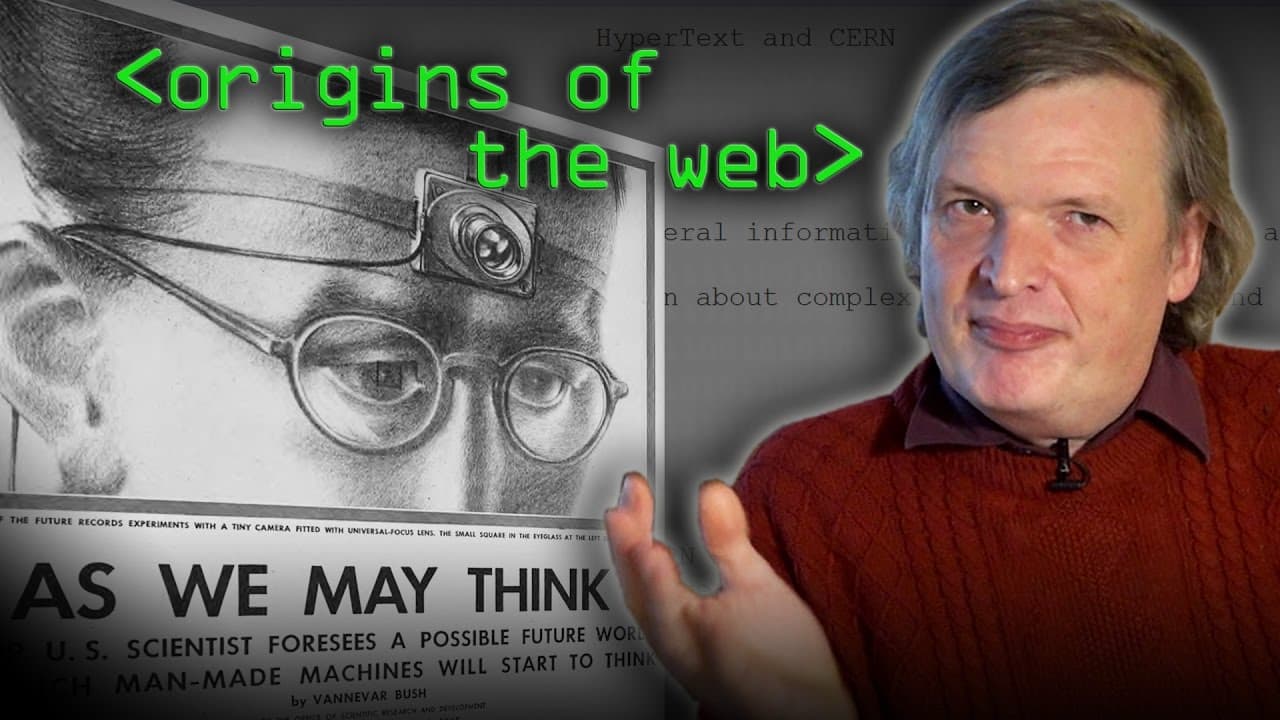
The World Wide Web's inception is rooted in decades of visionary ideas about information sharing, starting with Vannevar Bush's concept of the 'memex' in 1945. Pioneers like Douglas Engelbart and Ted Nelson contributed to hypertext systems that influenced modern computing. Ultimately, Tim Berners-Lee's commitment to openness made the web revolutionary, enabling widespread adoption and accelerated innovation.
Transcript
today is really about where the world wide web has come from it's hard to think of any invention since possibly the printing press that's actually had this sort of level of impact and influence but it didn't spring into being fully formed it was really a very very simple implementation of the vision that had been around for decades so simple in fac... Read More
Key Insights
- 🫚 The World Wide Web's roots can be traced back to the vision of Vannevar Bush and early inventions like the memex.
- 💠 Douglas Engelbart and Ted Nelson were influential figures in shaping the concept of hypertext systems.
- 💨 The development of various hypertext systems in the 1960s-1990s paved the way for the internet and World Wide Web we know today.
- 🤗 Tim Berners-Lee's stroke of genius was making the web open and accessible to everyone, leading to its widespread adoption and transformative impact.
- 🕸️ The simplicity and openness of the web allowed for rapid innovation, resulting in the development of better web servers and browsers, leading to its exponential growth.
- 🕸️ The evolution of the World Wide Web faced challenges, such as the slow connection speed issue with certain web servers.
Install to Summarize YouTube Videos and Get Transcripts
Explore YouTube Video Summarizer or Get YouTube Transcript Extractor
Questions & Answers
Q: What was the initial perception of the World Wide Web, and why was it rejected?
The World Wide Web was initially considered too simple and was rejected by the hypertext conference. It was seen as just a collection of documents and pointers, without considering the potential impact of hypertext.
Q: Who was Vannevar Bush, and what was his contribution to the development of the World Wide Web?
Vannevar Bush was a scientist and engineer who recognized the need for managing vast amounts of information. He proposed the concept of a "memex," an automated microfilm reader, which laid the foundation for future information management systems.
Q: How did Douglas Engelbart influence the development of the World Wide Web?
Douglas Engelbart is credited with inventing various technologies, such as the mouse, word processing, and video conferencing. His work at Stanford, later continued at Xerox Park, contributed to the development of augmentation systems that enhance human intellect and paved the way for the modern internet.
Q: Who is Ted Nelson, and what role did he play in the development of hypertext systems and the World Wide Web?
Ted Nelson, primarily a writer, invented the term "hypertext" and designed systems inspired by Vannevar Bush's work. His grand vision, called Project Xanadu, aimed to store all of the world's literature in distributed servers and introduced concepts like micro charging and advanced linking.
Summary & Key Takeaways
-
The World Wide Web was initially a simple implementation of a vision that had been around for decades, but it was rejected for being too basic.
-
Vannevar Bush, an American scientist, addressed the problem of information overload in 1945 and proposed a machine called a "memex" as a solution.
-
Pioneers like Douglas Engelbart and Ted Nelson further developed the concept of hypertext systems, inspiring the modern internet and World Wide Web.
Read in Other Languages (beta)
Share This Summary 📚
Summarize YouTube Videos and Get Video Transcripts with 1-Click
Try YouTube Summary with ChatGPT & Claude or YouTube Transcript Generator
Explore More Summaries from Computerphile 📚





Summarize YouTube Videos and Get Video Transcripts with 1-Click
Try YouTube Summary with ChatGPT & Claude or YouTube Transcript Generator