How to Prove Fact 2 in Theorem 1
TL;DR
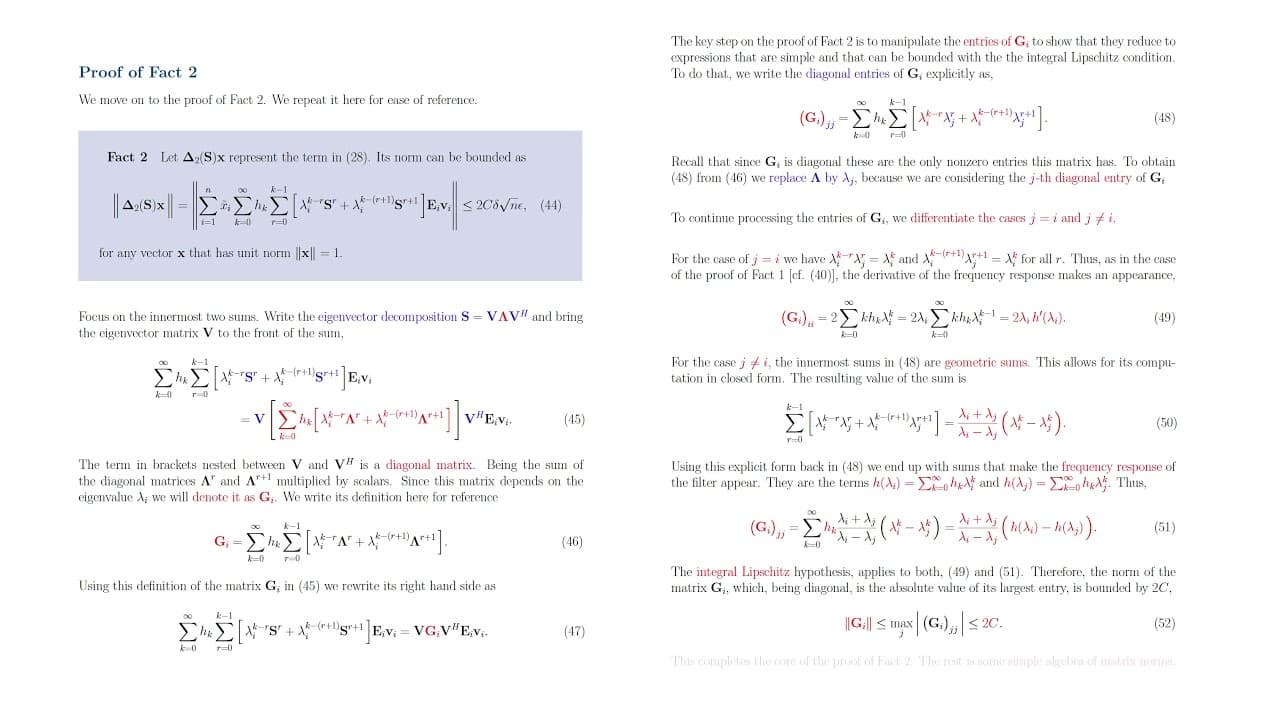
Fact 2 involves bounding the norm of Delta 2 of s * X by 2 * C * Delta * the otk of n * Epsilon for any unit norm vector X. The proof uses eigenvalue decomposition and integral Lipschitz conditions to simplify and bound complex matrix expressions, concluding with algebraic manipulations to establish the required bound.
Transcript
we move on to the proof of fact two which we repeat here for is of reference Fact Two involves the definition of the term Delta 2 of s * X and the bounding of its Norm by 2 * C * Delta * the otk of n * Epsilon this bound holds for any Vector X that has unit Norm in the definition of delta 2 of s we have as we had in the definition of delta 1 of s t... Read More
Key Insights
- Delta 2 of s * X is bounded by 2 * C * Delta * the otk of n * Epsilon for any unit norm vector X.
- The proof uses eigenvalue decomposition to simplify expressions involving powers of s.
- Matrix GI is defined as a diagonal matrix with complex expressions that are bounded using integral Lipschitz conditions.
- The key step is manipulating GI's entries to show they have simple expressions, enabling bounding by integral Lipschitz conditions.
- The norm of matrix GI, being diagonal, is the absolute value of its largest entry, bounded by 2 * c.
- The proof concludes by using the triangle inequality and properties of the graph Fourier transform to achieve the final bound.
- The graph Fourier transform preserves energy, ensuring the true norm of the gft coincides with the true norm of signal X.
- The proof involves verifying norms using the sub-multiplicative property and eigenvector perturbation lemma.
Install to Summarize YouTube Videos and Get Transcripts
Explore YouTube Video Summarizer or Get YouTube Transcript Extractor
Questions & Answers
Q: How to bound Delta 2 of s * X?
To bound Delta 2 of s * X, the proof uses eigenvalue decomposition to simplify expressions and integral Lipschitz conditions to bound complex matrix expressions. The final bound is achieved through algebraic manipulations, ensuring the norm of Delta 2 of s * X is bounded by 2 * C * Delta * the otk of n * Epsilon for any unit norm vector X.
Q: What is the role of eigenvalue decomposition in the proof?
Eigenvalue decomposition plays a crucial role in simplifying expressions involving powers of s. By decomposing matrices into eigenvectors and eigenvalues, the proof rewrites complex expressions, allowing for easier manipulation and bounding of matrix GI's entries, which are essential in establishing the bound for Delta 2 of s * X.
Q: Why are integral Lipschitz conditions used in the proof?
Integral Lipschitz conditions are used to simplify the bounding of matrix GI's complex expressions. These conditions help in demonstrating that, despite their complexity, the entries of GI have simple expressions that can be bounded effectively, which is a key step in proving the bound for Delta 2 of s * X.
Q: How is the norm of matrix GI bounded?
The norm of matrix GI, being diagonal, is determined by the absolute value of its largest entry. The proof uses integral Lipschitz conditions to show that these entries have simple expressions and are bounded by 2 * c. This bounding is crucial for establishing the overall bound for Delta 2 of s * X.
Q: What is the significance of the graph Fourier transform in the proof?
The graph Fourier transform (gft) is significant because it preserves energy, ensuring that the true norm of the gft coincides with the true norm of the signal X. This property is used in the proof to achieve the final bound for Delta 2 of s * X, leveraging the fact that the signal X has unit energy.
Q: How does the proof use the triangle inequality?
The proof uses the triangle inequality to bound the norm of sums in the expression for Delta 2 of s * X. By applying the triangle inequality, the proof can express the norm of a sum as the sum of norms, facilitating the use of previously established bounds to achieve the final result.
Q: What is the role of the eigenvector perturbation lemma?
The eigenvector perturbation lemma is used to bound the norm of EI, which is part of the expression for Delta 2 of s * X. The lemma provides a specific claim that the norm of EI is at most Epsilon time Delta, which is essential in the algebraic manipulations leading to the final bound.
Q: How does the proof conclude?
The proof concludes by verifying norms using the sub-multiplicative property and the eigenvector perturbation lemma. It ensures that the derived bounds hold true, leading to the final bound for Delta 2 of s * X. The conclusion relies on algebraic manipulations and properties of the graph Fourier transform to establish the bound conclusively.
Summary & Key Takeaways
-
Fact 2 is proven by bounding Delta 2 of s * X using eigenvalue decomposition and integral Lipschitz conditions. The proof simplifies complex expressions in matrix GI and uses algebraic manipulations to establish the bound.
-
Eigenvalue decomposition allows rewriting expressions involving powers of s, while integral Lipschitz conditions simplify bounding matrix GI's entries. The final bound is achieved using the triangle inequality and graph Fourier transform properties.
-
The graph Fourier transform's energy preservation ensures the true norm of gft matches the signal X's true norm. The proof concludes by verifying norms with the sub-multiplicative property and eigenvector perturbation lemma.
Read in Other Languages (beta)
Share This Summary 📚
Summarize YouTube Videos and Get Video Transcripts with 1-Click
Try YouTube Summary with ChatGPT & Claude or YouTube Transcript Generator
Explore More Summaries from Alelab Alelab 📚






Summarize YouTube Videos and Get Video Transcripts with 1-Click
Try YouTube Summary with ChatGPT & Claude or YouTube Transcript Generator