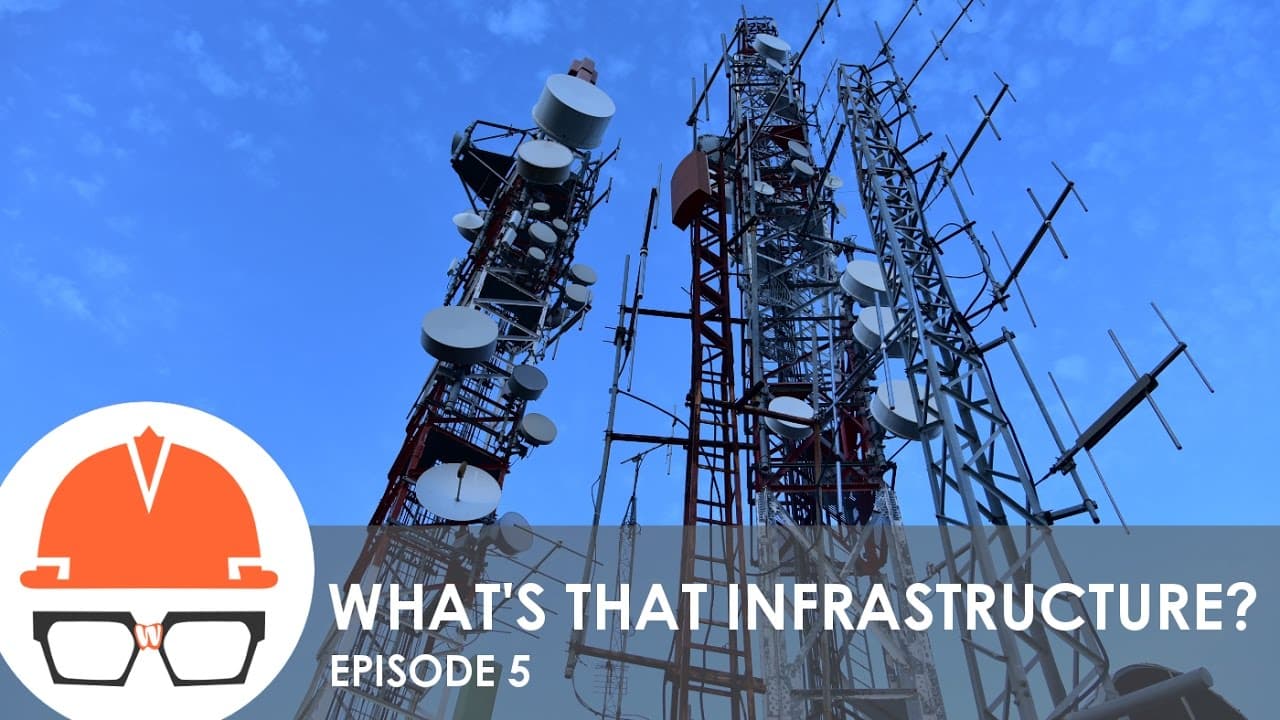
What's That Infrastructure? (Ep. 5 - Wireless Telecommunications)
TL;DR
Explore the history and evolution of wireless telecommunications infrastructure.
Transcript
In today’s increasingly-connected world, the creation, distribution, and consumption of information has become a major part of our lives, and telecommunications infrastructure serves as the backbone of our information society. From the telegraph and telephone wire to the cable and fiber optic lines, we’re always working to find new ways to communic... Read More
Key Insights
- Telecommunications infrastructure forms the backbone of the information society, evolving from telegraph wires to wireless systems.
- Radio transmitters and antennas have played a significant role in telecommunications, with historical installations in places like Ethiopia and Vienna.
- The AT&T long lines network utilized horn-reflector antennas for cost-effective long-distance communications in the 1950s.
- Radio telescopes, such as the one in Mauritius, use large helical antennas to capture weak astronomical radio waves.
- Microwave antennas on traffic signals facilitate real-time communication for efficient traffic management.
- Cellular networks consist of transceivers serving specific areas known as cells, essential for modern mobile communication.
- Wireless Internet Service Providers (WISPs) extend internet access to rural areas, bridging the digital divide.
- Community contributions of infrastructure photos enrich the understanding and appreciation of telecommunications technology.
Install to Summarize YouTube Videos and Get Transcripts
Explore YouTube Video Summarizer or Get YouTube Transcript Extractor
Questions & Answers
Q: What role do radio transmitters play in telecommunications?
Radio transmitters are crucial in telecommunications as they enable wireless communication over long distances. They convert electrical signals into radio waves, which can be transmitted through the air to receivers, facilitating communication without the need for physical cables. Historical installations, such as those in Ethiopia, demonstrate their longstanding importance.
Q: How did the AT&T long lines network impact communications?
The AT&T long lines network revolutionized long-distance communication in the 1950s by using horn-reflector antennas for microwave relays. This significantly reduced the cost of transmitting information compared to wired systems, allowing for more extensive and affordable communication networks. Despite their decline, these systems were a remarkable engineering achievement.
Q: What is the significance of radio telescopes in Mauritius?
The radio telescope in Mauritius is significant for its ability to capture weak radio waves from astronomical sources like stars and galaxies. Utilizing large helical antennas, it contributes to our understanding of the universe by collecting data on celestial phenomena, highlighting the intersection of telecommunications and astronomy.
Q: How do microwave antennas improve traffic management?
Microwave antennas on traffic signals enhance traffic management by enabling real-time communication between signals and centralized systems. This allows for adaptive signal timing based on current traffic conditions, improving flow and reducing congestion. Such technology represents a significant advancement from traditional timer-based systems.
Q: What is the function of cellular networks?
Cellular networks provide mobile communication by dividing geographic areas into cells, each served by a transceiver. This structure allows for efficient use of frequencies and supports the widespread use of mobile phones for calls and internet access. As demand for wireless data grows, these networks continue to expand and evolve.
Q: How do WISPs contribute to internet access in rural areas?
Wireless Internet Service Providers (WISPs) extend internet access to rural and underserved areas where wired connections are impractical. By creating wireless access points, WISPs provide affordable connectivity, helping to close the digital divide and enhance opportunities for education, business, and communication in remote regions.
Q: What community involvement is encouraged by the channel?
The channel encourages community involvement by inviting viewers to submit photos of telecommunications infrastructure. This participatory approach enriches the content, showcasing diverse examples and fostering a collective exploration of engineering marvels. Contributors can have their photos featured and receive a Practical Engineering sticker as appreciation.
Q: What is the purpose of the video series 'What's That Infrastructure'?
The 'What's That Infrastructure' series aims to educate viewers about the constructed world around them, focusing on various infrastructure topics. By exploring engineering feats and their historical and modern applications, the series seeks to increase understanding and appreciation of the technologies that underpin our daily lives.
Summary & Key Takeaways
-
The video explores various aspects of wireless telecommunications infrastructure, highlighting historical and modern examples from around the world. It emphasizes the evolution from wired to wireless systems and the significance of radio technology in communication.
-
Contributions from viewers showcase diverse telecommunications installations, including radio transmitters, microwave antennas, and cellular networks. These infrastructures play crucial roles in enabling communication and internet access globally.
-
The video invites viewers to participate by sending in photos of infrastructure, fostering a community-driven exploration of engineering marvels. It concludes with an invitation to like, subscribe, and engage with the channel.
Read in Other Languages (beta)
Share This Summary 📚
Summarize YouTube Videos and Get Video Transcripts with 1-Click
Try YouTube Summary with ChatGPT & Claude or YouTube Transcript Generator
Explore More Summaries from Practical Engineering 📚




Summarize YouTube Videos and Get Video Transcripts with 1-Click
Try YouTube Summary with ChatGPT & Claude or YouTube Transcript Generator