How To Calculate The Hydroxide Ion Concentration | Chemistry
TL;DR
This lesson explains how to calculate the hydroxide ion concentration in various solutions using different methods.
Transcript
in this lesson we're going to talk about how to calculate the hydroxide ion concentration for different solutions let's focus on part a we're given a solution of barium hydroxide and the concentration is 0.03 m what is the concentration of hydroxide in the solution barium hydroxide is soluble in water and it's going to dissociate into the ba2 plus ... Read More
Key Insights
- 🥳 The hydroxide ion concentration in a solution of barium hydroxide is double the concentration of barium hydroxide due to a 1:2 ratio.
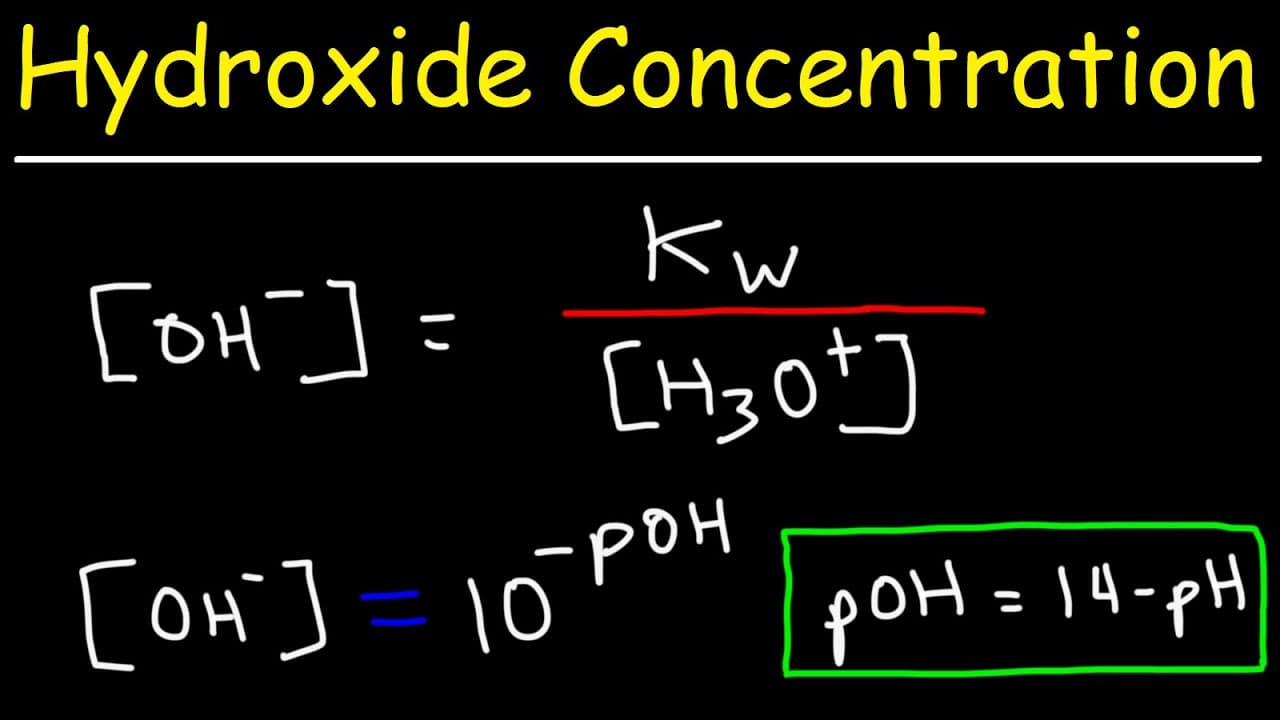
- ➗ The hydroxide concentration can be calculated from the hydronium ion concentration by dividing Kw by the hydronium ion concentration.
- ❓ The hydroxide concentration can also be determined from the pOH of the solution by using the formula 10^-pOH.
- 😥 Similarly, by finding the pOH from the pH of the solution, the hydroxide concentration can be calculated using the formula 10^-pOH.
- ➗ In acidic solutions with strong acids like hydrochloric acid, the hydroxide concentration is obtained by dividing Kw by the hydronium ion concentration, which is equal to the acid concentration.
- ❓ For weak acids like hydrofluoric acid, the hydroxide concentration is calculated using the acid dissociation constant and the equilibrium equation.
- ⚾ Weak bases like ammonia require the base dissociation constant and the equilibrium equation to determine the hydroxide concentration.
Install to Summarize YouTube Videos and Get Transcripts
Explore YouTube Video Summarizer or Get YouTube Transcript Extractor
Questions & Answers
Q: How is the hydroxide ion concentration calculated for barium hydroxide solutions?
The hydroxide concentration is double the concentration of barium hydroxide due to the 1:2 ratio, so if the barium hydroxide concentration is 0.03 M, the hydroxide concentration is 0.06 M.
Q: What is the formula to calculate the hydroxide ion concentration from the hydronium ion concentration?
The hydroxide concentration can be determined by dividing the autoionization constant of water (Kw) by the hydronium ion concentration. For example, with a hydronium ion concentration of 1.4 x 10^-5 M, the hydroxide concentration is 7.14 x 10^-10 M.
Q: Can the hydroxide concentration be calculated from the pOH of the solution?
Yes, by using the formula 10^-pOH, the hydroxide concentration can be determined. For a pOH of 3.89, the hydroxide concentration is 1.29 x 10^-4 M.
Q: How can the hydroxide ion concentration be found from the pH of the solution?
First, calculate the pOH by subtracting the pH from 14. Then, use the formula 10^-pOH to find the hydroxide concentration. For example, with a pH of 5.14, the hydroxide concentration is 1.388 x 10^-9 M.
Q: What is the hydroxide ion concentration in a solution of hydrochloric acid (HCl)?
In a solution of hydrochloric acid, the hydroxide ion concentration is obtained by dividing Kw (1 x 10^-14) by the hydronium ion concentration, which is the same as the HCl concentration. Therefore, for a 0.05 M HCl solution, the hydroxide concentration is 2 x 10^-13 M.
Q: How is the hydroxide ion concentration calculated for a weak acid solution?
With a weak acid like hydrofluoric acid (HF), the acid dissociation constant (Ka) is used. By solving the equation using the ice table method and taking the square root of the product of the HF concentration and Ka, the hydronium ion concentration is determined. For a 0.50 M HF solution, the hydroxide concentration comes out to be 5.26 x 10^-13 M.
Q: How can the hydroxide ion concentration be found for a solution of a weak base like ammonia (NH3)?
For a weak base, such as ammonia (NH3), the base dissociation constant (Kb) is used. By solving the equation using the ice table method and taking the square root of the product of the NH3 concentration and Kb, the hydroxide ion concentration is determined. In a 0.25 M NH3 solution, the hydroxide concentration is 2.12 x 10^-3 M.
Summary & Key Takeaways
-
Part A: Given a solution of barium hydroxide with a concentration of 0.03 M, the hydroxide concentration is 0.06 M due to the 1:2 ratio of barium hydroxide to hydroxide ions.
-
Part B: Using the autoionization constant of water (Kw) and the hydronium ion concentration, the hydroxide concentration can be calculated as 7.14 x 10^-10 M.
-
Part C: From the pOH of the solution, the hydroxide concentration is calculated as 1.29 x 10^-4 M using 10^-pOH.
-
Part D: Given the pH of the solution, the pOH is determined, and then the hydroxide concentration is calculated as 1.388 x 10^-9 M using 10^-pOH.
-
Part E: For an acidic solution with hydrochloric acid (HCl) of 0.05 M, the hydroxide concentration is 2 x 10^-13 M by dividing Kw by the hydronium ion concentration.
-
Part F: With a weak acid, hydrofluoric acid (HF), and its acid dissociation constant (Ka), the hydroxide concentration in a 0.50 M HF solution is found to be 5.26 x 10^-13 M.
-
Part G: By using the concentration of a weak base, ammonia (NH3), and its base dissociation constant (Kb), the hydroxide concentration in a 0.25 M NH3 solution is determined to be 2.12 x 10^-3 M.
Read in Other Languages (beta)
Share This Summary 📚
Summarize YouTube Videos and Get Video Transcripts with 1-Click
Try YouTube Summary with ChatGPT & Claude or YouTube Transcript Generator
Explore More Summaries from The Organic Chemistry Tutor 📚


Summarize YouTube Videos and Get Video Transcripts with 1-Click
Try YouTube Summary with ChatGPT & Claude or YouTube Transcript Generator