Why Is It Tough To Land On A Comet?
TL;DR
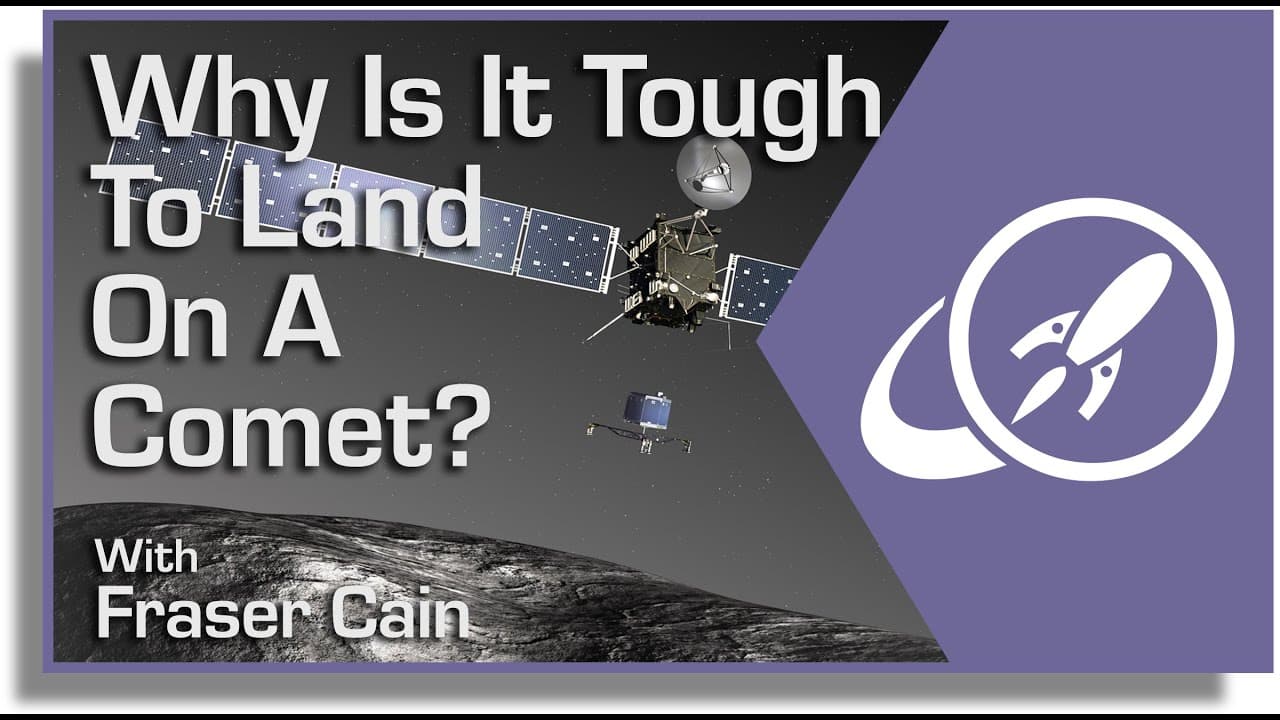
Landing on comets is difficult due to their low gravity, as seen in ESA's Rosetta mission.
Transcript
so we nerds were riveted by the coverage of ESA's Rosetta mission and its arrival at comet 67p in 2014 and one such nerd is Paco Juarez friend of the show and patron he wanted to know why is it so darn hard to land on a comet so in 2014 the tiny feel a lander detached from the spacecraft and slowly descended down to the surface of the comet if ever... Read More
Key Insights
- 😘 Landing on comets is challenging due to their low gravity and soft surfaces.
- 👶 Future missions to asteroids will require new landing techniques and technologies.
- 👾 Philae's landing failure provides valuable lessons for upcoming space exploration endeavors.
- 🦖 Cometary missions, like OSIRIS-REx, aim to collect samples for scientific study.
- 👾 ESA's Rosetta mission demonstrates the complexities of space exploration and the need for continuous innovation.
- 🪡 Asteroid mining poses potential risks and difficulties that need to be addressed.
- 👾 Space agencies like NASA and ESA are working on new technologies to improve landing capabilities.
Install to Summarize YouTube Videos and Get Transcripts
Explore YouTube Video Summarizer or Get YouTube Transcript Extractor
Questions & Answers
Q: Why is landing on comets so challenging?
Landing on comets is difficult due to their low gravity, making it hard to secure a lander to the surface. This was evident in ESA's Rosetta mission where the Philae lander bounced off comet 67p.
Q: What precautions were taken during the Philae landing attempt?
Philae was equipped with harpoon drills in its landing struts to secure itself upon touchdown. However, the comet's surface was softer than expected, causing the harpoons to possibly malfunction or not fire.
Q: What does the Philae landing failure teach us about future missions?
The Philae landing failure highlights the challenges of landing on low mass objects like comets and asteroids. Future missions, like NASA's OSIRIS-REx, will require new techniques and technologies for successful landings.
Q: How will future missions to comets and asteroids differ from the Philae mission?
Future missions will involve visiting and studying asteroids for science and potential resources. Lessons from the Philae landing will help in developing safer and more effective landing methods.
Summary & Key Takeaways
-
ESA's Rosetta mission in 2014 attempted to land a probe, Philae, on comet 67p.
-
Philae bounced off the comet's surface due to low gravity, causing challenges in landing.
-
Future missions to smaller comets and asteroids will require new landing techniques and technologies.
Read in Other Languages (beta)
Share This Summary 📚
Summarize YouTube Videos and Get Video Transcripts with 1-Click
Try YouTube Summary with ChatGPT & Claude or YouTube Transcript Generator
Explore More Summaries from Fraser Cain 📚




Summarize YouTube Videos and Get Video Transcripts with 1-Click
Try YouTube Summary with ChatGPT & Claude or YouTube Transcript Generator